Maintenance
Everything on model trains, model railroads, model railways, locomotives, model train layouts, scenery, wiring, DCC and more. Enjoy the world's best hobby... model railroading!

Donald is about to test your knowledge and hopefully get an answer to his question about oiling locomotives:
“Can one of your readers tell me how often and how do I clean and oil my locomotives? They seem to run forever, but then I really don’t run them often, a few hours a couple of days a week at best. How do I oil them them, should I oil them at all? How do I do this? With what? Hopefully one of your readers will know the answer.”
To help Donald add your comments using the green comments link below. Simple!
Robert comments:
Yes, oil locomotives, but not usually freight and passenger cars.
In modeling, the primary purpose of oil is to reduce wear and tear on moving parts, particularly those subjected to intense friction. Locomotives are under constant stress to transmit power and will eventually break without proper lubrication applied to the motor bearings and gears. (It is important to use the correct lubricants on those parts for maximum performance).
Too much or too little lubrication can cause damage. Too much lubricant will saturate the wiring, insulating material and attract a modelers worst enemy – DIRT and DUST!
The resulting effect could shorten the life of your trains electrical components and adversely affect performance. Most at risk are the motor bearings, commutator and the brushes.
Damaged to the commutator and brushes can happen when oil reaches the commutator. This is because the electrical current passing between the brush and commutator will vaporize the lubricant and glaze the brush surface. This causes an increase in resistance between commutator and brush, greatly increasing the arching between the brush and commutator. The consequence of a dirty commutator is that higher voltages will be needed to operate the trains.
It is true that freight and passenger cars have friction points too, but they’re generally under far less stress than locos. Modern day models reduce friction by using acetal plastic side-frames and needlepoint axles. Oiling is unnecessary, because when the oil becomes dirty and breaks down, it actually increases the friction.
More about oiling trains and other useful model railroad tips here.
Here is a question you might like to answer for Jim:
“I am rather new at railroading so my question is awfully basic to you guys but, what is the best way to clean the wheels, gears, and motor on the engine?”
Post your answer using the green comments link below.
Victor has a question about HO engine repairs:
“I am a new model railroader. What is a good book, pamphlet, or articles for me to read on how to make basic repairs/maintenance to HO engines? I need something that is basic enough to include naming the engine parts once the shell is removed and then what needs to be checked step by step.”
Greg asks for ideas with lubricating an HO Atlas switcher.
“I have had this switcher for about 4 years and it makes a lot of noise and takes a long time to get going. Once it gets running it is okay. Can one of your readers tell me; does it need yearly lubrication, or does the factory lubricate it for life?
We live in a hot, humid South Texas climate.Do I need to disassemble the body, or can it be done another way?
I noticed two white plastic screws in the middle of the body. Is that where the body comes off from the wheels, etc.? Any help from other train buffs would be appreciated please.”
To offer suggestions or comment on Greg’s posting, simply click on the green comments link and have your say.

Jay has a question that affects everyone in the hobby:
“Dust on my layout is my greatest problem. Will someone please let me know a good or even the best way to remove dust from my layout? I can remove it from the track, but scenery,( grass, trees, bushes, water, etc. ) is a puzzle.”
Jay, here is a snippet from my Model Train Help ebook relating to dust build-up. If others in the hobby would like to offer a solution, they can add their comment below this posting.
How do I keep my layout free from dust and cobwebs?
Dust and dirt, are any model railroad’s biggest enemies. The first step to keeping track clean is to eliminate the sources of dust and dirt. Among the best ways to do this is to put your layout in its own room (if possible). To cut down on dust and dirt, finish the walls and ceiling.
If your layout is in a basement or attic, consider installing a suspended ceiling in the entire room or just over the layout to reduce the amount of dust and dirt that gets on the rails and scenery.
A vacuum with a slit end works well for cleaning away dust. To avoid sucking up any parts of your layout try putting a piece of nylon over the end of the vacuum hose. A brush attachment can be used for removing dust from fixed structures. Also, sweep the surrounding area regularly to keep dust down.
Keeping windows closed also helps, as open windows let in a lot of dust and dirt. If possible, it is best to keep your layout and workshop areas separated to reduce contamination. Also, a no smoking rule is a good policy, because cigarette smoke can leave a buildup of grime on the track.
Running trains is the goal – not nudging stalled engines. By cleaning track regularly, you can keep your trains running smoothly. Dirty track is the result of dirt and dust that accumulates on railheads. Also, an oxide forms on both brass and nickel-silver rail over time. The oxide on brass rail inhibits electrical contact, whereas the oxide on nickel-silver rail is conductive. For this reason nickel-silver rail are preferable.
Dirt and dust are less of a problem with pre-molded roadbeds. The roadbeds hold the sections securely together to help prevent dirt from reaching moving parts.
If you have some other tips for Jay, click on the comments tag below.
Jerry wants to use a railcar to clean track. Do have any suggestions to help him?
“Does anyone have the plans to convert a railcar into a track cleaning tool?”
To answer this posting click on the GREEN comments link below this posting.
Roger asks this question about engine wheel traction.
“I have some older (more than 25 years) engines that had rubber ‘O’ rings on the traction wheels. The traction wheels had a recessed area where the rubber rings would ‘snap’ into place. I have been to my local hobby shop and searched through the Walthers 2008 Model Railroaders Reference book, and I can’t find them anywhere. Are there any suggestions from your readers? By the way…thank you, so much for putting this blog up on the Internet. I’ve been wanting to ask many questions, but, did not know who to ask or where to look. Thanks, Again!!”
This is your opportunity to help others in the hobby. Here are three questions from fellow model railroaders who would like your suggestions. Simply click on the green comments tag below to offer an answer.
“I have a 6×10 train o gauge layout. When it comes around the far end of the layout the trains get very slow and sometimes almost stop. What can I do to fix this problem. How can I fix a Lionel coal tender it has a whistle on it, but it rattles & whistles. I see a wheel under neath the goal tender, should I spray WD-40 in the wheel that spins? Please can your readers let me know their ideas. Also I have built a lot of houses and different things out of cardboard, with paint they look pretty good instead of spending money on plastic models. The videos are great thanks a lot!”
“I am having difficulty in finding a book that contains layout plans (particularly n-scale) that includes a track materials list along with the plan. Otherwise it’s just a big guess on what to purchase. I received layout books from Kalumbach ( 101 plans & 48 top-noch plans) but they didn’t help. Any suggestions from your blog readers?”
“I’m doing a landscape design project for a class I am taking and would like to use a railroad flatbed as a bridge over a small creek. Do your readers know where I can get some drawings of flatbeds? I’d like to be as accurate as possible. Thanks for any help your readers can give me.”
To offer your suggestions or thoughts, simply click on the green comments tag below.
After a year in the making a series of 42 amateur model railroading videos were finally released today.
These videos do not pretend to be Hollywood productions as they focus more on providing good content rather than flashy presentation.
The 42 model train videos cover a range of model railroading topics and include tours of several private layouts… not normally open to the public.

These videos, available by download, also feature visits to some train shows and include lots of useful ideas and tips to help hobbyists build, or improve their own model railroad. Other video topics cover baseboard construction, electrics, foliage making, DC and DCC operation. The series even includes three videos about building a garden railroad.
These videos range in length but average around nine or ten minutes each. The step-by-step tutorials in the videos provide answers to many common (and not so common) model railroading problems.
Access to these videos is by “membership only” so is restricted to a limited number of keen model railroaders.
To find out more about these model train videos and to read the list of contents and see a sample video click on this model train video link.
Happy railroading!
When working on scenery ideas remember to carefully study photographs of prototype scenes. There is usually a lot of detail around the enginehouse area, but also remember to add details out along the main, including battery boxes by the signals, yard limit signs, telephone boxes, even a pile of boxes might add to the character and authenticity.

Remember too, there are often signs of maintenance being carried out on sections of the track. Track crews and their equipment can add considerable interest.
Add line shacks, bridge runouts with sand or water barrels, tool sheds, spare parts storage, track and turnout parts, piles of fishplates new ties. Details like these can all contribute to the feeling that real people are maintaining and running the trains over the tracks.
Plan your model railroad layout to be easily accessible, so that you can quickly and easily fix problems.
What can go wrong? Regardless of how good your model railroad trackwork is – train derailments still happen.
Sometimes model train derailments are caused by a super-light flatcar being shoved behind a heavy boxcar, or a hopper with out-of-gauge wheelsets somewhere waiting to pick a switchpoint or be forced off the train track.
Model railroad layouts with S-curves can be a hazard for passenger cars. As well as train derailments, locomotives stall on spots of dirty track, or on turnouts that have insulated frogs.
None of these things are much of a problem as long as you can reach the spot of the accident. The trouble starts when you locate tracks and turnouts on your model railroad layout that are outside your reach.
On paper the placing of a critical turnout 36” or more from the layout edge doesn’t seem like a problem, but once the yard starts to operate, it can become your biggest headache.
For more model railroading tips on avoiding derailments.

Here is a question from a Model Railroader in Victoria Australia. Bob wants to know “Can I use WD-40 to lubricate the gears on my locomotives? Could I also use use WD-40 for oiling the tracks and trucks on the freight cars?”
Bob tells me that he has already used it and it seems to work well on all the moving parts. He is also using it for maintaining a smooth running track.
Firstly, just to put one thing right, WD40 doesn’t stand for “War Department 1940” as some people think. WD40 is short for “Water Displacement, 40th attempt”.
WD40 was developed by Norm Larsen an employee of the Rocket Chemical Company in 1953. Larsen developed WD40 to prevent corrosion and eliminate water on electrical circuitry.
Now for my answer to Bob’s question. WD40 is basically a penetrating oil (cleaner, lubricant and anti-corrosive solution) in spray form. I personally think using WD40 on, or near, anything plastic could be risky. WD40 can cause “crazing” or surface deterioration of many plastic materials.
Uses for WD40 around the home and automobile include:
The material safety data sheet lists the main ingredients as:
 The flywheels on the locomotive are another important feature. Flywheels are solid-metal cylinders mounted in line with the motor. Flywheels at one or both ends of the locomotive motor ensure a smooth take-off by slowing down the initial rotation of the motor. Flywheels help achieve a smoother stop when the electricity is turned off. They also help the locomotive operate more smoothly and negotiate dirty track better.
 When buying a new or used locomotive always feel its weight. Locomotive weight is important to ensure that the wheels connect and stay firmly on the track. This is achieved through solid metal frames.
For more model railroad information on locomotive wheels and flywheels have a look at the Model Train Help Ebook.
Cleaning model railroad track is one of the best ways of improving model train performance.
Several track cleaning methods are available to the hobbyist including using Goo Gone®. This product is a general cleaning agent that seems to remove much of the grime that build up on railway track.
Goo Gone® is a combination of Citrus Power and scientific technology designed for tough cleaning problems.
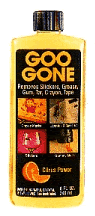 Goo Gone® has minimal impact on the environment and is safe to use on almost any surface.
When cleaning rails use a small amount of Goo Gone® on a rag and just wipe. If the railroad track is rusted or corroded use fine sandpaper or a track cleaning block after sanding the rails. Then wipe with Goo Gone® or other cleaners.
Some hobbyists also use Goo Gone® on the wheels of their locomotives. Goo Gone® or fine sandpaper can be used to make the wheels bright and shiny.
As well as using Goo Gone® on model railroads, the product can also be used on: carpets, upholstery, clothing, tile, glass, grills, appliances, vinyl, wood, draperies, autos, boats and fiberglass.
The manufacturers claim Goo Gone® is effective on: gum, tar, crayon, fresh paint, tree sap, oil and grease, blood, ink, asphalt, scuff marks, tape and tape residue, makeup, lipstick and mascara, adhesives, candle wax, kitchen grease, shoe polish, soap scum, bumper stickers, duct tape and bicycle chain grease.
A keen model railroader named Keith, has offered to share his ideas on weathering track to give a rusty appearance on Gauge 1 and other thoughts on this fascinating hobby we are involved in. Here are his thoughts. If you would like to offer your ideas on this subject, simply click on th comments tag and submit your thoughts to the blog moderator for publication on this blog.
“Thanks for the model railroading tips and info you have sent me. My own model railroad journey has gone through Gauge O then Gauge N back to O and now into Gauge1 live steam. All this has been over a period of nearly 30 years and almost entirely British outline until recently. “
“The Gauge 1 will eventually be run outside, I am planning about 70 yards of track per loop and eventually 3 tracks wide plus a steaming bay and sidings for rolling stock marshalling. In this scale a scale mile is just under 60 yards. “
“I am using Cliff Barker Code 180 stainless steel track which is supplied as separate 1 or 2 yard rail lengths and moulded UV stabilised sleepers. For realism I am rusting the rails by acid etching, thorough washing then covering with fresh degreased mild steel and leaving this to rust outside for a few weeks before removing the rusted steel and assembling thetrack. The moulded plastic chairs can be painted in suitable rust colour enamels for realism.The rust stains the etched surface and this appears to be quite stable although it remains to be seen how durable this is outside. The nice thing is that the colour has to be right as it is real rust and it has that dry matt appearance of rusty rail.”
“The running surface can be buffed back to bright steel using wire wool.This technique may be adaptable for nickel silver railin other scales. “
“For locos I already have an Aster Flying Scotsman, an Aster Schools class, an Aster Prussian T3 tank loco,an Aster BR86 tank loco and an Aster Lion andhave on order an Accucraft Canadian Pacific Royal Hudson which is due for delivery during the summer. I also have a few items of rolling stock both British outline and German epoch 1 and have ordered 6 carriages to go with the Hudson. “
“I am developing a real taste for North American railroads and next on my wants list is a Burlington Pioneer Zephyr set proper diesel electric in Gauge 1. Just to confirm what a nut I am I have also started to build miniature buildings in 1/32 scale from real brick, slate and stone to go on the outdoor railway. “
“My big problems are time and money as Gauge 1 is incredibly expensive and layout building on this scale requires lots of pre-preparation, planning, materials and continuous time to build the basic structure. From then on lots of the work can be done gradually. At my current speed I expect it will besome time in 2008 before I am ready to run a train. Happy model railroading from a fellow nut.”
The Aztec Annihilator is a system for cleaning dirty track (HO). The Annihilator was engineered for ease of use and minimal maintenance. Aztec are the first to admit that the car was not built to look utilitarian but instead to be a functional piece of rolling stock.
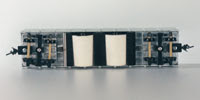
The custom painted 40ft gondola is gray with black “M.W.” and dimi data. No road or end numbers are provided. The modeler can apply decals (not included) in the railroad of his/her choice. To finish off the car the hobbyist might want to cover the mechanism with a piece of cloth (not supplied) to simulate a tarp.
The Aztec Annihilator can be run in a train and go unnoticed without hitting scenery or derailing.
A hard black anodized aluminum chassis holding two free rolling canvas rollers at a slight angle to the railhead, a magnet and a fluid reservoir (1/2 oz. capacity) is housed in a 40 ft gondola equipped with Kadee® couplers.
There is a valve to regulate the amount of cleaning fluid dispensed to the front roller. The rear roller is run dry and mops up loosened grime. A clear plastic lid covers the reservoir allowing you to see when it is running out of fluid. Turn valve about one quarter turn for ten seconds or so. Turn off and run for 10 to 15 minutes (or change times to suit).
This stealthy lightweight tips the scales at a mere 7-3/4 ounces soaking wet. The Aztec Annihilator will clean in either direction but works best with the magnet to the rear.