Technical
Everything on model trains, model railroads, model railways, locomotives, model train layouts, scenery, wiring, DCC and more. Enjoy the world's best hobby... model railroading!

Like many model train clubs, members of the Black Diamond Lines Model Railroad Club build their own switch machines. This gives them flexibility that a purchased switch will not always be able to provide….and it keeps the cost down.
On the club website they go through the construction and installation process of a machine . The switch machines consist of the base, motor, threaded rod, three (3) cherry switches, two (2) diodes, flat head machine screws with nuts, 3/4″ x 3/4″ alum angle 1/16″ thick, and a square piece of plastic with an eyelet in it. Off the green wire are the diodes that direct power to the motor.
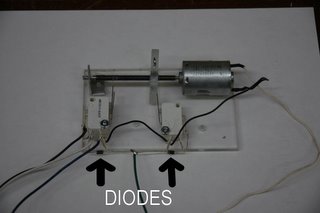
The base is plexiglass, 1/4″ thick, 5″ by 3″. Plexiglass is easy to work with, non-magnetic, but is pricey. Luckily the club was given a bunch of it. Here the base has the motor siliconed to it and the threaded rod has been pressed onto the motor shaft. The end of the screw is supported by the alum angle.
Before securing the motor the base, remember to put the plastic on the threaded rod.
 For full directions and more interesting photos visit the club website http://www.blackdiamondlines.org/switchmachine.html
The site also shows how to wire the switch. The cherry switch has three connectors on it. The connector on the side is connected to one of the diodes. The other end is connected to the green wire. This is the power wire from the control panel. The other diode attaches to the green wire and to the outside connector on the bottom of the other cherry switch.
The black wire from the motor is connected to the left connector. A jumper wire is attached to the right connector on the bottom cherry switch. The right connector on the single cherry switch is not used.

Take a look at the club website. The Black Diamond Lines is an active, operating HO scale model railroad club located in Antioch, CA.
Most model trains run on low voltage. Unlike the AC electrical circuit in your house, the electricity that moves your locos is DC, ie. Direct Current. The supply to your layout comes by plugging a power pack (also called a transformer) into a wall socket that takes the AC supply, steps it down to the 12-15 volts needed to run the trains and up to 18 volts for the accessories.
The model train transformer converts the output to DC, filters the DC to purify it, then outputs the supply from the terminals on the back of your controller, along a couple of wires to the tracks where it is picked up by your locomotives wheels, turning the motor within. The throttle control varies the voltage to the rails, changing the speed of the motor and consequently the rate your locomotive moves down the track.
DC electricity is directional, so the electricity flows along the wires in a certain direction, and the locomotive moves in the direction set by the directional switch on your controller (or left and right if your controller has a centre off type control knob).
There are, however, exceptions to using DC for trains… if you have Lionel or Marklin, they operate on controlled AC power with 3 rail track.
A follow-on from the last posting. Diesel engines are compression ignited. Unlike , say, a gasoline-powered automobile engine, which is spark ignited. Diesel engines are also very fuel efficient. This is why diesel-powered automobiles became popular during the energy shortage of the 1970s.
There is a big choice when it comes to model train set transformers. They come in all shapes and sizes depending on your requirements. All model train set transformers contain a few basic components, including a transformer to provide the 12 volts, a throttle to vary tile output voltage, and a direction switch to control the polarity of the circuit. Model train set transformers also have screw terminals for the track (which is DC) and AC accessory connections.
Larger units may include a larger power supply as well as additional electronic features such as: operating modes, pilot lights and meters, and multiple terminals for accessories such as add-on walkaround throttle units. These units make it easier to operate your train, enabling you to follow it as it moves around the track, rather than standing in one spot and watching it.
Small model train layouts can get by with the basic power pack (transformer) that comes with many starter model train sets. Remember, that a starter model train set power pack probably won’t have a much extra power. Also, it may not have a circuit breaker to prevent burn-outs. If however, the locomotive you’ve purchased doesn’t have a powerful engine, then this type of power pack may be all you need to get started with your model train set.
Get all the latest model railway news and views from the world of model trains. Stay up to date in the most enthralling (ok I’m biased) hobby in the world… model railroading!