Everything on model trains, model railroads, model railways, locomotives, model train layouts, scenery, wiring, DCC and more. Enjoy the world's best hobby... model railroading!
A reader wants your advice:
“I’m planning a N scale layout based during the late 40s to late 50s. I will be including a Switcher/Yard engine for my small branch line’s yard. My layout is a simple D.C. arrangement that will be up-graded to D.C.C. at a later time. Thanks for what advice I can get.”


Water tower for 2-6-2 Steam locomotive HO scale
Joe sent in these photos of his HO layout to share.
After reading a recent article on layouts for small areas, I decided to breakdown my 4×8 and construct a layout around the room. I painted the walls with forest and mountains and clouds. I was able to construct a two tier track pattern that are separate. The third set of tracks Is a trolley running from one side to the other.
Imagination was a big part of the scenery. This HO DCC layout was fun to build and even more fun when my grandchildren come and their eyes go wide as I shut the lights and turn on the street lamps, buildings, and neon signs. It seems to come to life. A small area doesn’t have mean a small layout.
Add a comment.
Bob sent in this question for readers:
“I’m re-doing my N Scale layout and I plan on using KATO Unitrack. My question is: How many feeder tracks do I need per 10 feet of track? This will be DCC controlled. I’ve been told that it’s not like using Atlas and others as the connectors on the Unitrack carry the electricity better. On my old layout I had feeders every 2 feet, sometimes closer. I was thinking a feeder every 5 feet. Too far? Thanks.”
Add your suggestion.
If model train manufacturers want to promote the hobby it should be done through advertising, something that model railroading doesn’t get enough of. This is the view of at least one keen model railroader (watch video). Do you agree?
Add your comment to this posting and/or take part in the poll.
There was a great response to last weeks poll which asked: Do You Operate DC Or DCC?
In all 841 model railroaders had their say with the majority (53%) of railroaders saying they operate DCC. Another 20% hoped to convert.
Although I’m not a professional pollster, I did notice one thing of significance.
Throughout the polling the percent results remained constant, indictating (to me) that the results were very accurate and hardly changed as more and more people voted. Here are the survey results:
>> DCC – I have always operated DCC (14%, 120 Votes)
>> DCC – I converted from DC to DCC (39%, 326 Votes)
>> DC – I hope to convert to DCC at some stage (20%, 169 Votes)
>> DC – I will be sticking with DC (19%, 162 Votes)
>> I don’t have a layout yet (8%, 64 Votes)
Click here for more DCC info
Positioning buildings in front of the background scenery (or backdrop) can give the impression the layout is bigger than it actually is. When done well, the distant scenery can appear go on forever. Trees or a road disappearing behind a hill can give a similar effect.
This quick video shows an easy way to construct a building in low relief. The building can be made with 3 sides and a roof, or just attach the front directly onto the backdrop. The construction material is either core flute or foam core… both are available from a hardware store. A big sheet will probably cost you less than $10 and make lots of buildings. Also remember, because the building will probably be positioned in the background, you could make it smaller than the scale you are operating.
The plan is one of a series of six available from http://www.modelbuildings.org/Low-Relief-Buildings-B.html
Stanley asks readers:
“I would like to know how to convert either a dummy loco or one with a defunct motor in order to run on dead track. I presume it would require off/on switch, wiring [of course] and maybe four AA batteries. Any help out there?”
Add your suggestion.
Thom has a question for readers:
“I have 2 Bachmann DCC equipped diesel engines a GP35 CSK light future and a GP38-2 Dark future. I’d like to add DDC sound to both HO engines, however a Digitrax rep has looked at these and doesn’t believe sound can be added due to the limited area under the shell. Has anyone added sound to these Bachmann engines? Thanks in Advance!”
Add your comment.
Tony has a question for others in the hobby:
“I have an HO NCE Power Cab and a Hornby R8247 Decoder for lighting/accessories. Can any one help with programming for a simple on/off operation for the layout scenery lights please.”
Add your comment.
Gil wants your help:
“I have 2 N gauge Rivarossi Pullman cars and a model power freight car that are giving me grief as the wheels will not stay attached to the micro trains chassis. It seems to me that the holes for the wheels have now worn out so that they no longer have the capacity to hold the axles in place. Any clues or do I need to buy wheels/chassis….by the way this is not a constant problem ..it doesn’t occur all the time when trains are running, but it is annoying.”
Add your comment.
Margie asks readers for the name of a retail outlet or manufacturer:
“Hello everyone, Hope you can help. I’m looking for HO trestles for a subway (actually, elevated train system). There are lots in other gauges, but having trouble finding HO scale. Thanks!”
Add your comment.
Model railroading has evolved from clockwork mechanisms or steam power through to battery operation and now electrics and digital control. The last few decades has seen real improvements in the quality of model trains (detail, materials, and control). This biggest change in recent years came with the invention of digital command control (DCC).
With DCC you can control and operate each locomotive individually, and you can choose to have it operate on its own, or you can operate it in concert with other locos. By comparison; using conventional DC control, you control “blocks of track”, so any locomotive on the track will respond the same way. With DCC the wiring can be less complex – with more operational flexibility and possibilities. That’s not to say DC can’t be a huge amount of fun – it is!
Why do you prefer DC or DCC? Add your comment.
DCC has been around for many years – yet for many in the hobby, how DCC operates is still a mystery.
DC Wiring
Basically with DC you need to break your layout into various electrical sections and add suitable switching. Pickups on the loco get power from the track directly to the motor. You need to have one controller for each locomotive running. You will also need to run a large amount of wire even on a small layout.
Tuning a loco’s performance on a DC railroad can be very difficult without changing motors or gearboxes. Locomotive lights will vary with the voltage. A low speed will mean low voltage, so stalling can be a common issue unless the trackwork is perfect.
DCC Wiring

There are several brands of DCC controllers to choose from.
DCC can be as simple (or as complex) as you want it to be. A DCC layout can consist of a simple common electrical circuit (you decide) – or if you are a wiring enthusiast…well, the sky is the limit!
With DCC each loco can be operated independently without worrying about unwanted interaction with other trains. There is no operational requirement for isolated sections or separate controllers.
The DCC controller provides a full voltage at all times so locomotive (and coach) lighting is constant. With the availability of a higher track voltage, the starting and slow speed running is often better than if the same loco were running on DC.
Two new DCC ebooks
If you are comfortable with DC then stick with it. If you want to explore new possibilities, then consider DCC. It really is a matter of personal choice.
If your layout operates well on DC, then it operate well on DCC too.
These new DCC ebooks are available from http://www.dccmodeltrains.org
Ken G from sunny Queensland in Australia has kindly sent in this article to share:
After reading a recent blog posting and the article about John’s small layout that had too many trees etc I thought you might be interested in my T Gauge layout. T Gauge is 1:450 so its roughly half the size of Z and one third the size of N.

Although “T” stands for Three (3mm track) it could also stand for “Tiny”
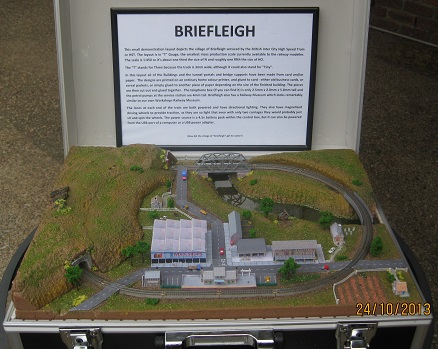
Its called “Briefleigh” because it fits into a briefcase.
I work as a volunteer at the Workshops Rail Museum in Ipswich Qld and over the weekend of 26th and 27th October we held the Queensland Model Railway Show at the museum. After last year’s show I made a promise to myself that I would build a layout for this year’s show. It wasn’t really what I had originally intended but I built a T Gauge layout inside a briefcase and called it “Briefleigh”.
John’s story was a reminder of my thinking when I built the layout. I deliberately used trees and bushes sparingly so as not to dominate the scene and distract viewers from the overall appearance of the layout. I even used flocking quite sparingly. The base is made of extruded foam which was firstly painted with a flat brown acrylic. I then randomly air brushed the hills and areas outside of where the village was going to be with green and yellow/ochre. When the flocking was applied I left bare areas, again randomly, to depict a more earthy landscape.
The buildings, bridge supports and tunnel portals are all made from card. The larger industrial looking building is a model of enough of the museum for viewers at the show to recognise it as such. The whole museum would have almost filled the briefcase. The little layout generated an enormous amount of interest and comment, especially the eagle magically flying above the river, which unfortunately proves to be very difficult to photograph.
Robert adds – If you would like to submit an article for publication, please follow the “Submit Your Article” Link in the right hand column.
The Beginners Guide To HO/OO Trains by Tom Hobson has just been released. It is an ebook that can be downloaded to your computer, burnt onto a disk, or printed out for handy reference. It will benefit many in the hobby and focuses on OO gauge and HO scale.
 Model railroaders choose the scale they want to model for different reasons. Some prefer bigger trains; some like lots of scenery and track so opt for a medium scale size such as HO or OO, whilst others are more limited for space and choose N scale or even smaller scales.
There is no right or wrong scale… it really comes down to personal preference and/or space and budgetary considerations.
That said; the biggest selling model train scale worldwide is HO scale (1:87), with the UK equivalent OO gauge (1:76) being the number one size in that part of the world.
If you are interested in building an HO scale or OO gauge layout then this ebook is a good starting point. After all, the more you know, the less mistake you’ll make.
600 Model railroaders took part in our latest survey which asked “Do you plan to expand your layout size in the future?”
Here’s how they voted:
>> YES – I hope to (43%, 257 Votes)
>> NO – Unfortunately I don’t have the space (40%, 237 Votes)
>> I don’t have a layout yet (17%, 106 Votes)
Add your comment to this post.
There are all kinds of ways to approach the construction of this model railroad office building structure. The first thing is to decide what scale you want to use. The plan is in PDF format which you print on your home printer, so you just scale it to meet your needs – HO scale, OO gauge, N scale etc.
The next thing is to decide if you want to assemble it in full 3D with all sides visible. The other option is to make it as a low relief building for positioning against a wall on a backdrop. That way you could just construct the building frontage (1 side), or maybe construct the frontage and part of 2 sides and part of the roof.
The third thing to consider is what construction method you prefer. The building can be made very strong by just using card such as an old cornflakes pack. You can strengthen the corners if you wish, but it is optional. The other method is to use foam core board or core flute board, both of which are very rigid and available cheaply from a hardware DIY store.
This plan is available from http://www.modelbuildings.org/office-building-B424.html
Add your suggestions.
Pete is hoping other model railroaders can give him some suggestions:
“In an effort to be as prototypical as possible, I am searching for a resource that depicts what engines and rolling stock were used during various eras?”
Add your comment.