Everything on model trains, model railroads, model railways, locomotives, model train layouts, scenery, wiring, DCC and more. Enjoy the world's best hobby... model railroading!
Sharad asks readers for advice:
“I Specialise in OO/HO gauge, and have 15 steam locomotives collected over 20 years. Eight of these are from Bachmann, 5 from Hornby and 2 from an Indian manufacturer. Of the 8 Bachmann locos, 4 are DCC which I have purchased this year.
1. My question is: How can I run all the trains together- Analog (DC) with the DCC. Please advise me how to convert the DC to DCC. Should I maintain 2 track systems: DC and DCC?
2. The layout I am constructing is in a newly acquired garage 9x 16 Please advise me whether I should have along the wall layout or in the centre of the garage. Please advise me.”
Add your suggestions.
When you think about it, a backdrop can have just about as much surface area as the model railroad itself. That’s why a backdrop is an integral part for any layout. Having a perpendicular orientation to your line of sight requires special thought.
In real life we view things in 3D, yet when you add anything extra to a backdrop (apart from blue sky), there is always the risk the backdrop will lose the 3D illusion. Painting clouds, mountains, and structures onto the background can look effective when viewed straight on. When viewed from a different angle however, the illusion of 3D can suddenly be lost.
Here are some tips for creating effective backdrops:
Keep the horizon low and make sure anything that is supposed to be vertical is vertical eg. telegraph poles, people, trees, buildings etc. Avoid abrupt horizon lines. Use trees, buildings, hills, or bridges to hide the meeting line where the vertical backdrop meets the horizontal layout. Avoid deep or bright colors for the sky. Light muted shades can work best. Soften and lighten the distant colors.
Although you won’t want everything to look artificially perfect, you also won’t want the eye to be drawn to something that looks out of place e.g. a dark blue sky. Vehicles need to be correctly positioned in the streets and not be cocked at strange angles.
Buildings painted on a background can sometimes look okay when there are other buildings or features in front of them. Otherwise it is best to design the buildings to stand out from the backdrop in low relief with the front and part of a couple of the sides showing. This can help achieve a credible 3D effect.
For more scenery tips http://www.modelrailwayscenery.org/model-railroad-scenery.html
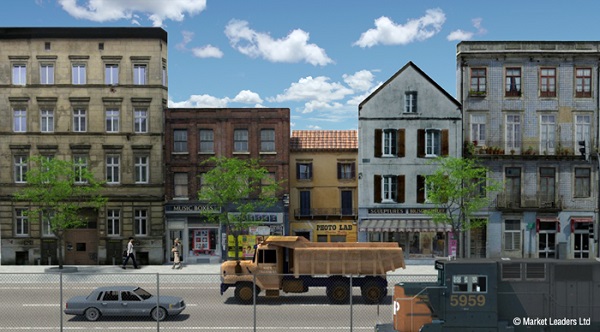
The buildings shown here are low relief buildings made from core flute. Foam core can be used instead. Both materials are very inexpensive to buy and are readily obtainable from Hardware DIY stores.
To get a close-up look at the detailing on the buildings in this town scene http://www.modelbuildings.org/low-relief-buildings.html
Add your suggestions.
Ugly solder joints can be a result of inexperience or maybe the surfaces or tip is dirty. It is an indication the solder did not properly flow, and that perhaps the soldering iron might also not have been hot enough. A good solder joint is typically flat and shiny. To achieve a good solder flow, you will need to have the surfaces clean and shiny, and the iron heated to maximum temperature, before the solder touches the tip of the iron.
Read the comments.
If you would like to learn more about DCC operation http://www.dccmodeltrains.org
The latest survey asked “Are Model Train Manufacturers Doing Enough To Promote Model Railroading?”
415 model railroaders responded as follows:
— No, I think they could do more (79%, 326 Votes)
— Yes, I think they are (21%, 89 Votes)
Add your comment
Nathan has a question for readers:
“I was wanting to hear ideas for a custom HO layout. I am kinda new to this. The size doesn’t matter unless it’s bigger than 150 sq ft. I only have cheap set locos but I have got 10 of them. Any help is appreciated. Thanks.”
Add your suggestions here.
A reader wants your advice:
“I’m planning a N scale layout based during the late 40s to late 50s. I will be including a Switcher/Yard engine for my small branch line’s yard. My layout is a simple D.C. arrangement that will be up-graded to D.C.C. at a later time. Thanks for what advice I can get.”


Water tower for 2-6-2 Steam locomotive HO scale
Joe sent in these photos of his HO layout to share.
After reading a recent article on layouts for small areas, I decided to breakdown my 4×8 and construct a layout around the room. I painted the walls with forest and mountains and clouds. I was able to construct a two tier track pattern that are separate. The third set of tracks Is a trolley running from one side to the other.
Imagination was a big part of the scenery. This HO DCC layout was fun to build and even more fun when my grandchildren come and their eyes go wide as I shut the lights and turn on the street lamps, buildings, and neon signs. It seems to come to life. A small area doesn’t have mean a small layout.
Add a comment.
Bob sent in this question for readers:
“I’m re-doing my N Scale layout and I plan on using KATO Unitrack. My question is: How many feeder tracks do I need per 10 feet of track? This will be DCC controlled. I’ve been told that it’s not like using Atlas and others as the connectors on the Unitrack carry the electricity better. On my old layout I had feeders every 2 feet, sometimes closer. I was thinking a feeder every 5 feet. Too far? Thanks.”
Add your suggestion.
If model train manufacturers want to promote the hobby it should be done through advertising, something that model railroading doesn’t get enough of. This is the view of at least one keen model railroader (watch video). Do you agree?
Add your comment to this posting and/or take part in the poll.
There was a great response to last weeks poll which asked: Do You Operate DC Or DCC?
In all 841 model railroaders had their say with the majority (53%) of railroaders saying they operate DCC. Another 20% hoped to convert.
Although I’m not a professional pollster, I did notice one thing of significance.
Throughout the polling the percent results remained constant, indictating (to me) that the results were very accurate and hardly changed as more and more people voted. Here are the survey results:
>> DCC – I have always operated DCC (14%, 120 Votes)
>> DCC – I converted from DC to DCC (39%, 326 Votes)
>> DC – I hope to convert to DCC at some stage (20%, 169 Votes)
>> DC – I will be sticking with DC (19%, 162 Votes)
>> I don’t have a layout yet (8%, 64 Votes)
Click here for more DCC info
Positioning buildings in front of the background scenery (or backdrop) can give the impression the layout is bigger than it actually is. When done well, the distant scenery can appear go on forever. Trees or a road disappearing behind a hill can give a similar effect.
This quick video shows an easy way to construct a building in low relief. The building can be made with 3 sides and a roof, or just attach the front directly onto the backdrop. The construction material is either core flute or foam core… both are available from a hardware store. A big sheet will probably cost you less than $10 and make lots of buildings. Also remember, because the building will probably be positioned in the background, you could make it smaller than the scale you are operating.
The plan is one of a series of six available from http://www.modelbuildings.org/Low-Relief-Buildings-B.html
Stanley asks readers:
“I would like to know how to convert either a dummy loco or one with a defunct motor in order to run on dead track. I presume it would require off/on switch, wiring [of course] and maybe four AA batteries. Any help out there?”
Add your suggestion.
Thom has a question for readers:
“I have 2 Bachmann DCC equipped diesel engines a GP35 CSK light future and a GP38-2 Dark future. I’d like to add DDC sound to both HO engines, however a Digitrax rep has looked at these and doesn’t believe sound can be added due to the limited area under the shell. Has anyone added sound to these Bachmann engines? Thanks in Advance!”
Add your comment.
Tony has a question for others in the hobby:
“I have an HO NCE Power Cab and a Hornby R8247 Decoder for lighting/accessories. Can any one help with programming for a simple on/off operation for the layout scenery lights please.”
Add your comment.
Gil wants your help:
“I have 2 N gauge Rivarossi Pullman cars and a model power freight car that are giving me grief as the wheels will not stay attached to the micro trains chassis. It seems to me that the holes for the wheels have now worn out so that they no longer have the capacity to hold the axles in place. Any clues or do I need to buy wheels/chassis….by the way this is not a constant problem ..it doesn’t occur all the time when trains are running, but it is annoying.”
Add your comment.
Margie asks readers for the name of a retail outlet or manufacturer:
“Hello everyone, Hope you can help. I’m looking for HO trestles for a subway (actually, elevated train system). There are lots in other gauges, but having trouble finding HO scale. Thanks!”
Add your comment.
Model railroading has evolved from clockwork mechanisms or steam power through to battery operation and now electrics and digital control. The last few decades has seen real improvements in the quality of model trains (detail, materials, and control). This biggest change in recent years came with the invention of digital command control (DCC).
With DCC you can control and operate each locomotive individually, and you can choose to have it operate on its own, or you can operate it in concert with other locos. By comparison; using conventional DC control, you control “blocks of track”, so any locomotive on the track will respond the same way. With DCC the wiring can be less complex – with more operational flexibility and possibilities. That’s not to say DC can’t be a huge amount of fun – it is!
Why do you prefer DC or DCC? Add your comment.
DCC has been around for many years – yet for many in the hobby, how DCC operates is still a mystery.
DC Wiring
Basically with DC you need to break your layout into various electrical sections and add suitable switching. Pickups on the loco get power from the track directly to the motor. You need to have one controller for each locomotive running. You will also need to run a large amount of wire even on a small layout.
Tuning a loco’s performance on a DC railroad can be very difficult without changing motors or gearboxes. Locomotive lights will vary with the voltage. A low speed will mean low voltage, so stalling can be a common issue unless the trackwork is perfect.
DCC Wiring

There are several brands of DCC controllers to choose from.
DCC can be as simple (or as complex) as you want it to be. A DCC layout can consist of a simple common electrical circuit (you decide) – or if you are a wiring enthusiast…well, the sky is the limit!
With DCC each loco can be operated independently without worrying about unwanted interaction with other trains. There is no operational requirement for isolated sections or separate controllers.
The DCC controller provides a full voltage at all times so locomotive (and coach) lighting is constant. With the availability of a higher track voltage, the starting and slow speed running is often better than if the same loco were running on DC.
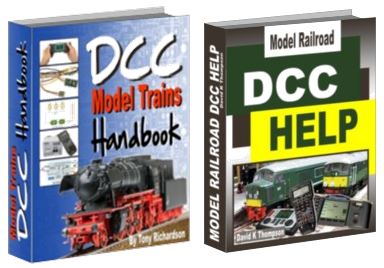
Two new DCC ebooks
If you are comfortable with DC then stick with it. If you want to explore new possibilities, then consider DCC. It really is a matter of personal choice.
If your layout operates well on DC, then it operate well on DCC too.
These new DCC ebooks are available from http://www.dccmodeltrains.org