Everything on model trains, model railroads, model railways, locomotives, model train layouts, scenery, wiring, DCC and more. Enjoy the world's best hobby... model railroading!
Jason sent in these thoughts:
Poor solder joints can be a big time waster and cause endless electrical problems on a model railroad layout. Keeping the solder iron tip in first class condition is critical if you want to achieve sound solder joints. Tip problems are easily prevented by always keeping the tip tinned with a thin coating of solder.
Most tips on solder irons are manufactured using a copper core which has been electroplated with iron to prolong the life of the iron. The “non-working” part of the tip is usually plated with nickel to protect against rusting and corrosion. It is then plated with chrome to stop the solder from sticking to it. It is only the very end tip that is un-plated so it will hold the solder.
Recommended model train resources
Looking after a solder iron is important – especially the unplated part of the tip that will quickly oxidize. This is why you need to coat the tip with solder at all times. It will slow down the oxidation process and help keep the tip in good condition. Despite your best intentions, the tip will eventually burn out – they all do. You know this has happened if you struggle to maintain the tip in a clean and shiny condition. If this happens the tip will need to be replaced. Filing or sanding the tip will not solve the problem long term. Tip replacement is best.
To avoid pre-mature burn out of the tip, keep it tinned with a thin coating of solder – not just while you are doing some soldering, but also when your soldering iron is idling. Get into the habit of applying a coat of solder to the tip before you set the iron down.
After you have finished soldering, always clean the tip and then apply a coating of solder prior to switching the iron off.
Whenever you buy and install a new tip, begin by applying a thin coating of solder, because otherwise the tip could burn out within a few minutes.

Switch Tamper
Maintenance of Way (MOW) Equipment is used for laying out the tracks, and for cleaning the area around and under the tracks. There are many categories of railroad equipment including Ballast Cleaning, Rail Grinding and Handling. A few common types are given below.
Ballast Regulator – gives tracks the desired shape.
Clearance Car – ensures that trains do not run into obstacles on the way.
Dynamometer Car – analyzes engine’s performance factors such as speed and power.
Jordan Spreader – removes snow from the railroads, must be operated by the train engine.
Tamper – sets rails along a track, capable of aligning, lifting and tamping rails.
John would like to hear opinions on Kato #4 Switches:
I don’t know if Kato N-Scale Unitrack is available where you happen to be, but I have found it to be very good, above manufacturers of other roadbed track such as Atlas and Bachmann. However, I have trouble with Kato’s #4 Switches, and I was wondering if others have had trouble with them. #4’s are good to save some space on a small layout or a yard, but the short straight sections that come with the switch to make the track fit bring it out longer, almost to #6 size. The #4 configuration on the back end of the switch can be confusing, and it seems like the modeler has to put power sections all over the place or the engine will stop. #6 switches are power routing but run much better, and can be used on some small layouts.
Add your comment.
John seeks advice from experienced model railroaders and asks:
“My wife and I are building a 15ft X 9ft HO layout to represent Swiss/Austrian theme. I have used to date some 65 meters of Peco 100 track and 30 points. Problem is that some of my dozen Fleischmann steam locos of various vintage will not run over these points [insulfrog] Is there any way I could ‘doctor’ the reluctant points. Thank you for any advice.”
Add your comment.
Rich asks readers:
“I’m fairly new to model railroading. I am confused about something….My layout is Not set up for DCC. Can I run an engine that has DCC on my layout. How hard is it to up grade to DCC if that is the coming thing? Is that something I should do, all my track is in place and a good bit of scenery,will that be a problem. Thanks for any help.”
Comment below.
Ed has a question for readers:
“Can anyone tell me where I might be able to find a Norfolk Southern Engine with the decal of horses on the engine.”
James asks:
“I am looking for an N Scale 44Tonner but can only find those made by Bachmann and I haven’t read any positive reviews about them. Has any other manufacturer made an N Scale 44Tonner?”
Comment below.
Jack has a question for fellow model railroaders:
“I need to adjust the wheel gauge on an O-Scale 2-track truck. Any suggestions how to accomplish this? The wheels are too close together.”
Add your comment.
John asks readers:
“I have been told much about how to wire up my model railway but,very little about what wire to use. Could anyone help?”
Add your answer.
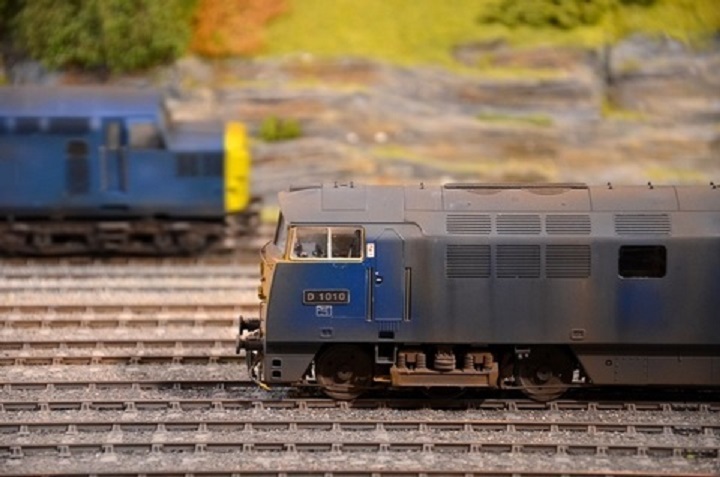 The last poll asked:
Do you like to weather your locomotives and rolling stock?
Brian sent in these ideas:
Scratch building steel bridges can prove challenging and if you don’t want to give it a go there numerous commercial bridges available to choose from. Some bridges are ready built and others come in kit form to assemble.


I can be a good idea to design and build bridges before assembling the baseboard. Adding a tall viaduct may require a deeper baseboard to accommodate it.
I prefer to construct these structures on my sub-base which I can later properly affix to the baseboard. I like to paint it and add my detailing then lay the track. I even finish off the scenery surrounding the structure as I find this easier to finish at my workbench.
As a rule I include thin plywood lip at each end of the track-bed which helps me accurately attach the adjacent track-bed.
To see more ideas from Brian, watch the video at http://www.modelrailwayscenery.org/scenery2.html

Claude has a question for readers:
“I am looking for a source of patterned styrene siding for metal bldgs. I have checked Plastrut and all they have is a corrugated metal profile. Evergreen only has a grooved sheet. Metal bldgs now-a-days have a raised 2 rib on 12 centers. I am wondering what others use to realistically model this type of metal siding. Thanks for any suggestions.”
Comment below.
Lee is having a problem with rusty O scale track and asks:
“One of my tracks goes through the wall of the game room out into the garage. I live at the coast (NC) and I am having a hard time keeping this track clean. As in rust. HELP PLEASE!”
Add your comments.
Archie has a question for other hobbyists and asks:
“I received an email where it mentioned something about car weight. My question is, do ho train cars need to be weighed down any? How can you add weight to a tank car? I’m sure that in a box car you can take it apart and put weight inside but tank cars and flat cars?”
Add your comment.
Charles from Canberra in Australia asks readers:
“G’Day from Oz, I have just ordered an HO Walthers Sperry Rail Detector Car and it’s in the Mail. It is HO DC and I would like to convert it to DCC.
Any advice/suggestions/recommendations from those in the know will be very much appreciated.”
 527 model railroaders participated in our recent poll which asked: “Do you take railroading photos/videos? If so, what do you prefer to use?” The results were as follows:
Click this link for some great model train photos and clever ideas.
 Some quick tips submitted by Andy:
A staging yard is a hidden place that is used for storing unscheduled trains. It can also be used for rearranging trains between or during scheduled times. A classic and fiddle staging yard consist of parallel tracks on plain ground and a pivot respectively.
Advantages:
Disadvantages:
Click this link for some excellent model railroad scenery ideas.
 Ed sent in this short tutorial to share:
“Spurs are short-length rail road tracks used for train storage, customer/station services and loading/unloading operations.
Spurs are of two main types; single ended and double ended. A single ended spur has only one terminal connected to the main line. It can be leading or trailing. A leading point spur branches off in the forward direction and a trailing point spur branches off in the reverse direction. The latter is a better choice because it simplifies operations. A double ended spur has both ends connected to the main track.”