Everything on model trains, model railroads, model railways, locomotives, model train layouts, scenery, wiring, DCC and more. Enjoy the world's best hobby... model railroading!
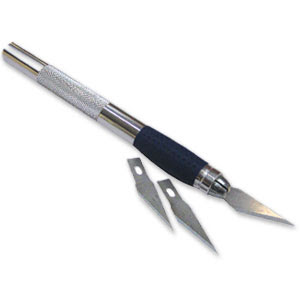
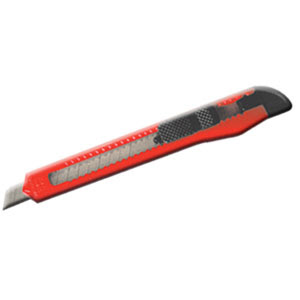 A craft knife (with snap-off blades), a Stanley knife, or a scarpel is a very useful tool for anyone doing hobby work. These tools are great for giving a clean cut through cardboard, balsa wood, polystyrene etc. However be very careful, because they are also very efficient at cutting through flesh. That’s why surgeons use scarpels in operations!
 I have found from experience it is best to make several cuts along the same line using light to medium pressure on the knife rather than pressing down hard on the knife to make one deep cut. The knife (or your grip) is more likely to slip under pressure and result in a serious cut to a finger (or damage to the object you are cutting).
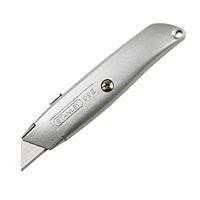 Many in the hobby prefer using a Stanley knife as they are more sturdy than the snap-off blade types. However, they are a little more bulky so it depends on the type of project you are working on, or what you prefer using. Whatever you choose be careful!
Sherry is building a Z layout and wants to hear from others who know anything about building Z layouts:
“I am doing a small Z layout and have the basics assembled. I am disappointed in the Marklin track in that I think it is hard to get a smooth joint. I am wondering if I would find the Micro-Track with the attached road bed any better/easier to work with?
I don’t live near a store that carries Z supplies and don’t know anyone doing Z so I am just going by pictures. I have worked with all the other scales….this is my first Z layout. Would appreciate any in-put on this question from those who model Z scale….or any other hints from anyone.”
Add your comments to Sherry’s posting by using the green Comments & Feedback link below. Simply register (it takes just 2 minutes if you haven’t already done so) and then you can participate in future Model Train blog discussions.
Jeff recalls the rattling, clanging and squeaking of trains and writes:
I grew up in the Bronx and the memories of trains that I have are of the elevated passenger trains. They use to shake the house as they went by. I would hear the rattling and clanging and squeaking of the metal brakes.
I sinced moved away from there to a peaceful quiet place and in my heart I do miss those trains.
Now I am in my my late fifties and I have moved again. I moved about a few hundred yards away from tracks carrying freight. I now hear the trains and feel the rattling and the objects in the house shaking. I love it! I run out sometimes and count the engines and see which way they are facing.
What memories I now have old ones and new ones.
Gary remembers his days working for the Chicago Transit Authority and writes:
I started working with the CTA in 1979 as a conductor on the elevated line and the subway which are rapid transit passenger trains. I also worked as a motorman, a ticket agent, a switchman, a foot collector (witch means collecting money from the ticket agents after they collected from the passengers) riding the train getting from one part of Chicago and suburbs to another.
After the agents stopped collecting money from the passengers, CTA used the ticket agents as Customer Asssistants who now help passengers find their way around Chicago. I worked that job part time and then ended my time (28 years 9 months) as a courier. A courier collects paper work from customer assistants and take them supplies and maps of the system and other jobs as assigned.
I traveled from one end of Chicago to the other with this job. I really liked my job. At one time CTA sold replicas of their Trains and also their bus system. That was when I got interested in Model Trains and also diecast cars & buses.
Jeremy kindly sent in these tips for readers:
Re non-shine to make things look more realistic – I use Acrylic artists paints as these are naturally matt, can be mixed (and inexpensive). In our Pound Stores (equivalent of US Dollar Stores) you can get a set of Acrylic paints (red, blue, green, black, white etc) for a pound ($1.60).
Re saw dust – besides fabric dye you can use wood dye and besides sawdust, wood flakes (hamster bedding) can be dyed and used as leaves.
Shannon sent in this story for readers:
When I was young… very young, I always wanted to see the train that ran on the Baltimore and Annapolis short line in Maryland. One day my Mom called the B7A Railroad to make the inquiry and they called right back and said the train was sitting at the Crain Highway crossing in Glen Burnie. She drove me up there and there it was. The engineer came down, took me into the cab and allowed me to open the throttle a bit and to blow the horn. That locomotive is now on display at the B&O railroad museum in Baltimore, MD.
Kevin recalls the Western Pacific line and writes:
I was just a little snapper when my Great Uncle Alma Jones who was a conductor on the Western Pacific line took me from Reno to Portola, California. He always wore a fine blue uniform with a vest and everyone knew he was in charge.
I loved riding the train throught the Feather River Canyon and seeing the people in the little towns and so many animals near the tracks enroute.
When he retired from the railroad he flush his false teath down the toilet because he hated wearing them I said to him “Uncle Alma, how are you going to chew your food”? He replied “I don’t need to chew Jack Daniels and Coke a Cola. Ha!
I am still amazed by the size of the engines and the beautiful accomodations of the passenger and dining cars. It was such a civilized way to travel and you didn’t have some yelling at you to “sit down, shut up and buckle up!”
Check out the new model railroading poll (quick survey) in the right hand column. Simply select your answer. You can then instantly click to see the results to see how others answered. It’s fun and it is FREE to take part (see right hand column for poll details).
Dale kindly sent in this info on model railroad lighting to help others:
Lighting – Here is a subject that, from what I’ve noticed, is never touched in model railroading. By lighting I mean overhead lighting on a layout.
I would imagine that most layouts use fluorescent lighting in the ceiling above the layout. While this is good, it usually leaves some room for improvement in the quality of the light. I’m not talking about expensive improvements, but very inexpensive improvements that can make a big difference.
Most often the fluorescent bulbs that we use are cool white or warm white bulbs to light a given area (in this case our layout). While those lamps are adequate to get the job done they cast a lighting color on the layout that may actually mask or reduce our ability to see all the colors in the layout. They simply do not render all colors of the light spectrum equally making colors look somewhat dull.
Let me give you an example you’re familiar with where lighting makes a big difference. Retailers often take advantage of improved fluorescent lamps and food stores are big users of improved lighting. They often use lighting over the meat cases that enhances the color red or full spectrum lighting over the store shelving that makes the colors on their product boxes just ‘jump off the shelf’. The results are you see the various products as bright and inviting resulting in greater sales.
Simply changing the fluorescent lamps over the layout can make a huge improvement in the colors displayed on the layout and all for very little money.
I would suggest to replace those default cool white and warm white lamps with lamps along the line of those listed below: Use lamps with a color temperature of 3500K (degrees Kelvin) or higher and a color rendering index (CRI) of 80 and higher (0 to 100 scale). The CRI is the most important issue for true color rendering.
Here are some examples:
Brand Wattage Model Name Model No. Temperature(K) CRI
Phillips 40W Warm White Natural F40/N 3700 90 (Warm White)
Phillips 40W Deluxe Cool White F40/CWX/ALTO 4200 89 (Cool White)
Phillips 40W Colortone 50 F40/C50 5000 85 (Full Spectrum)
Phillips 34W Ultralume F34/35U/RE/EW/ALTO 3500 85 (Warm White)
Phillips 34W Ultralume F34/41U/RS/EW/ALTO 4100 85 (Cool White)
Phillips 34W Ultralume F34/50U/RS/EW/ALTO 5000 85 (Full Spectrum)
The goal is to reveal all colors accurately making your layout look its very best.
Brent has a model RR problem and wants help from readers:
“I have Walthers budd lighted passenger cars that at some spots on the circuit the lights flicker. I have cleaned the track etc, but to no avail. My units are new. Does anyone know what to do?”
Joe asks readers with DCC experience:
“I am unable to program my control to move two trains on my track.”
If you think you can help either of these readers, then use the Comments link to add your suggestion.
Jim needs help from someone with experience in creating a logging scene for his N Layout and asks readers:
“I’m pretty new at railroading and have decided that my layout will be Alaska and I’d like to have a logging camp. I cannot find any suggestions of how to make realistic looking logs. I enjoy scratchbuilding and would prefer to make them myself. Any help from some who knows would be appreciated.”
To assist Jim – use the green comments and feedback link below his posting.
Ernie sent in this great story about his narrow gauge train rides:
This experience took place many years ago. I was 10 years old and I am now eighty two. My home was in Pueblo Colorado and I had an aunt and uncle who lived in Ignacio, Colorado.
To get to my destination I would catch the 11:30 P.M. D&RGW standard guage at Pueblo and ride that section to Alamosa, Colorado arriving about 2:30A.M. My mother would tell the conductor where I was going and he would tell the Alamosa Station Master, who would tell the Conductor of the narrow guage train to Ignacio.
The narrow gauge would leave Alamosa at 7:A.M..I was always handed off correctly and with a lot of tender loving care. I made this trip three or four times a year between my tenth and thirteenth year so I got to know the railroad crew on a personal basis.
The trip on the narrow gauge was long but interesting. The train had a conductor, a brakeman and a porter. The porter would make home made ice cream on the spring and summer trips. Hot chocolate on the fall aand winter trips. The trip from Alamosa to Ignacio would take until 3:30 P.M.
During the course of the trip I would enjoy beautiful scenery and a lot of wild life. There were times, going up Cumbres Pass, that the train would go so slow that I could get off and walk beside it. Other times we would drop off fishermen who were going to fish the high lakes and streams. On the afternoon return train they would pick the fishermen and return the to a stop down grade. These were experiences that I have never forgotten.
Paul has sent in this wonderful memory for publication:
“My memories of trains in the UK began with my late dad Tom. He started on the railways in the late 1950’s through to the 60’s. He started on small steam engines with the LNER and he eventually progressed to be the fireman on the famous “Sir Nigel Gresley” which is one of the big “Mallard” class tender engines now held in the National Railway Museum in York. Sadly he never made a driver as the “diesels” took over. But, no matter whether he made driver or not I was proud of his achievement and always will be. “
Charles heard of an HO layout in New Jersey that set a record and asks readers:
“Back in the early or mid 70’s, there was a very large HO lay-out in New Jersey, they had 501 hopper’s and 20 Deisels and set a worlds record. My question is has the record been broken as of this date?”
Paul from South Africa writes:
Some information from my part of the world – in South Africa the entire railroad system is run on narrow gauge. The only piece of standard gauge railroad that has been built is in Saldana Bay, specifically for the movement of goods for shipping – a very big Iron Ore and coal export harbor!
One economical implication of this gauge is that in South Africa most goods are now moved by road, this has caused an unprecedented rise in the cost of goods, especially inland.
After watching a series on American rail services on National Geographic satellite tv I have seen the positives of changing our entire system to Standard gauge.
Outeniqua Choo-Choo
One other piece of information I would like to share is the Outeniqua Choo-Choo (a steam locomotive driven passenger train). This was a tour that ran along the Cape South Coast.
Unfortunately this was stopped when a few years ago very bad flooding and land slides in the Cape damaged the line and the tour was stopped. I will be visiting the Cape soon and hope to find out a bit more about the possibility of re-opening this tour – it may be a long shot but let’s see what happens!
Michael has sent in this story:
My memories of trains are of when I was somewhat younger. I grew in Birmingham, England during the WW2 and to get close to a train was very rare as in England the railroad was fenced off. It was almost inpossible to get close or even see a train. Also, due to the war lads of my age didn’t receive toy trains. In my teens when I could go further afield my friends and I went to an old passenger station were one could see mainly goods trains going straight through with the odd pasenger train on it’s way to New Street Station.
It wasn’t until I came to Canada that I actualy had an electric train set of my own. A friend was cleaning out and came across two train sets, one a CP and the other a CN. Since then I have managed to get a Amtrack train which I hope to convert into a BC pasenger train. Since I came to BC my Trains have been boxed up as I have no place to build a layout yet. I have a system which I used for two trains on a 8’x4′ table but when I get all working again I hope to run four trains by having a separate level below the table.
Ron wants to hear from anyone who know about coloring brick mortar on model railroad scenery and asks readers:
“I’ve never undertaken the application of mortar between brick on a structure and need some tips from those in the know! Is there a practical way to color the bricks before applying the mortar? “
If you think you know the answer use the green comments link below Ron’s posting and post your reply.
Karen remembers getting a Hornby clockwork train set for Christmas when she was eight and writes:
My Swiss Grandfather who was a mad train buff and I used to watch trains all the time and he even worked with steam trains and on bridges in Australia.
Santa bought me my first train set – a Hornby clockwork set when I was 8, and that was a pretty unusual present for a girl in those days! I ran the thing off the rails! Since then, I have built lots of small model railways and I am currently working on one of Penzance, Cornwall England, circa 1950’s. My nephews have carried on the passion in our family.