Everything on model trains, model railroads, model railways, locomotives, model train layouts, scenery, wiring, DCC and more. Enjoy the world's best hobby... model railroading!
Neville would like to hear from model railroaders in Melbourne, Australia:
“I would like to hear from people interested in joining an 0n30 group here in Melbourne, Australia to help each other with meeting to disguss all points of this great hobby and to help each other. If you are interested contact me on Australia 03 9850 9550. I am building a train layout at the moment. All the best and a happy new year. Neville from Templestowe, Victoria, Australia.”
Alan would like to hear from model railroaders who use fexi track:
“I am having a lot of trouble with smooth joints on curves where I have to make a joint in flex track. Even if I start with a fresh piece at the beginning of the curve I can’t make it all the way around. Then there is a goofy spot where ties have been removed and the track is joined. I have soldered the joints with a heat sink to prevent melting the remaining ties, but they still are not great. Does anyone know what I should do?”
To comment click on the green comments link below.
Leonard from the United Kingdom has a question for UK readers with an electric turntable:
“Someone bought me an electric turntable for christmas and, what I want to know is can it be wired up to the Hornby DC controller. I thought I may be able to take it off of the junction diode?”
To answer this question click on the green comments link below.
John has a DDC decoder question for those into electrics:
“Does anyone know, Is there a DCC decoder that works for a Bachmann Streamline Trolley and are there any tricks to hooking it up.”
Mitch has a question for on3 enthusiasts to try and answer:
“Hi everyone. I have a concern regarding scale as I am interested in starting an on3 layout.
I have purchased an engine and a couple of cars and have done some research on the on3 scale. I am a bit puzzeled since on3 is considered narrow gauge for “o” gauge and the scale is 1/4 inch.
If I place an “O” gauge human figure next to the on3 engine and he would have to be on his knees to operate the engine. I also have found structures claiming to be for on3 but look like monsters next to on3 cars.
With out a lot of kitbashing can a reader tell me how does one figure the scale? I guess I would work with 3/16 inch scale, but not sure. Can someone advise me or lead an old modelrailroader of 75 years down the right path? Thanks again – Mitch”
To comment on Mitch’s posting simply click on the green comments link below. Have a go and see if you can answer it.
Would a reader like to help Gary with an answer to his question:
“I have a question for a model railroader who reads your blog to answer please. I am starting to build a board for the layout. I have 2 Lionel train sets with a few pieces of extra track I purchased. What is the angle I may use for elevation of the trains? What rate of elevation can they climb? Does one of your readers know the answer?
To answer this question click on the green comments link below.
William has a question a reader might like to try and answer:
“I am trying to build medium size N scale model. Question is; I have MRC 280 transformer and MRC power station 8. What other electronics are necessary to operate using DCS?”
To give a comment click the comments link below


David has a question for readers about software for model railroad layout design:
“I wish to use my computer to design my HO scale railroad. What software packages are there to use, and how do they differ? What do the model railroading magazines use to generate those nice designs? Hopefully a reader will be able to guide me. Thanks in advance.”
Ian has a question for anyone using code 40 track:
“I have read that several N Scale modellers use code 40 track produced by Micro Engineering to differentiate between main line (code 55) and sidings, loops, dead ends and branch lines. I am doing the same, however, although all my rolling stock will pass over Code 40 track perfectly, being fitted with Micro-Trains low profile wheelsets, the only power which I have found that will do so is that made by Bachmann/Spectrum. Have any modeller colleagues any suggestions as to how I can extend the range of locomotives I can use on Code 40 track?”
To comment on Ian’s posting click on the green comments link below.
Nicky from the Gateway Model Railroad Club informs me that the Club is holding its Annual Open House on Saturday January 24th & Sunday January 25th 2009 and again on Saturday February 7th & Sunday February 8th 2009.
The Gateway Model Railroad Club is located at 100 E. Browning Road Brooklawn, NJ 08030.
Opening times are from 10am til 4pm with a $3 donation at the door.

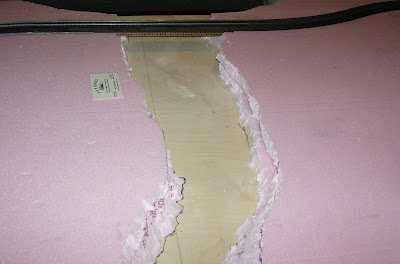
I wanted to share with your readers the beginnings of my model train set. It doesn’t look like much yet, but I am very proud of how far I have gotten. I started last spring. I built the table 4 x 8. It is still missing the wood molding to further strengthen the legs.

Keen model railroader “Guy” has an HO layout based on a drawing from John Allen’s ‘Timesaver’ switching. Here is what Guy has to say:
“Hi folks! This is the first layout I’ve created. It is based on the drawing from John Allen’s famous switching game called Timesaver. The entire track is handlaid on wooden ties with code 70 rail. The five turnouts, the 11 uncoupler magnets and the track lengths correspond to the given instructions from John.
I find it a lot of fun to operate this layout and even at a model exhibition people were interested to follow all the shunting work.
For best operating results, I operate my engines in DC mode with a small controller (faster shunting). For smooth and realistic operation with sound a LocoNet DCC unit is connected.
The turnout is manual control with a pushrod that activates a switch for frog polarity. The switchstand really works and indicates the position.
Wherever you go, this small layout is ready in a few minutes and the operation can be started with one Loco and some cars.”
Donald is about to test your knowledge and hopefully get an answer to his question about oiling locomotives:
“Can one of your readers tell me how often and how do I clean and oil my locomotives? They seem to run forever, but then I really don’t run them often, a few hours a couple of days a week at best. How do I oil them them, should I oil them at all? How do I do this? With what? Hopefully one of your readers will know the answer.”
To help Donald add your comments using the green comments link below. Simple!
Robert comments:
Yes, oil locomotives, but not usually freight and passenger cars.
In modeling, the primary purpose of oil is to reduce wear and tear on moving parts, particularly those subjected to intense friction. Locomotives are under constant stress to transmit power and will eventually break without proper lubrication applied to the motor bearings and gears. (It is important to use the correct lubricants on those parts for maximum performance).
Too much or too little lubrication can cause damage. Too much lubricant will saturate the wiring, insulating material and attract a modelers worst enemy – DIRT and DUST!
The resulting effect could shorten the life of your trains electrical components and adversely affect performance. Most at risk are the motor bearings, commutator and the brushes.
Damaged to the commutator and brushes can happen when oil reaches the commutator. This is because the electrical current passing between the brush and commutator will vaporize the lubricant and glaze the brush surface. This causes an increase in resistance between commutator and brush, greatly increasing the arching between the brush and commutator. The consequence of a dirty commutator is that higher voltages will be needed to operate the trains.
It is true that freight and passenger cars have friction points too, but they’re generally under far less stress than locos. Modern day models reduce friction by using acetal plastic side-frames and needlepoint axles. Oiling is unnecessary, because when the oil becomes dirty and breaks down, it actually increases the friction.
More about oiling trains and other useful model railroad tips here.
Here is a question you might like to answer for Jim:
“I am rather new at railroading so my question is awfully basic to you guys but, what is the best way to clean the wheels, gears, and motor on the engine?”
Post your answer using the green comments link below.
Have you ever wired street lighting on a model railroad layout. If you have, then you might have some tips for Pete who is trying to add street lights to his N layout:
“Someone has just bought me some street lights to put on my layout. There are no instructions on how to wire the lights. There are about twenty in total. My question is; can the lights be joined together some how and then go to a power source or do I need to wire each light separately?”
To comment on Pete’s posting click on the green comments link.
A reader ask for your advice or suggestions for creating a stucco look on buildings:

Model Railroading is alive and well down-under in countries like Australia and New Zealand. The methods and scales are basically the same as in the Northern Hemisphere, although some of the scenery modeled is different.
Down-under they tend to use the British term ‘railway’ rather than the more commonly used term in North America of ‘railroad’. The Aussies and Kiwi use British spelling so words like modeling (US) becomes modelling, color (US) becomes colour, signaling (US) becomes signalling, DCC controled becomes DCC controlled. So if you read a book and the spelling seems a bit strange, it may just be that it is written in a different country.
Here is some information about the an Australian RR club based on the Gold Coast in Queensland just south of Brisbane.
David the President of the GOLD COAST MODEL RAILWAY WORKSHOP has submited these details for publication:
The Gold Coast Model Railway Club Workshop has the largest number of static layouts in Queensland. The displays encompass the following gauges :
N Gauge. This is currently being expanded.
HO/OO Gauge ( one circuit of track on either the ‘up or ‘down line = 1 scale mile in each direction ). This contains sections which are representative of America, British Rail and Europe. It is erected in a letter ‘E’ configuration, (but there are four ‘arms’, thus each ‘arm’ represents its own world of modelling.
This layout is being upgraded adding a turntable that will turn a ‘ bigboy’ loco.
0n30 Gauge Digitally controlled and growing in size.
0 Gauge This is incorporated with the 0n30.
G Gauge This is full sound and electronic controlled.
The Gold Coast Model Railway Club Workshop’s exhibition layout is D.C.C controlled and named ‘ United Nations ‘.
It is built from members modules, which are called ‘in ‘ when it goes out to an exhibition. As such it’s size can be varied from small to very large dependent on the venue. The Gold Coast Model Railway Club runs trains/engines which are representative of the world wide fraternaty of model railways.
The GOLD COAST MODEL RAILWAY WORKSHOP located at 16 KENDOR ST, LABRADOR, QUEENSLAND, AUSTRALIA is open to the general public every Saturday 10.00am to 4.00pm.
The Gold Coast Model Railway Club would enjoy your company