Everything on model trains, model railroads, model railways, locomotives, model train layouts, scenery, wiring, DCC and more. Enjoy the world's best hobby... model railroading!
Here is a question from a fellow modeler that readers might like to offer help with…
“I’m building a new N-scale railroad modeled after the Santa Fe. I’m usingKato track. I’ve already installed side-by-side a single track trestle anda double track trestle. What I need to find is a double track mountaintunnel. I haven’t yet got a copy of the new Walthers catalog. Do your readers have any suggestions?
This RR is on a 4’x8′ table. There will be 6 freight trains and onepassenger train. Since I’m retired, I’ll have plenty of time to work onthis project; there is no hurry.”
This blog is for all model railroaders, so feel free to contribute your ideas and help others in the hobby.
Here is another opportunity for readers to share their knowledge of model railroading. A couple of questions from a fellow railroader for you to consider – can you help this reader:
“I’m trying to get as much information possible on getting sound on N guage. I’m just getting started on model railroading, and have chosen to do it the DCC way..I’m told that SoundTraxx and Digitex are doing some things, and it is possible on some N locomotives, steam and deisel with some decoders. “
The reader asks:
If you can help this reader then please feel free to contribute your thoughts.
Here are a couple more questions from South African model railroading ethusiast Hettie. (see earlier blog posting).
Readers are welcome (and encouraged to contribute answers).
Hettie asks:
IS THERE A WIRELESS DIGITAL DEMAND CONTROL AVAILABLE THAT IS COMPATIBLE TO MARKLIN?
OUR SETUP IS ABOUT 20M LONG AND WE HAVE A PROBLEM SEEING AROUND THE CORNERS AND CHIMNEY WALL THAT’S DIVIDING THE ROOM IN THE ATTIC. MARKLIN APPARENTLY DO NOT MANUFACTURE A CORDLESS CONTROL TO CONTROLE THE TRAINS ANYMORE. IN THIS DAY AND AGE EVERYTHING IS WIRELESS… IS THERE A NEW PRODUCT THAT CAN BE INTEGRATED WITH HO SCALE MARKLIN PRODUCTS?
WE WILL BE VISITING THE STATES NEXT YEAR JANUARY. WILL ANY OF THE TRAIN ENTHUSIASTS SHARE THERE SETUPS WITH US TO VIEW? WE INTEND TO POP IN AT VEGAS, LOUISVILLE ATLANTA NEW YORK AND SCRANTON.
Here is your chance to contribute a suggestion or two.
Can a model railroading enthusiast in the USA help Hettie?
MY NAME IS HETTIE AND WE LIVE IS SOUTH AFRICA.
WE ARE BUSY BUILDING A HO SCALE MODEL RAILROAD AND LOVING IT.
IN JANUARY \FEBRUARY 2007 WE WILL BE VISITING LAS VEGAS, NEW YORK AND ATLANTA. WE PLAN TO SEE THE TRAIN SHOWS IS LOUISVILLE AND ATLANTA. I AM REALLY STRUGGLING TO FIND WHERE WE CAN GO ON A STEAM TRIP IN THAT AREAS. I DO REALISE THAT IT IS IN WINTER THAT WE WILL BE THERE, BUT ANY NICE…EVEN A DIESEL TRIP WILL DO.
WE ARE ALSO INTERESTED TO SEE DIFFERENT LAYOUTS OF ENTHUSIASTIC MODEL BUILDERS IN THE STATE.
Can you help Hettie?
Membership groups to join in Michigan and Minnesota include:
Michigan:
Ann Arbor Model Railroad Club, Ford Model Railroad Club Dearborn, Glancy Trains Modular Club Birmingham, Grand Rapids Model Railroad Historical Society, Gratiot Valley Railroad Club Mt. Clemens, Kalamazoo Model Railroad Historical Society Kalamazoo, Lansing Model Railroad Club Lansing, LanNTrak Lansing & Livingston County Michigan NTrak Model Railroad Club, Michigan Small Scale Live Steamers Lake Orion. Northern Michigan Railroad Club, Peninsular Modular Railroad Club (PMRC) Battle Creek – Kalamazoo, Rails On Wheels HO Modular Model Railroad Club Ann Arbor/Washtenaw County, Raisin Valley Model Railroad Club Blissfield, Riverbend Model Railroad Club Hudsonville, Society Of N-Scalers Royal Oak, South Oakland County Model Railroad Club Hazel Park, Stoney Creek Model Railroad Club Rochester, Tri county model railroad club Saginaw, West Michigan Chapter of the Train Collectors Association Grand Rapids, Western Michigan Railroad Club Grand Rapids.
Minnesota:
Crow River Junction Model Railroad Club Monticello, The G Whiz Gang The G Whiz Gang of Minnesota, Luce Line RR Club Inc. Hutchinson, Minnesota Central Model Railway Club, Minnesota Free-Mo Modellers Twin Cities, St. James Model Railroad Club, Twin City Model Railroad Museum, Railroad Club at the University of Minnesota Minneapolis, West Side Lumber Co Rochester, Winona Railroad Club Winona.
Here are some questions from a model railroader that other readers might like to get their teeth into. Your contributions are welcome.
Readers contributions are welcome.
Vance Altman of FSMTREES has kindly allowed me to publish the following tree making tutorial from his website.
Sagebrush Tree Construction
This tutorial will go through a step-by-step process to create realistic looking miniature trees for use in wargames, dioramas, and model train layouts.
Materials:
Description of Materials:
The trickiest part of making this type of tree is finding the correct materials. Sagebrush can be found in several places including specialty hobby shops, online shops, and simply out in nature. Since I do not know of any sage growing in my area, I opted for the next easiest (unfortunately the most expensive) method of obtaining this material. A local hobby shop specializing in trains carries sagebrush for $2-3 per armature. The cost is quite a lot considering there is still a lot of work, which needs to be done to get a tree out of the deal. I do, however, prefer the look of the finished product over anything that can be bought or of any of the other attempts at tree making I have done.
The cheaper the hair sprays the better (usually). What is basically needed is a spray adhesive. Real spray adhesives such as those from Elmer’s should work as well, but I haven’t tried them. I use Unscented Aqua Net hair spray that I picked up from K-Mart and have had good results.As with my other terrain products I use Woodland Scenics flock to add ‘leaves’ to the trees. I use Burnt Grass Fine Turf as the foundation for the trees with a touch of Green Grass Fine Turf to add a bit of highlight.
A pair of clothespins or a small clamp work well to hold the armature while working with it. When connecting two clothespins in an L fashion they also serve as a convenient stand to keep the tree upright when drying.
At the base of each tree I poke a straight pin in to help hold the tree in place when ‘planted’ on the layout. After the pin is stuck in the end is clipped off with a pair of side cutters.A simple pair of side cutters or anything else that will cut a straight pin will work just fine.
Tree Construction Steps:
Prepare the armature. Stick a straight pin into the base of the tree to add stability when ‘planted’. Clip the pinhead off after inserting the pin.

Pull a very small amount of poly fiber from the bag. About 1/2×1/2×1/4 inch section will do. The sections do not and should not be exactly the same size -just keep them fairly small.

Pull the piece apart so it is the density of a three-dimensional spider web. Be sure to pull the fiber out in all three dimensions rather than making ‘sheets’.
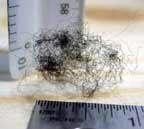
Starting at the bottom of the armature, place the fiber on a single branch of the armature. Try not to span multiple branches – each branch should get its own fiber.

Continue the process working your way from the inside and bottom of the armature to the outside and top. Continue until all desired branches have been covered with fiber.
Be sure that the fiber is not too dense. It is tempting to have a very ‘full’ looking tree at this point, but after the flock is applied it will be far too thick. Over a bag or in some other environment set up to catch the overshoot, spray the fiber with the hair spray until the spray beads up on the fiber. Be careful not to blow the fiber from the branches – try to spray in bursts instead of one constant stream.

Carefully and slowly sprinkle on the flock. Darker flock can be applied to the bottom side of the fiber then apply some lighter to the top of the tree to give it a bit of a highlight. It is very important not to overdue the flock.

You should still be able to see through the tree after the flock has been applied. Set the tree aside to dry and admire the creation!

Tap off the extra flock into a container. You can use a small pair of scissors to trim offsome of the excess fibers that are sticking out that are out of place.Give the tree another light coat of hairspray to help keep the flock in place. Doing three or four trees at a time can speed up the process a bit and look nice all out together.
This tree making tutorial for model train layouts is kindly supplied with permission of Vance Altman at http://www.fsmtrees.com/
Many model train enthusiasts make their own realistic miniature trees using a variety of materials including branches and twigs from real trees.
For others however, the option of purchasing ready-made trees is an attractive option. This is where someone like Vance Altman of fsmtrees.com (First in Scaled Miniature Trees) can help out.
This is what Vance has to say, “I supply a top quality sage brush tree armature from mother nature. These allow the modeler to add foliage for a prototype tree or use as is for a Great looking Oak tree for winter scenes or dead trees”.
Vance adds, “Our scaled Sagebrush tree armatures are stand-alone realistic oak trees or add tree foliage for superb model tree scenery. Some have knarly twisted trunks and knots that look like a real natural miniature tree. These Scaled Miniature Trees are natural pieces of real wood Armatures for model train layouts or dioramas”.
Vance supplies quality trees for all scales, N, HO, HOn30, S, O. with delicate realistic branching.
Membership groups to join in Maryland and Massachusetts include:
Maryland
Baltimore Society of Model Engineers Baltimore, Baltimore Area N-Trak Club (BANTRAK) Baltimore, Chesapeake & Allegheny Live Steamers Baltimore, Four County Society of Engineers, Frederick County Society of Model Engineers Frederick, Gaithersburg Model Railroad Society Gaithersburg, Hagerstown Model Railroad Museum Hagerstown, Maryland Central Model Railroad Club Rockville, Mason-Dixon Large Scale Railroad Society, Inc. Bel Air, Severna Park Model Railroad Club, Sykesville and Patapsco Railway, Inc. Sykesville, Triangle & Western Model RR Club Baltimore.
Massachusetts
Amherst Railway Society Inc. Warren, Bay State Society of Model Engineers Roslindale, Nashua Valley Railroad Association, Middlesex Central Railroad Club Westford, Northeast NTRAK Wilmington, North Shore Model Railroad Club Wakefield, Pepperell Siding Model RR Club Pepperell, South Shore Model Railroad Club Hingham, Tech Model Railroad Club of MIT, Waushakum Live Steamers, Worcester Model Railroaders Club.
Readers might like to share their ideas and experiences and have a go at answering this question posed by a fellow model railroading enthusiast.
“I would like to design a diarama showing an after rain shower with puddles, water stains on the rolling stock and wet ballest. But I am at a loss as what to use to similate hard packed soil between the ties on the sidings from years of wind and dust which would eventually cover the ballest. I was told not to use plaster as it would crack. Any suggestions?”
This model railroad blog is for all model railroading enthusiasts so please feel free to contribute and share your ideas with other readers.
Whether you are a beginner, or experienced railroader, all trains set starts with the basics of a train and some track. Well, there’s a little more to it than that.
A typical model train set would include: at least one locomotive, three, four or five freight cars or trucks… and enough straight tracks and curved tracks to make an oval layout. A basic model train set would also include a power pack (transformer) and some wiring that runs from the track and the power pack. Those are considered the basics of model train sets.
A starter model train set is a good entry point for a beginner to this exciting model railroading hobby.
Membership groups to join in Louisiana And Maine include:
Louisiana
Arklatex Modular Club, Baton Rouge Model Railroads Baton Rouge, Crescent City Model Railroad Club Metairie, Cresent City S-Gaugers, New Orleans, Midsouth Railroad Club Baton Rouge.
Maine
Eastern Maine Model Railroad Club Inc. East Orland, Great Falls Model Railroad Club Lewiston, Maine Track N-Scale modular group in Southern Maine, Portland Terminal Modular Model Railroad Club Scarborough.
Membership groups to join in Kansas And Kentucky include:
Kansas
Northeast Kansas Railroaders Atchison, Topeka Model Railroaders, Inc. Topeka, KS.
Kentucky
K&I Model Railroad Club, Radcliff Model Railroad Association Radcliff, The shOw Modular Model Railroad Club Bowling Green, KY.
When planning a small model railroad layout, it’s important that you know the limitations that a small space can impose.
Although the space available for the model railroad layout might limit the choice of scales, the major limitation is usually in the choice of themes that can be effectively modelled in the space available.
In most cases main line model railroad themes wouldn’t fit. Whereas, a limited space may be better allocated to creating industrial, branch line or tramway themes. A mainline theme may still be possible if the model railroad layout is scaled down.
Membership groups to join in Indiana and Iowa include:
Indiana
Big Train Engineers Model Railroad Club Of Indiana Indianapolis, Columbus Area Railroad Club Columbus, Indiana Live Steamers Martinsville, Naptown & White River Model Railroad Club Indianapolis, Purdue Railroad Club, Ridge Model Railroaders Griffith, St Joseph Valley Railroad Club Mishawaka, Union Station Railroaders Association Indianapolis, IN.
Iowa
Cedar Valley “O” Scale Modelers Cedar Falls, Central Iowa Railroad Club Des Moines, Iowa State Railroad Club Ames, IA.
Heat and arcing can cause long-term wear and result in a worn commutator. A poorly performing train motor can cause higher than normal transformer voltages, hence the arcing. Greater resistance from a poor performing motor requires higher transformer voltages to operate a model train.
A commutator can also, over time, be damaged by using too much lubricants. The oil gets vaporized and “baked” to the commutator surface which lowers performance.
This request for help is posted by a keen model railroader (Glen) who is hoping one of the readers of blog can contribute some ideas. If you think you can offer some suggestions to help Glen then please post them on this blog.
Here is what Glen has to say –
“I would like help from a reader. My situation is this: I’m 87 years old and no longer active. I like to draw home floor plans on my computer. My latest floor plans include a full room above a four car garage. Very large!!! The room is about 15′ X 60′. I decided I was going to use the entire room for an HO guage layout.
Many years ago I was very active in several HO clubs and I have had my own HO and N guage layouts. My problem is—sizing/dimensioning/or whatever you call it. Everything I put in my home drawings is to scale, i.e., pianos, beds, stoves, sinks, etc. all to the same scale as the home.
I want my HO to be to scale also but I have not been able to locate any documents on the internet that give me what I want. I need physical dimensions of engines (modern diesels, as well as old timers), cars (flat cars, box cars, passenger cars, etc.).
I also need track layout dimensions, i.e. how far apart are two high speed parallel tracks both in straight and curved areas. Also in passenger stations and in freight yards. What are turnout sizes? Turnout radaii? etc. “
Glen goes on to say –
“I have read most of the Model Train Help ebook I downloaded yesterday and I very much like what I read.”
Membership groups to join in Idaho And Illinois include:
Idaho –
Eagle Rock Railroad Historical Society Idaho Falls, Pocatello Model Railroad & Historical Society Pocatello, Rocky Mountain Hi-Railers.
Illinois –
Chicago Big Train Operators Chicago – Illinois, Chicagoland Area Garden Railway Society Chicago, Chicagoland Lionel Railroad Club Chicago, Elmhurst Model Railroad Club Elmhurst, Fox Valley O Scalers Elgin, Illinois Live Steamers, Illinois Tech Model Railroad Club Chicago, Lake Shore Model Railroad Association Chicago, Little “Q” Model Railroad Club Aurora, Midwest ‘N’ Pioneer Model Railroad Club, Mississippi Valley N Scalers St. Louis, Northwest N-Trak An N Scale, Northwest Trainmasters Model Railroad Club, Oak Park Society of Model Engineers (OPSME) Oak Park, Salt Creek Model Railroad Club West Chicago, Stateline S Gaugers Rockford, Will County Model railroad association Joliet, IL.
Here is a list of groups in Delaware, Georgia and Hawaii –
Delaware: Nordel Model Railroad Club
Georgia: Flint River Model Railroad Club Albany, Metro Atlanta N-Scalers Atlanta, Middle Georgia Model Railroad Club Warner Robins, North Georgia Modurail Atlanta, North Georgia LEGO Train Club, Northwest Georgia NTRAK Kennesaw, GA.
Hawaii: Oahu Model Railroad Society.
For details on individual groups visit http://www.model-railroad-resources.com