model trains
Everything on model trains, model railroads, model railways, locomotives, model train layouts, scenery, wiring, DCC and more. Enjoy the world's best hobby... model railroading!

Trackwork, Weighting, and Setup Tips for Smooth, Reliable Model Railroad Operation
If derailments are still sneaking up on your model railroad, don’t worry… you’re not alone. Even well-built layouts can suffer from annoying tip-offs and wheel lifts if a few key details are overlooked. The good news is that most derailments are caused by small, fixable issues, especially around car weight, track alignment, and transitions.
In Part 1, we covered maintenance basics like wheel gauge, couplers, and cleanliness. In this second installment, we’ll focus on trackwork and rolling stock setup, which play a huge role in keeping your HO, OO, or N scale trains running smoothly.
Below are Tips 13–23 in the complete series of 29 derailment-prevention techniques. (The final tips continue in Part 3.)
Model trains are light by nature, which means they’re far less forgiving than the real thing. Slight bumps, uneven joins, or poorly balanced cars can easily push wheels off the rails. Getting the fundamentals right here will dramatically improve reliability across your entire layout.
Rolling stock that’s too light tends to wobble, bounce, or derail… especially through turnouts and curves. Use NMRA (or local equivalent) recommended weights as a guideline to keep cars stable and predictable.
If a car feels “floaty” or tips easily when handled, it probably needs more weight. Extra mass helps wheels stay planted on the rails and improves tracking through curves and minor imperfections.
Where you place the weight matters just as much as how much you add. Position it as low and central as possible to lower the center of gravity. This reduces rocking and side-to-side sway, especially on curves.
Uneven weight distribution can cause a car to lean, overload one wheelset, and increase derailment risk. Try to balance weight left-to-right and front-to-back so the car rides flat and true.
Sharp curves are a common trouble spot, particularly for long cars or lightweight rolling stock. If wheels lift or cars lean excessively, your curve radius may be too tight. Added weight can help, but redesigning the curve or using shorter cars may be the better solution.
Even a tiny misalignment at rail joins can grab a wheel flange. Run your fingertip across joints… if you can feel a bump, your trains will feel it too. Light sanding or filing can eliminate many hidden derailment causes.
Baseboards and benchwork aren’t always perfectly flat, and small dips or humps can throw cars off balance. Use a small spirit level and check trouble spots regularly, especially near joints and turnouts.
Oversized gaps between rails can cause wheels to drop, particularly in smaller scales like N. Keep gaps tight and uniform while still allowing for temperature expansion. Alignment is just as important as gap size.
Soldered rail joints are far less likely to shift over time. Unsoldered joins can slowly open up due to temperature changes or layout movement, leading to electrical issues and derailments. Soldering improves both mechanical strength and electrical reliability.
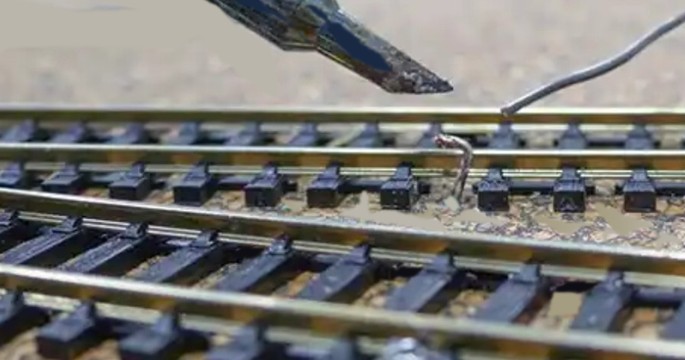
After soldering, inspect the rail carefully. Any bumps, blobs, or sharp edges can snag wheel flanges or coupler trip pins. A fine file can quickly smooth these areas… just be careful not to scratch the railhead.
Sudden changes in direction or height… such as from straight to curve or one baseboard to another… are derailment magnets. Transitions should be gradual and flowing. Always test with rolling stock before ballasting or final wiring.
One of the best habits you can develop is testing constantly. Roll cars by hand, push long trains slowly through problem areas, and watch closely for wobble or hesitation. It’s far easier to fix issues before scenery and ballast lock everything in place.
The final part of this series will cover advanced derailment prevention tips, including turnout tuning, grades, train length, and operational practices that keep trains running reliably during long sessions.
Smooth-running model trains don’t happen by accident. They’re the result of careful weighting, solid trackwork, and attention to small details that many hobbyists overlook. Dial these in, and you’ll spend far less time rerailing cars—and far more time enjoying realistic, frustration-free operation.
Your trains deserve it.
Step into a world where imagination meets craftsmanship, and tiny trains tell big stories. Whether you’re a curious beginner or someone rediscovering a childhood passion, model railroading offers a hands-on adventure that’s as rewarding as it is fascinating. This guide will help you explore the many layers of this captivating hobby, and maybe even inspire your first layout!
Why Choose Model Railroading?
Often called “the world’s greatest hobby,” model railroading earns its title by blending a wide range of interests and skills. It’s not just about trains… it’s about building entire worlds in miniature, solving technical puzzles, and expressing your creativity in ways that are both personal and shareable.
Ask a few enthusiasts what draws them in, and you’ll hear answers as varied as the railroads themselves:
A Hobby That Has It All
Model railroading touches on:
It’s a hobby that welcomes all ages and backgrounds. Whether you’re 9 or 90, there’s joy to be found in laying track, running trains, and watching your miniature world come to life.
From Steam to Silicon: A Journey Through Time
Exploring model railroading is like stepping into a time machine. You can recreate the golden age of steam, experiment with futuristic bullet trains, or blend eras to suit your imagination. As real-world rail technology evolves, model railroading keeps pace… offering new tools, materials, and digital systems to enhance your layouts.
So, bring your sense of wonder. This hobby isn’t just about trains… it’s about the stories they carry, the worlds they connect, and the joy of building something truly your own.
If you want some color plans to make your own tunnel portals go here
https://www.modelbuildings.org/walls-tunnels-bridges
Download your Free Catalog here http://www.modelbuildings.org/Free-Catalog.html
Ken writes:
“Greetings. I have somewhat of an elaborate HO layout (for a residential layout) with over 30 commercial businesses, half dozen residential houses, a campground and multiple streetlights. They are all powered by 2 adjustable 3 amp 3-24 Volt power supplies on 2 buses under my layout. Most of the lights are LED’s that draw around 20 milliamperes each, but some of the “grain of wheat” incandescent’s go up to 70 milliamperes. I figured I could safely wire up about 40 – 50 lights on each power supply, because I’m not even close to 50% capacity. But, one of my power supplies started humming yesterday and it felt much warmer than the other one. I don’t know if I got a bad unit or not, but I’d like to upgrade to a more heavy duty power source to give me more head-room and security knowing I’m under my load limits. Does anyone have any suggestions on what kind of power supply I should be looking for? I really like to be able to dial them back to around 9-10 volts in the evening so the lights are more pleasant around the track. Thanks in advance for your responses.”
If you can your thoughts with Ken, then I’m sure he would appreciate any advice he can get. Simple use the comments link below.