Everything on model trains, model railroads, model railways, locomotives, model train layouts, scenery, wiring, DCC and more. Enjoy the world's best hobby... model railroading!
12 Creative Ways to Transform a Simple Oval Into an Exciting Model Railroad Layout
Tired of watching your train run in endless circles? A basic oval track is a fantastic starting point for any model railroad, but it doesn’t have to stay basic. With a few smart track plan tweaks, you can turn a simple loop into a layout that offers realistic operation, visual interest, and hours of engaging run time.
Whether you’re building in HO, OO, or N scale, these creative oval track plan ideas will help you get more enjoyment out of your existing space… without needing a complete rebuild.
Let’s explore how to make a standard oval layout far more fun to operate.
Why Improve a Basic Oval Layout?
Oval track plans are popular because they’re easy to build and allow continuous running. But after a while, trains circling endlessly can feel repetitive.
By adding variation… such as elevation, branches, sidings, or operational features… you can:
- Increase realism
- Add switching opportunities
- Create the illusion of distance
- Run multiple trains more creatively
- Make your layout feel larger
Here are 12 proven ways to upgrade your model train oval layout.
1. Dog Bone Track Plan
The dog bone layout stretches your oval into a longer mainline with loops at each end. It still allows continuous running, but visually feels more like a railroad traveling between destinations.
The longer straight sections give you space for towns, industries, and scenic features. It’s one of the easiest and most effective oval upgrades.
2. Folded Dog Bone Layout
Take the dog bone concept and fold it over itself. By crossing one side over or under the other, you create elevation and depth.
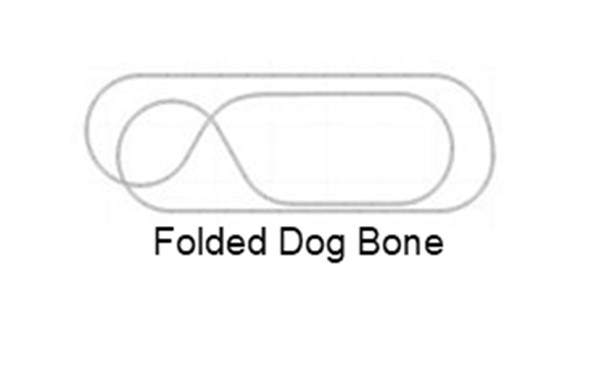
This design adds visual complexity and makes it appear as though trains are traveling much farther than they actually are. Elevation changes also enhance realism and photography.
3. Figure 8 Inside an Oval
Adding a figure 8 within your oval introduces directional changes and operational interest. The center crossing becomes a focal point… especially if running two trains.
For smoother operation, consider an overpass rather than a flat crossing (see idea #5).
4. Twice-Around Track Plan
A twice-around layout allows the train to circle the layout twice at different elevations before reconnecting.
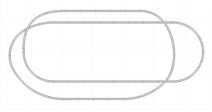
By using a tunnel, bridge, or hidden section, you create the illusion of a long mainline journey in a small footprint. This design dramatically increases run time without expanding your space.
5. Over-Under Figure 8
Instead of a flat crossing, build an overpass where one track climbs above the other. This eliminates collision risk and adds scenic interest.
Watching a train pass over itself adds movement and drama to the layout.
6. Out-and-Back Branch Line
Add a branch line that leaves the oval, travels to a destination, loops around, and returns.
This creates a mini “journey” within your layout. You can place an industry, yard, or small town at the turnaround point to give trains a purpose.
7. Point-to-Point with Hidden Return Loop
Want the realism of point-to-point operation but still enjoy continuous running?
Hide a return loop behind a backdrop or under the layout. Trains disappear at one end and later reappear from the opposite direction, creating the illusion of long-distance travel.
8. Add a Scenic Divider
Sometimes the best upgrade isn’t track… it’s scenery.
Install a hill, tree line, or building row down the center of your oval. This visually separates the layout into two scenes, making it feel like trains are traveling between different regions rather than circling one continuous loop.
9. Install a Reverse Loop
A reversing loop inside your oval allows trains to change direction. This adds operational flexibility and realism, especially for passenger or commuter services.
If using DC control, proper wiring will be required. DCC makes reverse loops easier to manage.
10. Add Switching Sidings and Spurs
Even a simple oval becomes engaging when you introduce switching operations.
Add industrial spurs, freight sidings, or a small yard. Now you’re not just watching trains… you’re building consists, spotting cars, and running a working railroad.
Switching adds a whole new layer of operational fun.
11. Extend a Purposeful Branch Line
Attach a branch line that leads to a specific industry such as:
- A mine
- A logging camp
- A port
- A grain elevator
This gives your layout a story and operational reason for different train types. It also justifies varied rolling stock and locomotive use.
12. End-to-End Shunting Layout (Highly Engaging for Small Spaces)
If you want maximum interaction in a small space, consider converting part… or all… of your oval into an end-to-end shunting layout.
Instead of continuous running, trains operate between two terminal points. The focus shifts from watching trains circle to actively managing movements.
Why an End-to-End Shunting Layout Is So Engaging
- You perform realistic switching operations
- Every train movement has a purpose
- Locomotives must run around cars
- You control speed, direction, and sequencing
You can design one end as a small yard and the other as an industrial district. Add multiple sidings and create switching challenges for yourself.
Even on a compact shelf layout, this approach provides hours of operational enjoyment. Many experienced model railroaders find shunting layouts more rewarding than continuous loops because they simulate real railroad work.
And here’s the best part… you can still incorporate a hidden return loop if you want occasional continuous running.
Final Thoughts: Your Oval Is Just the Beginning
A simple oval track layout doesn’t have to stay simple. With thoughtful additions like elevation changes, branch lines, reverse loops, scenic dividers, or an end-to-end shunting section, you can transform it into a layout that feels dynamic and purposeful.
You don’t need more space… you just need smarter design.
By upgrading your oval with these creative track ideas, your model railroad will feel larger, more realistic, and far more enjoyable to operate.
If you’re ready to move beyond trains running in circles, start with one of these ideas and build from there. Your layout… and your operating sessions… will never feel the same again.
Subscribe
Login
0 Comments
Oldest
SUBMIT YOUR QUESTION