Everything on model trains, model railroads, model railways, locomotives, model train layouts, scenery, wiring, DCC and more. Enjoy the world's best hobby... model railroading!
Creative Model Railroad Ideas: How to Use HO Scale, OO, and N Scale Shipping Containers for Realistic Scenes
Shipping containers might be small, but on a model railroad they can do some seriously heavy lifting. Whether you model in HO scale, OO gauge, or N scale, containers are among the most flexible scenic items you can add to a layout. They instantly suggest modern freight activity, add visual mass without clutter, and help tell a believable story… even in tight spaces.
If you already have a few containers tucked away, or you’re considering adding them, here are several smart and practical ways to make them work harder on your model railroad.
- Add Instant Purpose with an Intermodal Yard
An intermodal yard is the most natural home for shipping containers. A short siding with a small stack of containers immediately explains why trains stop there. You don’t need a huge yard either… just stacking containers two or three high near a crane, forklift, or reach stacker creates the impression of a busy freight hub. Even a compact scene can feel active and modern with the right container placement.
You can download all 40 scale model shipping container plans at
https://www.modelbuildings.org/shipping-containers
- Repurpose Containers into Buildings
In the real world, containers are often converted into offices, workshops, cafés, storage sheds, and site huts. The same idea works beautifully on a layout. By adding doors, windows, signage, or rooftop details, you can turn a container into a temporary site office or urban pop-up business. This is a great way to add unique structures without needing full-size buildings.
- Use Containers as Scenic Breaks and View Blockers
Shipping containers are excellent at solving awkward layout transitions. Stacks of containers placed along a road, fence line, or track can hide backdrop seams, mask tight curves, or visually separate scenes. Because containers naturally appear in rows or clusters, they don’t look like “fillers”… they look intentional.
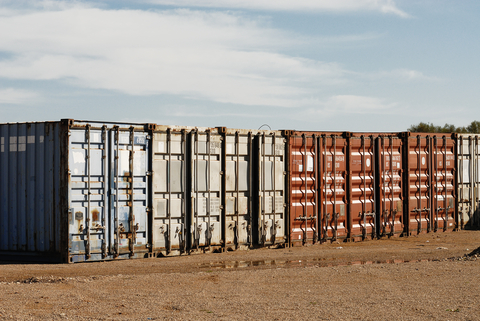
- Create a Container Storage Yard
A fenced container lot adds texture and storytelling to an industrial area. Containers can be arranged neatly in rows or scattered slightly out of alignment for a more weathered, hard-working look. Add weeds, oil stains, puddles, pallets, and discarded junk, and the scene quickly feels lived-in and believable.
- Load Containers onto Trains and Trucks
Containers shine when they’re actually doing their job—moving freight. Loading them onto flatcars, spine cars, or well cars instantly adds realism to your rolling stock. They also look great on truck trailers or parked on chassis, reinforcing the connection between rail and road transport.
- Strengthen Harbor and Dock Scenes
If your layout includes a port, dock, or waterfront industry, containers are almost essential. Even a small wharf scene benefits from a few containers scattered near cranes or stacked beside a pier. They visually explain cargo movement and help make the area feel busy without needing a large footprint.
- Add Realism Through Weathering
Brand-new containers have their place, but weathering brings them to life. Rust streaks, faded paint, dents, scratches, and graffiti make containers look used and authentic. Mixing clean containers with heavily weathered ones adds contrast and realism—just like the real world.
- Enhance Scale and Visual Balance
Containers are excellent scale references. On smaller layouts, a handful of containers can suggest a much larger operation just beyond the modeled area. On larger layouts, they fill space naturally without overpowering the scene. Regardless of scale, they help ground your layout visually.
In a nutshell…
Shipping containers are far more than simple freight loads. They’re compact, adaptable, and incredibly effective at adding realism, structure, and story to a model railroad. Whether they’re stacked in a yard, converted into buildings, or rolling past on a train, containers bring modern railroading to life with very little effort.
If you enjoy hands-on modeling, you can even construct highly detailed, photo-realistic scale shipping containers featuring rust, dents, refrigeration units, locking bars, and authentic company logos. With downloadable designs, you can build multiple containers of each type and populate your layout with dozens of realistic variations—perfect for trains, yards, and industrial scenes alike.
Subscribe
Login
0 Comments
Oldest
SUBMIT YOUR QUESTION