DCC
Everything on model trains, model railroads, model railways, locomotives, model train layouts, scenery, wiring, DCC and more. Enjoy the world's best hobby... model railroading!

Steve sent in this question for fellow train buffs:
“My son recently purchased what he was told were HO DCC locomotives. One is a Bachmann that is DCC equipped and is working fine. The other is an Atlas FM Trainmaster that we can’t seem to program to run. I tried loco 3 setting as well as the road number. The lights will come on, but it sounds like a dial-up modem. So my question is, did Atlas offer this locomotive in DC? I looked for information on the web, but only found information on it in DCC with sound. Any help would be appreciated.”
Ray with HOn3 asks:
“I have wired my new layout based on lots of advice I could find. I have one track that is 12mm gauge and a separate track on same layout that is 16mm gauge. So far neither loco will run. Should I somehow run 2 independent bus wires? Should I get a booster? I am trying to use a basic NCE unit. Hopeful.”
This article kindly contributed by club member Jim P.
If you grew up with a DC system, then you will be familiar with the term “Blocks.” Having blocks on a DC model train layout is basically the process of separating the railroad trackage into sections, so as to control one locomotive independently of another loco in a neighboring block.
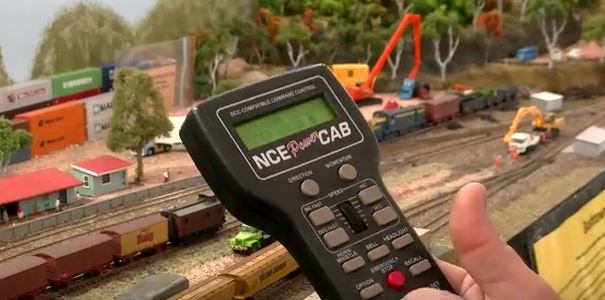
If you think of how real railroads operate, they typically divide mainlines into blocks, which are assigned signals to keep railroad traffic on the right track and at a safe distance or separation.
The question that often gets asked is, “Will I still require blocks with DCC?”
In theory you won’t need blocks as in the conventional sense. However, with DCC systems, blocks are regularly utilized to operate signal systems as well as to isolate problems. Blocks are necessary when using block detection, or polarity reversing sections i.e. wyes, turntables, or balloon tracks which are like a big loop tracks with a single switch to enter and exit. It’s worth noting that a reversing section will need to be at the very least the length of the longest train. This is especially so, if the train has passenger cars, or a lighted caboose.
Read more on DCC wiring techniques here…
Blocks for that purpose might be sufficient on some small model railroads, but incorporating more blocks would be beneficial on bigger layouts. Having additional blocks would certainly prove an asset on a layout operated by more than one person, or for one that is larger than would fit onto a standard sheet of plywood. Take it from me… it is so much easier to troubleshoot and isolate problems with blocks in place.
That said; a typical DCC layout won’t usually require as many blocks as would have been necessary on a conventional DC layout, but having some blocks will at least make it easier to locate and fix problem that might otherwise be difficult to pin down. Besides, without having blocks it might be necessary to shut down the entire DCC layout if there’s a short… and that not something any of us would want to do.
Barry poses this question for readers:
“I am having an issue with trying to program HO locos on my DCC system. I am using a Hornby ‘Select’ controller. I understand that cleaning of track and locomotive wheels is very important to ensure a signal can get through to control unit. I have cleaned the track with a cleaning rubber block and wiped the wheels using a cotton bud with a medical alcohol base. What else should I be checking, cleaning or other actions to the message through?”
John asks readers about DC or DCC:
“I think I posted a while back. I am getting into model railroading (My age 60 plus years) after being out from my childhood. I have bought some DCC on board locomotives on EBay. I get mixed opinions from the only hobby shop in this area. Some say go with DC only as it is much simpler, others say go with DCC. Need opinions since I am getting back into this hobby. Am looking at setting up a 4ft x 8ft with 3 different locomotives. Thanks for any input/advice.
David asks readers:
“I’m trying to hook up HO turnout signals with atlas #200 snap relay and Tomar two light vertical signal. Is there difference way from D.C. to Dcc?”
Richards questions readers on this:
“I have the older HO Walthers 130′ turntable which is not DCC ready. Do I need to make any modifications to use it on my DCC layout? I am not concerned with the control for the turntable as that can still run off of aux power, but I don’t know if there is common wiring between the motor control for the turntable and the bridge track itself. Any help would be appreciated. Thanks!”
Peter models HO and asks readers:
“What do people think of there DCC electronics for train detection and lights?”
Hayden asks readers:
“I have an HO loco fitted with a DCC chip that I couldn’t get to operate on a friends DC setup. Is this normal? Could I damage a DCC loco trying to run it on DC?”
Ian models OO gauge (similar to HO scale) and asks readers:
“I have converted my circuit layout to DCC and sometimes trains stall. Usually a certain train will pause in a certain place on the layout but not all the time and not all my trains do it. One train pauses not far away from the main feed. Some pause on points, but I have clips fitted to create continuation of current. If anyone can advise on how to eliminate this, I would be grateful.”
Robert P asks:
“Digitrax offered a wiring harness, DH123AT to convert HO DC locomotives to DCC. It has been discontinued. Does another manufacturer offer a similar product?”
Art models N scale and has this question for readers:
“I have watched many seemingly simple videos on DCC wiring and it seems to me that the only real difference from DC is the installation of a bus line and feeders at intermittent spots along the layout BUT the bus location line still has to be connected to the main power source, right? So why does running DCC necessitate installation of a the bus and feeders if ultimately the power is coming from th same main source? Sorry if this is a stupid question. I would love to go DCC to get all the sounds, horns, engines, etc but it just seems like an awful lot of work! I am using Kato unitrack by the way. Thanks in advance for any help!”
Ricky asks readers:
“I have a number of older DC engines and want to operate all my trains together DC (my current locos) and DCC (locos I will purchase). Can I operate them on the same layout? How practical/difficult is it?”
Troy asks readers:
“I’m changing my N scale layout to DCC and have heard good things about MRC control systems. I’m not sure exactly what I should be looking for in a system, and wondered if there is anything better? How easy is it to set up and operate? Will it give me enough different functions in the future? Haven’t thought much about what switches or signals I’ll need yet, so perhaps I should do that first?”
Travis asks readers:
“Can someone explain about a CV value and how do I go about altering it?”
Roger asks readers:
“Greetings from the Adelaide Hills. South Australia. My club uses the NCE control units. Is it possible for someone to give us a round down on the different DCC Decoders. I know you get what you pay for, however we live in a real world and that means budget restrains.”
Joseph is into O scale and asks:
“I’m just starting out. I bought a proto 3 diesel and a tiu so everything I’ve read in the tiu manual says proto 2. Is this generic for proto 2 and proto3?”