Tips & Resources
Everything on model trains, model railroads, model railways, locomotives, model train layouts, scenery, wiring, DCC and more. Enjoy the world's best hobby... model railroading!

The arrival yard is where arriving trains drop off the cars of their train. The cars are then moved to the classification yard, being switched back and forth as necessary to get the right cars onto the right trains. The trains are then built out and moved to the departure yard. After getting a new caboose and locomotive, they then proceed to their next destination.
Although train whistles can be annoying if you live or work near a railway track, they are an important safety device essential for warning of potential dangers.
Four “toots” is the most common train whistle you’ll hear. The four “toots” consists of two longs, a short and a long whistle. This whistle sequence is the one used when a train is crossing a road where cars or people might be present.
“Whistle boards”, commonly an “X” on a small plate on a post, indicate where the engineer is to begin to sound this signal. The law (rule) is that this signal is to be commenced a quarter mile in advance, or 20 seconds in advance of occupying the crossing or other structure.
As well as being a warning device, whistles also serve as a communication tool between train staff. Various combinations of whistles are used by the engineer to tell the conductor or brakeman of various conditions.
The train whistle is also used as a protection device when approaching tunnels and bridges. The engineer is required to sound the whistle where there are impaired side clearances.
A succession of short “toots” is sounded in an emergency such as people, vehicles or livestock on the track. Other trains hearing this signal must stop until it is safe to proceed.
The way the train engineer sounds the wistle has different meanings:
 The flywheels on the locomotive are another important feature. Flywheels are solid-metal cylinders mounted in line with the motor. Flywheels at one or both ends of the locomotive motor ensure a smooth take-off by slowing down the initial rotation of the motor. Flywheels help achieve a smoother stop when the electricity is turned off. They also help the locomotive operate more smoothly and negotiate dirty track better.
 When buying a new or used locomotive always feel its weight. Locomotive weight is important to ensure that the wheels connect and stay firmly on the track. This is achieved through solid metal frames.
For more model railroad information on locomotive wheels and flywheels have a look at the Model Train Help Ebook.
The Aztec Annihilator is a system for cleaning dirty track (HO). The Annihilator was engineered for ease of use and minimal maintenance. Aztec are the first to admit that the car was not built to look utilitarian but instead to be a functional piece of rolling stock.
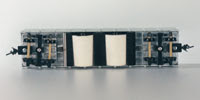
The custom painted 40ft gondola is gray with black “M.W.” and dimi data. No road or end numbers are provided. The modeler can apply decals (not included) in the railroad of his/her choice. To finish off the car the hobbyist might want to cover the mechanism with a piece of cloth (not supplied) to simulate a tarp.
The Aztec Annihilator can be run in a train and go unnoticed without hitting scenery or derailing.
A hard black anodized aluminum chassis holding two free rolling canvas rollers at a slight angle to the railhead, a magnet and a fluid reservoir (1/2 oz. capacity) is housed in a 40 ft gondola equipped with Kadee® couplers.
There is a valve to regulate the amount of cleaning fluid dispensed to the front roller. The rear roller is run dry and mops up loosened grime. A clear plastic lid covers the reservoir allowing you to see when it is running out of fluid. Turn valve about one quarter turn for ten seconds or so. Turn off and run for 10 to 15 minutes (or change times to suit).
This stealthy lightweight tips the scales at a mere 7-3/4 ounces soaking wet. The Aztec Annihilator will clean in either direction but works best with the magnet to the rear.

Flexi track is a popular option for many model railroaders but sometimes it needs to be cut to fit the layout.


Here is a quick model railroading tip that you might want to try for creating realistic looking concrete.
As soon as you paint the base color of your concrete, lightly dust some baking soda onto the wet paint. This gives the surface some additional texture and the weathering will have more depth.
Use Floquil’s Antique White with a drop or two of Box Car Red for the base followed by dry brushing rust streaks as needed from attached iron parts, earth colours at the ground level, grimy streaks following water down the wall, and a bit of white where calcium would leach from cracks.
Simple but effective.
On a model railroad layout both DC and DCC refer to the method of powering and controlling the movement of the train locomotive. DC stands for Directional Current. DCC stands for Digital Command Control.
The Advantages Of DCC Over DC
DCC control has almost done away with the need for isolation sections. With DCC you can have a single siding full of locomotives and only the one you want to move will move.
In the past to run more than one train you needed a second controller and a second loop of track. If you wanted to cross from one loop to the other it involved moving the first train in to an area where it could be isolated. The train was usually moved to a siding before a second train could be moved on the first trains loop. To then move the first train on to the second trains loop you would have to put the second train in an isolated section and then move the first train out and on to the second loop.
Every festive season, thousands of families bring out the old train set to run around the Christmas tree, or to just entertain young and old alike. Model trains (especially G scale,
O scale and O27 scale model trains) are part of the Christmas tradition for many households.
To quickly explain – G scale are 1/32 to 1/20 scale model trains. G track has two rails, and its gauge is 1 3/4 inches. O and O27 are 1/48 scale model trains, with a gauge of 1¼ inches.
O and O27 track has three rails. Lionel is probably the most well-known brand of O and O27 scale model trains. Other popular O and O27 manufacturers include Lionel, Marx, MTH, K-Line and Williams.
Here are 10 simple tips to make the Christmas tree and the model train experience a little safer over the holiday period:
1. The first thing to remember is that a model train running around the Christmas tree is likely to attract the attention and interest of people who are not used to handling model trains. This is especially true of young children who could be tempted to pick up the train, knock the track, or play with the transformer. Also, be aware that pets may take an interest in the Christmas model train set too! Be safety wise.
2. There is nothing like the look, real and smell of a real Christmas tree, but do remember to water it daily. A moist tree is a safe tree. When it becomes dry, it is time to remove it.
It pays to think of fire safety, since so many decorations involve light and electricity. Where there’s electricity and light, there’s heat.
3. Use a fire -retardant tree skirt around the base of the tree. The cheap cotton tree skirts are not safe. Spend a few extra dollars for a better tree skirt – and the better ones last year after year.
4. Keep metal away from train tracks. Be especially careful if you use tinsel. Tinsel can cause a short circuit if it falls across the tracks. (Tinsel can also be harmful to pets and small children).
5. Many Christmas train sets last for years and years and are only used during the festive season. This is why it is important to check the transformer’s wall socket wire and plug. If it is frayed or worn, have it serviced. The same goes for corrosion. Rust means it’s time for refurbishing or replacement. Make sure your transformer has a built-in circuit breaker for added safety. If not, replace it.
6. Check all wires for splits, cracks and wear. Consider replacing track and accessory wire with 18-gauge stranded wire from any electronic or electrical supplier. The shop staff should be able to provide the advice needed.
7. Sparking happens when contact rollers and wheels hit gaps or rough spots in track. If the track on the Christmas train set is old, replace it. It won’t cost much to replace track.
8. Lubricate gears on locomotives with lubricant, and oil axles. Make sure to oil the center rail contact roller, if you use O gauge.
9. For added safety, get a fire -retardant material (such as a fire retardant vinyl) and cut into strips to place under track. This will catch sparks.
10. Never leave trains running unattended.
A reader (Phil) has kindly offered this summary of locomtive numbering:
The number on a locomotive refers to the locomotive’s wheel arrangement. If it is all numbers, the engine is a steam locomotive. The first number will be the number of wheels on the leading or “pilot” truck, if any (or 0 if it has none); the last number is the number of wheels on the trailing truck (again, 0 if it has none). The middle number or pair of numbers is the number of driving wheels, that is, the wheels actually powered by the action of the pistons; these are connected by side rods so they work together. Tender wheels are not counted unless they are actually driving wheels, which would be an unusual situation; tender “boosters” are not considered driving wheels.
If a “T” follows the numbers, then it is a “tank” engine, which has no tender.This is the “Whyte” system of classification. (In Europe, particularly France, axles are counted instead of wheels, but European models intended for sale in the U.S. will use the Whyte system.) A “2-8-0”, then, has a pilot truck with two wheels, eight driving wheels and no trailing truck. This type is called a “Consolidation” or occasionally a “Pershing” (this refers to certain groups of Consolidations that were shipped to France during World War I and later given to the French).
A 2-8-8-4 has a pilot truck of two wheels, two sets of eight driving wheels each, and a four-wheel trailig truck. This is a “Yellowstone,” an articulated engine.There are a few exceptions, notably geared locomotives and Beyer-Garratts, but I won’t get into that.
If instead of numbers there are letters, or both letters and numbers, the engine is either a diesel or an electric. The letters designate powered axles, so a typical EMD diesel with four powered axles in two trucks would be a B-B. Unpowered axles receive numbers, so an A1A truck means there are two powered axles separated by an unpowered axle.
The Fairbanks Morse passenger C-liner, for instance, had a B-A1A arrangement. (Don’t confuse this with sets of diesel cab units, which usually do not use hyphens between the letters). Designations like Bo-Bo or Co-Co are European, and are the same as B-B and C-C. Unpowered leading and trailing trucks are handled the same way, with the number of axles counted, as for instance 2-C+C-2.
Generally, the more driving wheels an engine has the more powerful it is, and for steam locomotives, the more wheels in the trailing truck, the larger the firebox.
There is no “best” wheel arrangement; the railroad’s own operating requirements determined that, and also wheel arrangements evolved over time. For much of the 19th century the 4-4-0 was so common that it was known variously as the “American” or “American Standard”, sometimes just “Standard” (also “Eight Wheeler”). It was a dual-service engine, hauling both passendgers and freight. Later the 4-6-0 (Ten Wheeler), 2-6-0 (Mogul) and 2-8-0 also saw much dual service. As fireboxes grew larger, the 2-8-2 (Mikado) was introduced: it became a standard freight engine all over the country. The 4-4-2 (Atlantic) and 4-6-2 (Pacific), usually equipped with large driving wheels, were common passenger engines, especially the latter. Engines with four-wheel trailing trucks, to support still larger fireboxes, the 2-8-4 (Berkshire), 4-6-4 (Hudson) and 4-8-4 (Northern and other names) were introduced shortly before diesels and were again fast, dual-purpose engines.
The articulated types (2-6-6-2, 2-8-8-2, etc.) hauled long, heavy freight trains for the most part, though some also were used in passenger service: Southern Pacific 4-8-8-2 cab-forwards, for instance, were dual-service.
Engines with ten or twelve driving wheels were generally used for freight. Except in the earliest years (before the Civil War), engines without either pilot or trailing trucks were switchers.
There are numerous introductory books on railroads and model railroading that go into more detail on these matters.
If you are modeling a particular railroad, be aware that not every type was used by a railroad. The Kansas City Southern, for instance, had many Consolidations but no Mikados.For your own modeling, if your layout is small, with tighter curves, pick smaller engines with fewer driving wheels (shorter wheelbases, you see) to avoid excessive overhang and even derailments.I hope this has been of some help.
Here is an interesting suggestion from a keen model railroading enthusiast…
Hello Robert, I have throughly enjoyed every page of your Model Train Help and look forward to reading your next edition. The only topic I was wondering about was the use of a mirror placed at the end of a shunting yard used to make it look double in size as the late John Allen used so effectively on the old Gore & Daphetid. Thought you might be able to give this scenic trick some room in your next edition. Thanks for the great product, Lynn
Before getting started in the actual building of a model railroad layout, the most important detail to consider is what scale you are going to model. This is critical because the scale will determine how big your model railroad layout will be. SCALE simply means the ratio of the model compared to the real life object (prototype).
As an example, 1:87 scale means that the model is 1/87 as large as the prototype, or the real life object. Therefore 1 inch on the scale model represents 87 inches on the prototype. Your model railroad layout will look much more realistic if you keep the components on your model in the same scale. Sounds simple enough, but a trap that beginners to the hobby often fall into.
“We don’t stop playing because we grow old, we grow old because we stop playing”George Bernard Shaw
You don’t have to be a millionaire, or a technical genius, or a brilliant artist to be part of the wonderful world of model railroading. The single most important skill you will require for “the world’s greatest hobby” is patience. If you have plenty of patience, then you will thrive in this fascinating environment of model railroading.
Learn how the complex model railroading tasks can be made easy, quick, cheap and painless. Also, get a list of valuable model train resources… and all the manufacturer contact information you need. Learn model railroad tricks of the trade revealed and have the technical model railroading jargon demystified. http://www.model-train-help.com
Six railroad terms complete this series:
Undergrade Bridge
Any point where the trackage crosses above any stream, railroad, road, or pedestrian right of way. Abbreviated as UG.
Undesired Emergency (Also known as “Dynamiter” or “Kicker”.)
An undesired emergency application of the air brake system on a train.
Waybill
A document for handling and accounting for a shipment of freight.
Way Car
A box car from which LCL (Less than carload lot) shipments are loaded and unloaded at various towns.
Yard
A system of tracks used for the making up of trains and the storing of cars.
Yard Limits
The trackage between Yard Limit signs as designated in the Timetable. Restricted Speeds apply within Yard Limits.
Model train clubs are a great source of model railroading news, information and ideas sharing.
Staff at your model railroad hobby store probably have contacts at the local model train club and may be able to put you in touch with the model train club members. Most model railroading enthusiasts are more than helpful and gladly give you the benefit of their experience and introduce you to others with a similar interest in the model railroading hobby. This way, you can learn insider secrets and model railroading tips and tricks.
Don’t think that everyone in a model train club is experienced. Most model train clubs enjoy a mix of long-time experienced railroaders and new model railroad club members. It is a good place to learn, because most model train clubs encourage the exchange of ideas between club members. They swap train photos, show train films, discuss model train techniques, network with other model train clubs and even have guest speakers from time to time. Joining a model railroad club can be truly rewarding experience in terms of what you can learn, the people you meet and the fun you have.
More railroad terms for you to digest:
Switch Engine
A locomotive used for switching cars in yards and terminals.
Switch List
A listing of cars to be sorted or moved.
Tamper
A power-driven machine for compacting ballast under ties.
Tangent Track
Straight track.
Tank Car
A car with a tank for carrying liquids such as oil, acids, compressed gasses and granular solids.
Tank Dome
This is the vertical cylinder attached to the top of a tank car. It allows for the tank to be filled to full cubical capacity.
Tare Weight
The weight of an empty railroad car. Also refered to as Light Weight or Tare.
Temporary Block Station
A station (manned) that is established by Bulletin Order or Form D to control the movement of trains. Abbreviated as TBS.
Tunnels and a bridge will add interest to a layout. You’ll need a rail station too. Put operating signals at crossings. Use either a set of crossing flashers or a flasher and drop-arm combo. Kids (and adults too) are mesmerized by these ‘lights and action’ items.
Other ideas like a working grain elevator, water tower, coal loaders, or a control towers help complete a scene. Be creative, but specific, with your scenery.