Tips & Resources
Everything on model trains, model railroads, model railways, locomotives, model train layouts, scenery, wiring, DCC and more. Enjoy the world's best hobby... model railroading!

Continuing this series here are six more prototype railroading terms:
Junction
Where two or more railroad lines converge as designated by the Timetable.
Main Track
A track where train movements are authorized by ABS, DCS, or interlocking as designated by the Timetable.
Maintenance of Way
A location where work is being carried out by Railroad Crewsas designated by Form D. Abbreviated as MOW or MW.
Marker
A highly visible red/amber light, reflector flag, or marking device on the rear of a train.
Mile Post
A white sign with black numbers to designate the distance from a location. Abbreviated as MP.
Movable Point Frog
A frog with a moving alignment allowing open flangeway for train movement.
In this model train set blog posting includes another five railway terms:
Home Signal
A fixed signal controlling the entrance to an interlocking or controlled point.
Hot Box
Overheated wheel bearing or wheel journal which can cause the journal packing to smoke and burn.
Hump Yard
A switching yard on an incline where gravity is used to aid the shunting of cars (after movements by the engine).
Indepentent Application and Release Control
Controls independent brakes on multiple locomotives from a single control.
Interchange
A track on which cars are delivered or received from one railroad to another.
First you need to consider the factors that determine the length of the train you can run on your model train layout:
THE DRAWBAR PULL, or traction, of your locomotive is affected by its weight, contact with the rail, traction tires, motor and the power available. This pulling power is measured in pounds and ounces at the rear coupler or drawbar of your locomotive.
DRAG OF YOUR CARS depends on the number of axles, lubrication of the bearings and if there are track pickups on any of the wheels. The weight of each car is also a factor.
RADIUS OF THE TRACK CURVES is another factor to consider. The smaller the radius the more the drag. A reverse curve, without a straight line between, causes even more drag. Also remember that a clean track will reduce the drag on curves.
GRADE OF THE TRACK can be a major factor affecting the pulling power of a locomotive. Grade is the ratio of distance forward compared to the change in height. A forward travel of 100 inches with a rise of one inch is a 1% grade. A rise of two inches is 2%, three inches is 3% and four inches is 4%. You wouldn’t want anything steeper than a 4% otherwise you could experience all kinds of problems. (no more than a 2% grade for garden railroads).
So, the number of cars a locomotive can pull will depend on a number of factors.
As a summary here is are some important guidelines to get the best from your train set: Aim to have a heavy locomotive with adequate power available.If you want to run really long trains then it’s best to have clean track that is level or with only gentle curves. Keep your trains well maintained. The wheels on the locomotive should be keep clean, traction tires clean, bearings lubricated (including side rod linkage on steam). Have the locomotive motor checked regularly. Rolling stock should have clean wheels and lubricated bearings. Couplers should move freely to maintain alignment.
This model train blog will list various railroading terms over the next few weeks. Here is another six:
Crossover
This is a combination of two switches connecting adjacent tracks. When lined, the switch combination allows movements to cross from one track to the other.
Crow’s Nest
A box-like cupola structure raised above the roof of a caboose for visibility along the train while it is in motion.
Current of Traffic
The assigned timetabled direction for movement on a main track.
Cycle Braking
The process of applying, releasing, and reapplying train brakes to control speed without completely recharging the train brake system.
Dead Engine Device
Located near the locomotive control valve this device is used when a locomotive unit is handled dead-in-train (see below). Abbreviated as DED.
Dead-in-Train
Hauling locomotive or locomotives in a train without the MU cable and air hoses coupled (hauled like a car).
Happy Railroading!
This model railroad posting will list various railroading terms over the next few weeks. These railroad terms relate to braking:
Brake Cylinder
A cylinder containing a piston and piston rod. When compressed air is admitted into the cylinder, it forces the piston outward, which applies the brake. When the compressed air is exhausted, a release spring coiled around the piston rod inside the cylinder returns the piston to its normal position, which releases the brake.
Brake Cylinder Release Valve
The valve that bleeds brake cylinder pressure then, if held open, will also bleed auxiliary and emergency reservoir pressures.
Brake Force
Refers to the ability of a train to stop. Brake force is usually based on tons per brake ratio, with the effect of increasing braking power when the tons per brake ration is reduced.
Brake Pipe Gradient
This is the difference in brake pipe pressure between the locomotive and the rear car of the train.
Normal Gradient:
The gradient level when the system is fully charged.
Inverse Gradient:
A temporary condition that exists when brake pipe pressure is higher at the rear of the train than at the front end of the train. This can happen at the beginning of a service brake application.
False Gradient:
Again, a temporary gradient when the system is less than fully charged.
Brake Shaft
A shaft on which a chain is wound and by which the power of a hand brake is applied to the wheels.
Brake Shoe
Friction material shaped to fit the tread of the wheel when the brakes are applied.
You might hear some of these railroading terms, so if you’re not already familiar with them, this will be a handy reference.
Blue Signal
A blue signal warning that workers are on, under, or between equipment. It can be a blue flag, blue light, or blue tag depending on whether it is day or night.
Bolster Stop
This device limits the lateral movement of a drawbar (when properly fitted).
Bolt-Lock Switch
A hand-operated switch equipped with a pipe-connected locking device that is designated to shunt the signal system before the switch points are operated.
For more model train help and helpful model railroading tips and secrets you might want to read the Model Train Help website
Happy Railroading.
This model railroad blog will list various railroading terms four or five at a time over the next few weeks.
Alignment Control Couplers
These specially equipped couplers minimize rail turnover, wheel climb, and jack-knifing by limiting lateral movement and reduce lateral forces on the track.
Articulated Car
This is car that has two (or more) platforms that share a common truck. The platforms are permanently connected to each other by an articulated joint.
Automatic Block Signal
An automatic block signal is one that is activated by track circuit or in conjunction with interlocking or controlled point circuits. It automatically indicates track condition and block occupancy.
Automatic Block Signal System (ABS)
With this system the use of each block is governed by an automatic block signal, cab signal, or both.
Automatic Cab Signal System (ACS)
Cab signals and cab warning whistles operate automatically with this system.
Automatic Train Stop (ATS)
As the name implies it is a device on an engine that activates a brake application if the engineer fails to acknowledge a cab signal change.
I’ve compiled a list of some common railroading terms (with simple definitions). You might hear some of these railroading terms mentioned from time to time, so if you’re not already familiar with them, this will be a handy reference. The railroading terms I’ve listed here are reasonably universal, but some may vary depending on where you live. Also note, that the list is by no means complete, as there are literally hundreds of different railroading terms used on railroads around the world including several slang expressions.
Part 1 has the first seven railroading terms:
Absolute Block
A block which must not be occupied by more than one train.
Accelerometer
This device measures a trains rate of speed change.
Active Dynamic Braking
Uses the traction motors as generators where the output is dissipated in a massive resistor bank. The effect is to consume the trains momentum in generating electricity.
Adhesion
The amount of pulling or retarding force a wheel is capable of exerting on the rail without slipping or spinning. Adhesion can be affected by the load on the wheel, rail condition, wheel condition and other factors like oil, rust & weather.
Air Flow Indicator
This instrument measures the air flow through the automatic brake valve to the brake pipe.
Alertness Device This is a “deadman” type of safety device that activates a brake application if the engineer fails to maintain the required frequency of movement.
Angle Cocks
These are valves on the air hoses controlling air flow between cars.
In model railroading, narrow gauge models use the lower case letter “n” to follow the scale and then the track gauge in scale feet. Example: HOn3 means HO scale (1:87 proportion narrow gauge 3 feet between the tracks.). HOn2 would be HO scale narrow gauge 2 feet between the tracks.
There are few narrow gauge railroads still in operation. Some have been converted to the standard railroad system. Others have been dismantled and turned into scrap. Even though narrow gauge railroads were inexpensive to build, off loading and on loading became too much of an expense. Each time a narrow gauge railroad met a standard gauge railroad, shipments would have to be unloaded and reloaded.
As well as working on their own home layouts, the Prince William County Model Railroad Club members collaborate on an award-winning modular club layout displayed at events in Virginia & Maryland. The club occupies part of the Historic Quantico Depot in Quantico, Virginia where members are building an HO layout.
The club has its own website that includes several “how-to” pages with clever ideas like these:
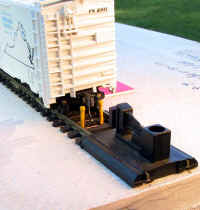
Broken couplers are a problem for many model railroaders and are often caused by hitting the bumpers too hard. This problem was solved by the addition of two small nails just before the bumpers. Placed exactly two and a half ties from the bumper, the nails were inserted so they caught the axel of the car and kept the coupler from hitting the bumper. This not only saved many couplers, but lowered the frustration level also. In the photo the nails have been painted yellow to make them easier to see.
Having a “finished” look is important to every layout. Here’s a good view of the painted and dappled fascia board, the complementary skirting and the recently added trim. A nice presentation makes every layout look better.

The riverbed has been painted in preparation to adding the water. Since the water will be clear, the bottom of the river will need to be painted darker in the middle, lighter on the sides.

To visit the Prince William County Model Railroad Club http://www.pwmrc.org/
It’s best to set up your model train track on a sheet of plywood, a tabletop, or other hard surface. Carpet fuzz and floor dirt can hamper smooth model train set operation.
Get all the latest model railway news and views from the world of model trains. Stay up to date in the most enthralling (ok I’m biased) hobby in the world… model railroading!