Trackage
Everything on model trains, model railroads, model railways, locomotives, model train layouts, scenery, wiring, DCC and more. Enjoy the world's best hobby... model railroading!

Tonif models HO and has this question for readers:
“I’d like to use curved turnouts to save space on my layout. I have Micro engineering flex track but they don’t make curved turnouts. Can I use Atlas or Peco turnouts or will that cause problems? Thanks.”
Andrew asks readers:
“I have a 6×4 foot, HO scale, DC layout with 3 separate tracks. Throughout the hot summer my tracks have expanded under the heat and are taking a while to contract back to the right position. Is there anyone out there who can suggest a way to stop this from happening all together or at least not as severe? “
Tom asks readers:
“I’m new to the hobby and I just set up my first HO layout. I’m ready to wire it. I have ten Atlas Snap Switches that need power. Atlas recommends an AC power supply that puts out 15 -16 VAC @ 2 – 3 amps. Such a supply seems impossible to find. I’ve seen many people recommend an old computer supply, cellphone charger, etc. . . . but these all put out a DC current. Is there any reason I can’t use DC on the Atlas Snap Switches? (I have two old computer supplies, one puts out 32V @ 3.5 amps, the other 20V @ 11 amps.) Will either of these work without burning out the Snap Switches?”
David who models HO asks readers:
“I went to DCC on my train setup. I want to have a signal to let me know when the turnout is not on main track. Can anyone advise me on doing this?”
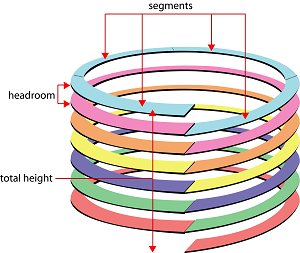 Scott asks readers:
“On a helix calculator – what is meant by a segment length? Is it measured from what point to what point?
There is a free helix calculator tool at here.
Another beginner Larry asks this question:
“I’m relatively new to model railroading and have numerous cars and engines with the horn/hook couplers. I would like to change over to knuckle couplers. The ones I have tried don’t match the height gauge I’m using. They are a little low. Any help is appreciated. “
Anthony has asks readers this question:
“I want to put side yards on my O gauge set. How do I switch off power too track when train is not to be used?”
Brian asks this question:
“Hi everybody. Hope someone will be able to help. I am 77 years old and disabled I decided that i should have a Hobby so started a train set OO scale, my board is 11ft X 38 inches. I am having trouble understanding Radius. I want to have three lines running around can I get away with this what does radius mean. I have laid track but feel the curves are to tight for some coaches to go round. Any advice would be Appreciated.”
Club Member Allan asks readers:
“This hobby is quite new to me so I need some advice. I am a bit confused with turnouts and how to control them. Do I need seperate wiring to control the switches or can I control them with DCC? I’m ok with making scenery and woodworking joinery, but struggle to understand technical wiring issues. Please help.”
Aaron sent in this tip to share:
“I have just recently gotten into railroading and I love it so much. I have run into multiple issues so far but see them as challenges and enjoy finding fixes for my issues. One thing I would like to share that I haven’t seen on any site yet that you will find your rail joining so much easier if you trim the little excess metal from the joiners after you cut them from the strip. This will guarantee that they don’t use up too much area in the joints and cause a gap. Thanks for letting me share and happy railroading.”
Phil asks readers:
“How do I stop my N scale trains from uncoupling and jumping the track?”
Bill operates N gauge and is confused with wiring requirements. He asks readers:
“I am just building a two mainline track with two side tracks going to separate buildings and terminating at each. There are two points wired, but but they seem to operate the track… in other words when a train passes one point, I have to switch the other point to keep the train moving. This is possibly simple to some? Who knows? Can you help please?”
Linda has a question for HO enthusiasts:
“Hi – I want to have 3 HO trains running on 3 circle tracks. I want the roadbed type of track and have only been able to find 3 different size curves in the Bachmann EZ track. 15″ 18″ and 22″. The 18″ has a rerailer section that I can get to power that track. But I cannot find how to power the 15 and 22… I saw on a site that you can get the atlas terminal joiners, but do not see how you can install them with the EZ Track roadbed. Help please.”
David from New Zealand kindly sent in this article to share –
Description of Conrad point motors and their suitability for my N gauge layout
 I have recently returned to railway modelling after more than 50 years and I spent quite a lot of time researching the current marketplace before buying any equipment. Having decided on N gauge (N scale in USA) because of space limitations, I set up a very simple test bed with some sections of Peco track and some turnouts, both insul-frog and electro-frog.
One of my aims was to have ALL the turnouts motorised, and the other was to use electro-frogs except possibly where no electro-frog version of the turnout was available, e.g. Peco ST44/ST45 curved turnouts. (I discarded these in the final layout as the radii were too small). So the hunt was on for point motors which could also switch electro-frogs, and which were affordable in quantity.
There’s no getting away from the fact that the Peco point motor is designed for OO/HO. It will fit under an N gauge turnout but the movement of N gauge turnout blades is only 3mm. Therefore it is difficult to get accurate and reliable operation with N gauge, particularly when you add a microswitch unit to the motor. A Seep point motor works on the same principle and with those, the built-in frog switch only just works because of the limited turnout-blade movement.
Testing the Conrad
During my investigations I came across a couple of short videos about the Conrad point motor, so I bought a couple of motors and tested them. The basic design of the Conrad motor is to use a stiff wire directly up through the baseboard into the tie bar. This works OK with OO/HO turnouts (and probably O gauge as well, but I have no experience there) but again, it doesn’t work too well with the short travel of N gauge turnouts. However, one of the videos shows the use of a crank and I can confirm that this works brilliantly. The crank reduces the motion of the Conrad slider bar from 7mm to 3mm, and it’s easy to adjust. The Conrad motor includes a frog switch so you don’t have to buy any extra parts to operate electro-frog turnouts. I have successfully installed 31 Conrad motors on my current layout and I’m very happy with them.
How do the Conrads work?
They are based on a 12V DC motor turning a crown wheel, with a slide bar engaging the shaft of the crown wheel. They are NOT slow-acting like a Tortoise or a Cobalt motor, but they are not nearly as “violent” in action as a solenoid. Limit switches cut off the motor power at each end of the travel of the slide bar. The electrical design allows operation on AC or DC. In AC mode, the wiring is identical to that of a solenoid motor, but you can get away with a simple SPDT switch in place of a passing contact switch.
In DC mode, you use two power supplies (+12V & -12V), and here you get the greatest advantage – you only need ONE control wire plus the common return. If you don’t have a dual DC power supply, you can always use a single 12v supply and a DPDT switch to reverse the voltage supplied to the motor, but there again, you would probably use the AC method instead.
Size: The Conrad motor is 70mm long, 25mm wide (38mm over the mounting flanges), and 26mm deep. The slide bar is 47mm long overall and moves about 7mm. The shallow depth means that these motors are well suited to being used on “upper levels” where you need clearance for trains running underneath them.

The crank: The above sketch shows what I mean by the crank. I use the thicker of the two pieces of wire supplied with the motors. This is 55mm long. The hole in the baseboard serves as the pivot for the crank. The photos below illustrate this in practice – on my test-bed. You don’t need to remove the over-centre spring from the turnout. I still make an elliptical hole under each tie bar just in case I want to use a solenoid motor at a later date.

Pricing and availability
The Conrad motor (part number 1396900) is available from Conrad UK (conrad-electronic.co.uk) at £9.99, including VAT but not including shipping. Conrad UK will not ship internationally so the VAT does not come off. From Conrad.com (Germany), they are available with a quantity discount, coming down to €6.93 when the VAT has been taken off for export. The snag is that there is a €55 shipping charge, which looks horrendous. However, if you buy a quantity, the pricing comes out roughly as follows (but don’t hold me to it as rates can vary): 10 cost roughly NZ$33 each, 20 cost roughly NZ$17 each. The most you can order while staying below the NZ$400 limit is 27 or 28.
Thanks David. If you have an article you would like to share with others, please submit details to the Blog Moderator using this link http://www.model-train-layouts.net/Submit-An-Article.html
Colin is constructing a 5 ft x 11 ft HO scale layout and asks readers:
“What is the best way to join track sections where the tracks joins at a removeable part of the layout if that make sense? It will be a lift out section.”
 Reggie models N scale and wants readers advice on turnouts:
“I have started modeling a layout and I was interested on getting some feedback about turn outs, remote versus manual. Which type is the most preferred and why?”
 Simon has an unusual question for readers:
“Hi all, I have never had a train set in my life and this is what I want to do. I have a sweet shop in Sutton on sea and the room is around 5 meters sq but I want to suspend the track from the ceiling so that you can see from under the track as well. I would like to use O gauge for the size of train. How can I suspend the track so it looks like it’s floating. What track do I use? How many are there? Where do I get it from? I really have know idea where to start if any one is local to me pop in and I sort you a free bag of sweets (candy). lol.”
Steve asks readers:
“Is the track from different from company to company?”