Trackage
Everything on model trains, model railroads, model railways, locomotives, model train layouts, scenery, wiring, DCC and more. Enjoy the world's best hobby... model railroading!

Kerry asks readers:
“I am using a small hack saw to cut my flex track to fit the HO layout I am working on. This seems to be not a good method. Is there some other way to cut the track for a good fit?”
George asks readers for advice:
“Hi guys; any suggestions for keeping dampness and your rust of first time track set up in my 8×10 shed? I intend to take in all trains and wagons etc inside for the winter months, but I’m a wee bit concerned about track being out in my shed during the winter. Please can you help? Kind regards. George. P.S. I love reading your model train blog. keep up the good work.”
Douglas asks readers for advice:
“I have an old ping pong table that I used for the base of my HO layout. I have placed a 1″ form board over all of it. Do I need to use cork for under the rails?”
Ted H asks readers:
“I use a track rubber to keep my rail heads clean but it is a messy process and leaves a lot of unwanted deposits for me to vacuum up. Is there a better method?”
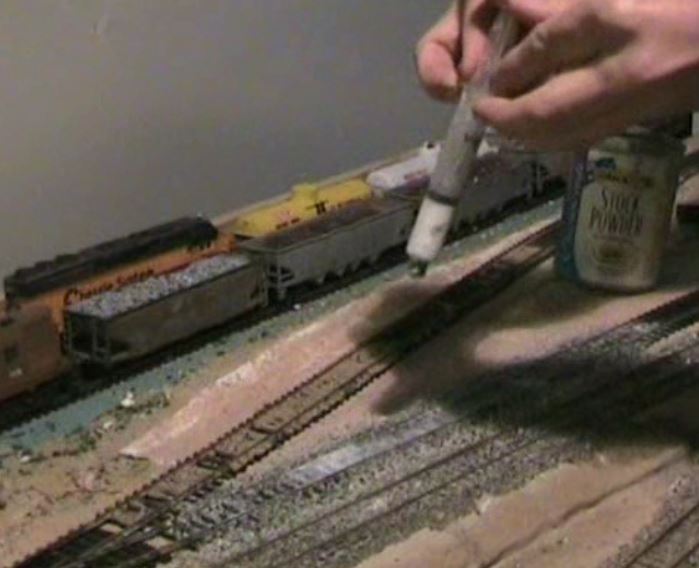 If you have been model railroading for some time, then this quick tip might seem obvious, but not so for newcomers to the hobby who struggle to keep their ballast in place. They glue it down and after a while with it comes loose, potentially causing problems.
The first thing is to not apply too much ballast. The more you use the more you’ll need to stick down.
Many experienced railroaders will wet the ballast first before applying it. You can use a plastic syringe, or a small indoor plant sprayer (from a garden store). Fill it with ordinary water and a couple of drops of dishwashing detergent. Then gently spray it over the ballast before applying a 50:50 mix of PVA glue and water. Personally, I have had more success using 70% isopropyl alcohol as the wetting agent instead of tap water. I hope this helps someone.
Karl (a new member to model trains and the Online Model Train Club) asks:
“Does anyone have an suggestions for keeping under-benchwork wiring organized and tidy. I am just starting off in HO and am worried I’m going to end up with a confusing mess below the surface. Any suggestions appreciated?”
Stan asks readers:
“I I notice there is all kinds of track out there – Kato Unitrack, Bachmann EZ track and Atlas Flex track to name a few. My N scale layout under construction has Bachmann E Z Track, but a friend offered me some unused Atlas flex track and a small section of Kato Unitrack for a cheap price. I think he picked it up at a garage sale. The Atlas is code 80 so would it be ok? Any advice would be a help. Thanks.”
Allan asks readers:
“Hi I am starting an HO layout on 4×8 or 5×9 board and want 2 levels but my problem is I want the track to climb 100mm (4 inch) in a complete circle. What I want to know is what is the minimum radius that I can climb to achieve this please? I am using strong engines and only about 5-6 wagons so won’t have much weight to pull up incline. Thanks for any help on this please.”
John asks readers:
“I’m creating an HO Timesaver layout. My question is about switches for the turnouts. I have the atlas switches that came with the atlas turnouts. But would like to use different switches for my control panel. Can someone recommend what type of switches I should buy and where I could find them. FYI. I’m using single pole switches for my blocks.”
Bob has a question for readers about track choice:
I already have the shelf idea in mind but in HO. I’m 60 years old and already have it tough enough working on HO Scale. I put together a HO Scale Model caboose and what a job that was. I have plans of constructing 2 Helix or Heli because of limited space and multi-level shelf. One at each end of the set. I do have one question. What would be the best track to construct a HO Scale train set? I bought 2 Bachmann Starter train sets because I liked the looks of the old style steam locomotives. The E-Z Trrack is nice to put together, but it doesn’t seem to be the best if there needs to be any kind of correction or adjustment, that it is easy to work with that pre-assembled track. Also, I see that Bachman is not as high a quality as BLI or a few other companies. But the pricing is a lot less.
If you are about to construct a layout, then here’s a couple of track laying tips.
Neil asks readers:
“Hi I have an HO layout and am thinking of adding a third track but not sure on how it can be done. Your suggestions would be greatly appreciated.”

Shaun asks readers for ideas:
“I am wanting ideas on how I could hide the ramp on my N scale layout as the next two tracks are a railway station. The down track and the one above the ramp are 40mm apart. I don’t know what to do with tracks 1 – 5. I am thinking of putting mountains to form a partition stright down the middle (lengthwise).”
Joseph asks readers:
“How much track do you need for a one mile of HO track?”
Hedley asks readers:
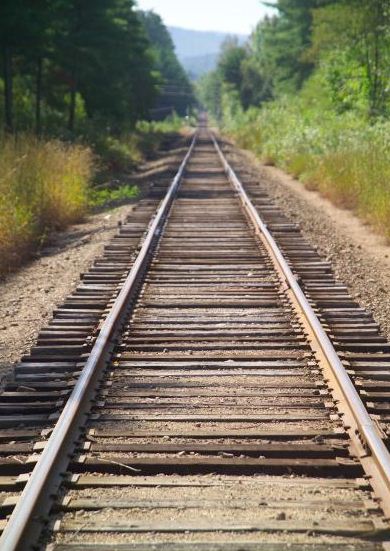 “What’s the best way to keep my track in top condition so my HO trains run smoother? I have used a fine sand paper, but a railroading buddy said rubbing alcohol is better. I’m confused – should I use sandpaper, or rubbing alcohol, both, or something else?
Herb asks readers:
“I’ve been having derailment issues and a railroad friend of mine claims locos and cars are less likely to derail on Code 100 track, compared to the code 83 track I am using. Is that true? I don’t want to rip up my track if I don’t have to.”
Robert comments: Readers might also like to comment on any differences they’ve personally observed with code 83 vs code 100 in regards to: track thickness, detailing, short circuits, ease of installation.
Roy asks readers:
“Is there a way to remove ballast and flex track? I want to replace flex track with Kato track.”
Unfortunately Roy doesn’t give any details of how his track and ballast are applied on his N scale layout. Hopefully he will add a comment to this post giving more detail.
Guy asks readers:
“Is there any difference in the track gauge? How much difference? Can you run a HO train on HNO3 rail and vice versa? Thank you.”