Trackage
Everything on model trains, model railroads, model railways, locomotives, model train layouts, scenery, wiring, DCC and more. Enjoy the world's best hobby... model railroading!

Larry has a problem with building a helix on his HO layout. If you have built a helix you might want to share your experience by helping Larry with some tips and advice. Here’s Larry…
“Hi, am planning on building a Helix for my bench and this is a new critter for me….making sure I get the correct grade as well as the correct radius or diameter of the curves. I know they have pre-made ones you can get, but it won’t work for me so am building my own……or attempting to.
I will be using 3/8 inch threaded rods for the uprights and masonite for the trackbed between them. I have been experimenting with different grade percents and plan on using a easy grade rise of about 2 inch rise for every 12 feet.
My engines are not expensive ones and it seems anything greater than that the engines have issues with.
I was wondering if anyone out there has built a helix and what rise you used and also the diameter or radius of the curves in the helix?
The widest area of my bench is 5 feet, or 60 inches, and the bench is 10 feet long and that is where I plan on putting the helix. I also have an area that is 46 inches wide x 9 feet long and I was wondering if that area would be wide enough for it?”
Help Larry by adding your comments using the green comments link below.
Railway terminology can be confusing at times, especially if you are new to the hobby. Mike has question for you relating to railroad terms you might like to help him out with.
“Hi all. I am relatively new to the world of model railways and I am unsure of the correct terms of various sections of rails. Some layouts show single track, others show two or even up to six. I have been told about the up fast line and the down slow line, could this be explained to me? Also other terminology like head shunt. Any information will be greatly recieved.”
Eric is having a problem with derailments on his HO layout. So much so, he is considering major layout changes to try and fix the problem. If you can help Eric with some suggestions, I’m sure he will be elated!
Here is what Eric has to say:
“I have a curved bridge on my lay-out … When my boxcars are pulled over the bridge they derail. When the boxcars are pushed they stay on the track. Adding or subtracting weights to the boxcars do not seem to make any difference. My question is; What other fixes could I try to solve this problem before I rip up my mountain layout and just go to a flat layout?”
Click link below to answer.

Quick Helix Definition: A Helix is spiral of tracks, raising or lowering on a model railroad. A helix is used on multilevel model railroad layouts.
Can you suggest an answer to Dan’s On30 layout question.
“I have an DCC, On30 layout with Peco track on cork roadbed afixed to two inch extruded foam. One switch in my wye is a little far for me to reach from inside the layout. I also have very little clearence under the layout (in this area). What would be the best switch machine for remote mount to work the switch?”
Robert is away this week so I am posting this question from a reader. If someone would like to help this model railroader they can click the comments tag below and submit an answer.
Adele
“I have a H.O. scale set that has a section that I want to bring back the opposite direction. I have the unit to reverse the polarity in the track. And I know how to wire it the right way. The problem I am having is trying to find where I can purchase the Plastic Rail Joiner’s.
I’ve tried everything from shaping a piece of wood to using a piece of wire coating, slicing the wire coating down the middle. To no avail has this helped me keep the track from touching each other. Would your readers please help to find these Joiner’s.”
Two of the videos in the new model railroad videos series are:
Video #7. Agriculture & Industrial Layouts
There are many clever model railroading scenery ideas in this video. Watch a sugar cane train on its journeys from fields to sugar mill. This layout features: a wheat growing district, a loaded coal train, open-cut mine and port facility. There’s even an outback town with livestock yards portrayed.
Video #8. Soldering The Track

In this model train video tutorial James shows you how to solder and wire track for a reliable connection every time. James talks you through the process step-by-step and reveals a little trick to get a good solder.
Feedback from model railroad fan Roger:
“I just wanted to drop you a line and say how much I have enjoyed your videos. I have already received the first 10 model train videos and they are great. When I received your first E-mail about the series, I was not sure as to whether I wanted to spend the money or not. I must say, just as your Model Train Help book is great, the train videos are great and well worth the money. Your videos have convinced me that I must visit Australia and see this stuff first hand.”
Roger B, Ohio
After a year in the making a series of 42 amateur model railroading videos were finally released today.
These videos do not pretend to be Hollywood productions as they focus more on providing good content rather than flashy presentation.
The 42 model train videos cover a range of model railroading topics and include tours of several private layouts… not normally open to the public.

These videos, available by download, also feature visits to some train shows and include lots of useful ideas and tips to help hobbyists build, or improve their own model railroad. Other video topics cover baseboard construction, electrics, foliage making, DC and DCC operation. The series even includes three videos about building a garden railroad.
These videos range in length but average around nine or ten minutes each. The step-by-step tutorials in the videos provide answers to many common (and not so common) model railroading problems.
Access to these videos is by “membership only” so is restricted to a limited number of keen model railroaders.
To find out more about these model train videos and to read the list of contents and see a sample video click on this model train video link.
Happy railroading!


My ebook has more helpful model railroad tips for you.
The arrival yard is where arriving trains drop off the cars of their train. The cars are then moved to the classification yard, being switched back and forth as necessary to get the right cars onto the right trains. The trains are then built out and moved to the departure yard. After getting a new caboose and locomotive, they then proceed to their next destination.
Here is an opportunity for experienced model railroaders to share their ideas with others involved in the hobby. An N gauge enthusiast has this question:
“What precautions / technique are needed to ensure N gauge points are not gummed up by ballasting when using the accepted ballast -diluted PVA method?”
If you would like to offer an answer to help this fellow model railroader, simply click on the “comments” link below and submit your answer to the moderator for publication.
Cleaning model railroad track is one of the best ways of improving model train performance.
Several track cleaning methods are available to the hobbyist including using Goo Gone®. This product is a general cleaning agent that seems to remove much of the grime that build up on railway track.
Goo Gone® is a combination of Citrus Power and scientific technology designed for tough cleaning problems.
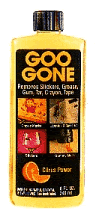 Goo Gone® has minimal impact on the environment and is safe to use on almost any surface.
When cleaning rails use a small amount of Goo Gone® on a rag and just wipe. If the railroad track is rusted or corroded use fine sandpaper or a track cleaning block after sanding the rails. Then wipe with Goo Gone® or other cleaners.
Some hobbyists also use Goo Gone® on the wheels of their locomotives. Goo Gone® or fine sandpaper can be used to make the wheels bright and shiny.
As well as using Goo Gone® on model railroads, the product can also be used on: carpets, upholstery, clothing, tile, glass, grills, appliances, vinyl, wood, draperies, autos, boats and fiberglass.
The manufacturers claim Goo Gone® is effective on: gum, tar, crayon, fresh paint, tree sap, oil and grease, blood, ink, asphalt, scuff marks, tape and tape residue, makeup, lipstick and mascara, adhesives, candle wax, kitchen grease, shoe polish, soap scum, bumper stickers, duct tape and bicycle chain grease.


Clean track is essential for any model railroad layout because the power for the locomotives motor comes from the track up through the wheels. Keeping the wheels clean is therefore critical as good performance depends around 90 percent on clean locomotive wheels and 10 percent on clean track. Both track and wheels affect smooth running on a model railroad layout.