Trackage
Everything on model trains, model railroads, model railways, locomotives, model train layouts, scenery, wiring, DCC and more. Enjoy the world's best hobby... model railroading!

Model train track comes in sections (called sectional track) for convenience and ease of use. You can purchase model train track in different lengths and shapes, straight and curved. Some model train track snaps together, and some model train track is made on plastic roadbed sections.
Sectional track is what most model railroaders start with simply because the sectional track is easy to use and it’s what usually comes with the model train sets.
When assembling sectional model train track do not force the track pieces together. Make sure both ends of the model train track are lined up with the metal rail joiners and fit snugly with little or no gap.
If your model train track has molded roadbed make the tabs lock securely between track sections. Make sure there are no gaps at the end of the rails when assembling the model train track.
The different train track materials are easy to pick. Steel is a silver color (or rusty if not looked after properly). You can also use a magnet to find out if it is a steel train track.
Brass has its own distinctive color(s).
Nickel silver train track is silver colored, but has a slight gold tint to it.
Nickel silver train tracks are one track option for model train enthusiasts to consider when building a model train set layout.
As with Brass track, Nickel silver train track also forms an oxide, but are still a good conductor of electricity. The oxide that forms on nickel silver happens to be electrically conductive whereas that which forms on steel and brass is not. What this means is that after a while on steel and brass rails the model trains tend to run erratically. This means you’ll need to clean the rails frequently to avoid this problem.
Using nickel silver train track means you will have better running model trains and less time spent cleaning train track. That’s why many model railroaders favor nickel silver train tracks for their model train sets.
True train story: USA December 19, 2005
A dog was found frozen to some railway track and was pulled free just 10 minutes before a train was due to pass by. The dog, nicknamed “Ice Train”, lost some hair in the rescue process and was taken to the Chippewa County Shelter where it recovered quickly.
The dog’s owners were identified but “Ice Train” has since been adopted by a Wisconsin family.
Brass train tracks are one track option for model train enthusiasts to consider when building a model train set layout.
It is generally accepted that brass train tracks are the best conductor of electricity, but brass train tracks do need a regular cleaning to keep them in good condition. This is because brass forms an oxide when in contact with the atmosphere, which creates a barrier to the current.
Zinc-coated steel train tracks are one track option for model train enthusiasts to consider when building a model train set layout. The big disadvantage with zinc-coated track is that the zinc can wear off. This can expose the steel that can then rust. However, zinc-coated tracks are often cheaper to buy than other track options and are worth considering by any model railroader who is on a tight budget.
Model train track comes in different types made of brass, zinc-coated steel, nickel silver and steel. Regardless of what the train tracks are made of, most track sets come with a terminal section so that you can hook into the transformer.
Brass track and zinc-coated steel track are common in starter model train sets and, when purchased separately, are usually cheaper in price than nickel silver tracks.
Model train track consists of two metal rails separated by plastic tie sections. Each rail carries one side of the electrical circuit. To work properly, the two rails should not contact each other and no metal object should contact both rails together. This would cause a short circuit, which could damage your model train power pack if it happened too often.
With this in mind, assemble your model train track and connect the transformer… and you’ll be ready to start operating your model train set. It is as easy as plugging in the transformer, carefully placing the locomotive on the train track, turning up the throttle…and enjoying!
Many beginners to the hobby of model railroading are confused with the difference between standard gauge and narrow gauge tracks.
Standard Gauge railroads have a width of four feet eight and a half inches between rails whereas Narrow Gauge railroads have a width of three feet between rails.
Narrow gauge equipment maintains the scale, but runs on a smaller gauge of track. Narrow gauge track is seldom used on main line railroads. Narrow Gauge track was generally laid in areas where rail traffic was light, curves may have needed to be tight, and cost was a major issue. Most popular in mining spurs, logging spurs, and scenic tourist rails where low speeds were usual.
The terms scale and gauge are two of the most confused terms in the model railroad hobby.
The SCALE proportion is expressed as a fraction of a real life-sized railroad. As an example, HO scale model train set is 1/87 the size of real life-sized railroads.
For model trains, track GAUGE is the width between the inside running edge of the rails. For toy trains, track gauge is the measurement from the center of the two outside rails.
No they don’t, but there are two main types: standard gauge and narrow gauge. In the US, Canada and most European countries, trains run on “standard gauge.”
One of the biggest problems a model railroader can have is couplers that cause a car to derail or not couple correctly. Where you use the Kadee or McHenry couplers here is a very inexpensive tool you should not be without. A coupler test track.

The set up is easy. Take the roadbed as is, you don’t need to split it. Just lay down the roadbed with white glue. You will want to trim the edges. While the glue is setting up, about 2/3 of the way down cut out a section of roadbed for the uncoupler magnet and the metal plate down.

Read more about coupler test tracks at The Ponderosa North Model Railroad Club website http://www.arizonarails.com/coupler_test_track.html
The Black Diamond Lines Model Railroad Club began back in July 1981 as a group of model railroaders who gathered in the back of a local Antioch, California hobby shop. Later that year, the group decided to make things official and were incorporated as a non-profit organization.
The Black Diamond Lines models in HO scale, which is a ratio of 1:87. This means that if a model is 1 foot long, it represents a real-life object that is 87 feet long. (One foot, in HO scale is actually 0.137 of an inch.)
The layout occupies approximately 1500 square feet of space, with a track elevation range from 46 inches to 82 inches above the floor.
All track is hand-laid on real wooden ties. All turnouts (switches) and crossings are hand made in place, which represents a lot of time and skill. Club members prefer hand laying over flex track and pre-built turnouts as they feel it has a more craftsman like quality.
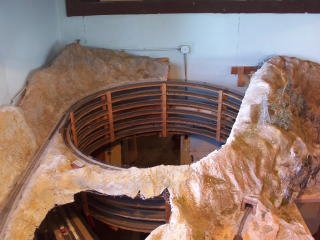
Though the double stack train is not visible, this photo shows the clubs Helix. It has 5 1/2 revolutions of 36″ radius. In a small amount of space the train will gain or lose 22″ of elevation. Grade is held at 2%.
The Black Diamond Lines Model Railroad Club layout also includes a new waterfront area.
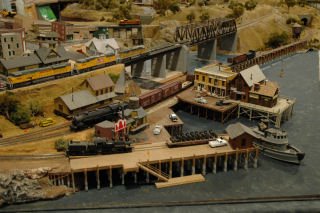
The Black Diamond Lines is an active, operating HO scale model railroad club located at 425 Fulton Shipyard Rd, Antioch, CA. The club website can be viewed at http://www.blackdiamondlines.org
Black Diamond Lines Model Railroad Club will be celebrating its 25th year of operation in 2006.
Even though narrow gauge railroads were inexpensive to build, off loading and on loading became too much of an expense for most railroads around the US. Each time a narrow gauge railroad met a standard railroad, shipments would have to be unloaded and reloaded.
There are few narrow gauge US railroads still in operation. Some have been converted to the standard railroad system. Others have been dismantled and turned into scrap.
Ballasted track adds more scenic realism to a model train set layout. However, you need to make sure that the electrics are all sorted out and that all the rail joiners are tight fitting before you start ballasting. Otherwise you may find that after you have ballasted your train track, some sections of track wont work properly.
For yards on a model train layout you may want to use a finer grade of ballast to give the impression of more lightly laid lines, while on the mainline you might want more coarse ballast.
Do train tracks have the same gauge? No they don’t, but there are two main types: standard gauge and narrow gauge. In the US, Canada and most European countries, trains run on “standard gauge.”