Uncategorized
Everything on model trains, model railroads, model railways, locomotives, model train layouts, scenery, wiring, DCC and more. Enjoy the world's best hobby... model railroading!

Richard asks readers: “I am having trouble finding traction tires for Tyco “Chattanooga” and O-8-0 tender drives. Please help!”
Our last poll of model railroaders asked: When do you spend most time working on your layout?
Since posting the question a few days ago, about 11,000 people visited this blog and 528 people voted.
Here’s what they said:
– Throughout the year (seasons make no difference) (48%)
– During the colder months (27%)
– During the warmer months (5%)
– I don’t have a layout yet (20%)
So the time of the year doesn’t make much difference for about half of us, with most others favoring the colder months.
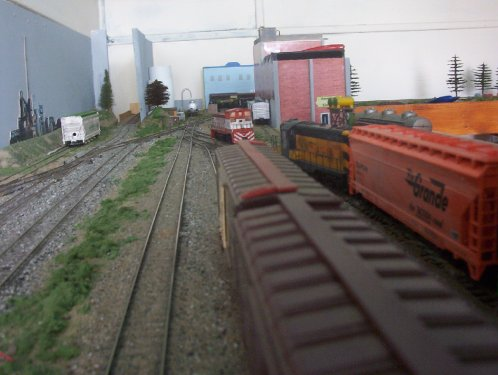 When it comes to rolling stock and locomotives, most of us own more than we could ever operate at one time. One solution is to store your excess trains in their boxes or put them on display in cabinets or on shelves. The other solution is to store all your extra engines and cars on yard tracks either as part your layout operation, or on separate “non-operational” tracks away from your layout.
If you have plans to build a rail yard then here are some considerations:
1. Try to integrate your staging track with it linked to the main track at each end.
If there is sufficient space for two staging tracks, then better still. The intent of a yard (other than for storage) is to gather inbound cars for redistribution, and to assign them to trains bound for the intended destination.
Although the easy way is to just lift a car off the track and plonk it down where you want it, that takes the fun out of solving the puzzle. Real railroads can’t do that, so taking the easy option defeats the whole purpose of operating model trains.
To rearrange cars properly requires enough yard space to efficiently move cars without physically lifting them off the track.
2. Try not to squeeze too many tracks into a cramped space.
The problem is; when the tracks are positioned to close together it might cause a “domino effect” when a car derails.
3. Always include an escape route so that locomotives don’t get trapped on track spurs at the REAR of a line of freight cars.
4. Keep your yard configuration simple.
A complicated design could trigger problems even with the simplest mistake.
Overall; where possible a yard should be easy to get rail traffic in and out of. Keep the track configuration simple and the train movements will be simple too.
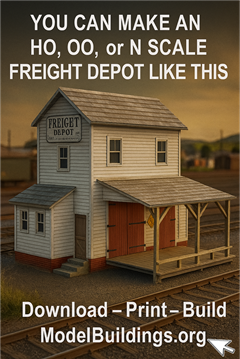
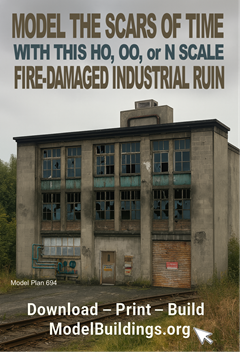
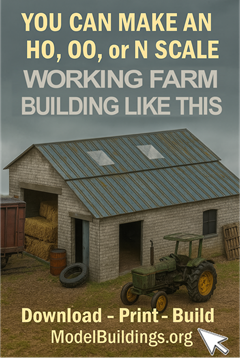
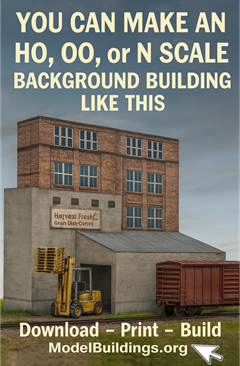
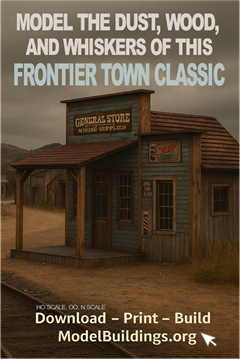
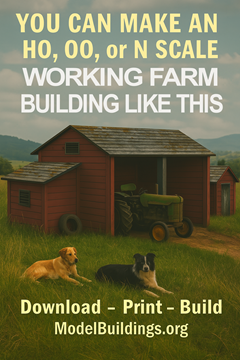
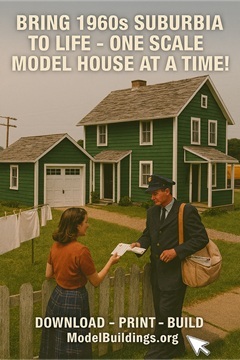
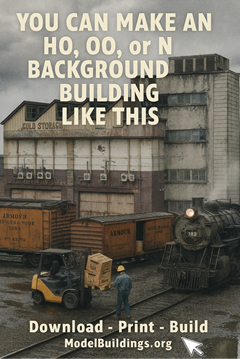
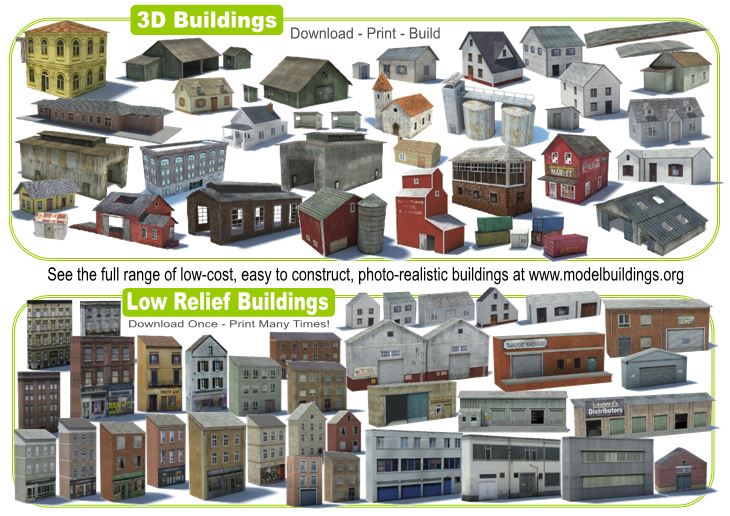 The bulk packs of downloadable buildings are proving popular with model railroaders and those interested in making dioramas. Many of the buildings can be purchased separately, but most are also available in bulk packs of 6 or more assorted buildings. Here are some of the most popular bulk packs:
Big Bundle Pack #1 (SAVE 67% of individual prices)
Big Bundle Pack #2 (SAVE 66% of individual prices)
Background Buildings Bulk Packs (Some up to HALF PRICE off individual buildings)
Multi Pack Buys (Saving between 35% to 68% off individual prices)
The buildings are fun and easy to build using card, corflute, or foam. The downloadable plans are already weathered & detailed so no paints are required (unless you want to add further detailing). Apart from being very realistic in appearance, they are also very sturdy after construction, although you can add extra internal supports if you choose. You only need to download the plans once, and you can then build several from the same download if you choose. The plans can be made to OO scale, HO, or N scale.
You are the first to see this brand new series of very authentic looking scale model buildings in low relief. The detailing is all pre-done as is the weathering, so it is just a matter of printing out the plans and constructing each model with corflute, foam sheet, or card.
This new series is available now at
http://www.modelbuildings.org/low-relief-buildings-G.html
Right now you can pick up the plans for this scale model store FREE OF CHARGE thanks to the guys at modelbuildings.org. The building is simple to download, print and then construct… and it looks amazing when built. There is no catch with downloading it (none of the usual forms to fill in or anything like that). You just download the plan and scale it to HO or N scale. The plan comes as OO scale. Instructions on what to do are on the website. Believe me, it looks incredibly real when you’ve constructed it. Perhaps you could send in a photo of your finished model in place on your layout when finished.
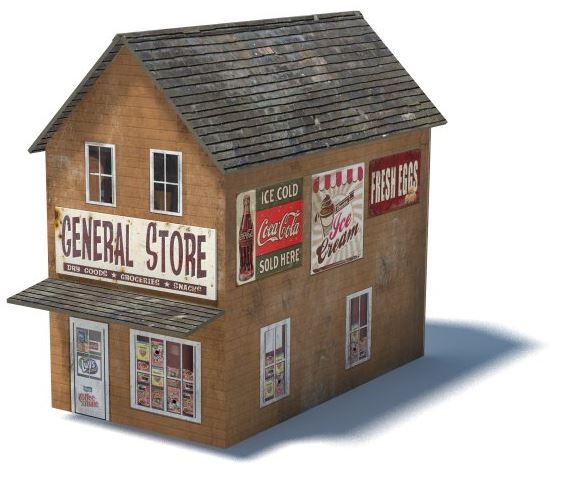
Get the free plans from http://www.modelbuildings.org/free.html
Please tell your friends about this excellent freebie and perhaps buy a couple of buildings from the site if you are impressed with this free gift!
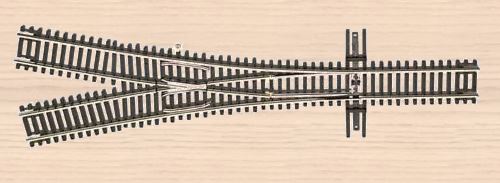 Jack sent in this short article to share:
A wye track is shaped like the letter ‘Y’ where tracks merge into a single one and single tracks diverge into two tracks. The track is designed like this because it allows easy turning of locomotives and routes trains to another track without reversing. It can be part of a junction or used in place of a turntable.
A wye track is connected in isolated blocks. If continuous wiring was employed, a short circuit would occur. Therefore, the track is wired in different blocks where each block is electrically isolated from adjacent ones. A Digital Command Control (DCC) system achieves this.
Add your comment