Uncategorized
Everything on model trains, model railroads, model railways, locomotives, model train layouts, scenery, wiring, DCC and more. Enjoy the world's best hobby... model railroading!

Tom is into Pre-War O scale:
“I have an American Flyer 9900 Burlington Zephyr set. I think this old beauty is from 1935-36. It is cast aluminum. I have the engine #9900 and 3 cars, #9911 REA car, #9912 observation car and the 9912 coach car. I have had this set since I was born.
Now that I am retired, I would like to fully restore it. I need things like decals, exhaust stack and a few other odds and ends. Can anyone give me a solid lead on who, where, I can chase parts? I would also like to find the 4th car which contained the whistle. Any help will be greatly appreciated.”
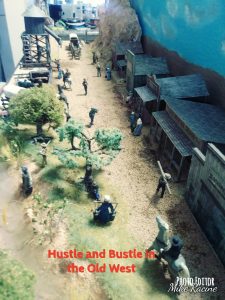 Mike Racine kindly sent in these photos to share.
I named the town Racine City Nevada. I built this for my Pop because he loves old west stuff. The buildings were awesome and easy to build. It just takes a little patience, a steady hand (sort of) and a bit of creativity. The cool thing is you can add whatever woodworks on the outside and the combinations are endless.
Mike downloaded the plans here.
The figures are all hand painted and everything on the dio is scratch built besides the buildings. I decided to paint up a quick background to give it some depth.
You may notice Waldo in one of the pics. That was just me being goofy. I also have an extremely multicolored horse ( not pictured) that I call a “Horse of a different color” (The Wizard of Oz reference). Those are just kinda like a signature because I like to keep everything light hearted.


I’ve since moved on to complete two other major projects which was a tropical paradise with waves crashing on the beach and my latest project was the Pompeii Amphitheater which came out pretty cool if I say so myself.

I just wanted to show that with your products and a good imagination you can make any train layout or diorama a beautiful work of art. Mining town plans also available here.
Comedian Buster Keaton was a pioneer of silent comedies in the 1920’s.
Keaton loved trains and had Stephenson’s Rocket recreated along with just on a mile of rickety track just for this film. Will the train stay on the track? It is kinda crazy, but an historic masterpiece.
Add your comment below.
It’s been a long time since we had a Spot The Difference puzzle. The last series was really popular with readers, so I hope you enjoy the challenge of this latest photo. I counted seven differences – see how many you can find. Enjoy!

You can add your answers by using the COMMENTS link below.

It’s always great to see some scenes from yesteryear. These photos of 1970’s commuter trains were sent in by Alexander who shot the photos at the Sydney Model Train Show.

For those who have never heard the term ‘Cab Forward’, it basically refers to various rail designs that place the driver’s compartment further forward towards the front than is usual practice.
Peter is building a loco and asks readers:
“Does anyone know where I can purchase a cab for an HO/OO ‘cab forward loco’ as I am building a cab forward loco depot.”
As I’m sure Peter understands, we don’t do Buy, Sell, Or Swap on this blog, but readers might be know of some online or local stockists who could supply the item.
John sent in this request hoping a reader might be able to help:
“I was at the Amherst show several years back and there was a lady selling this scenery material. I believe it was made out of shredded cloth but I am not sure about that. All you had do was mix with water and apply.
It was nice material, if you wanted to re-work an area all you had to do was wet again and you could work it. I am hoping somebody is familiar with this product as I can not remember the name, I have tried searching the web for it but no luck.”
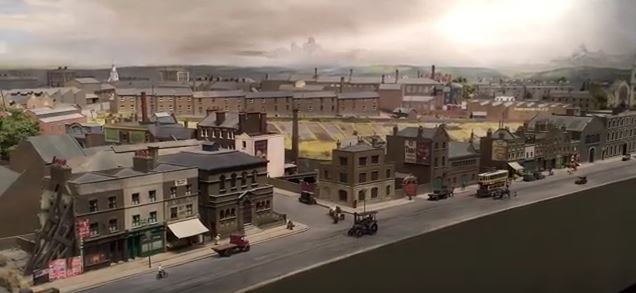
Wayne sent in this impressive photo he shot at the Warley National Model Railway Exhibition in the UK.
This 2 minute video shows some of the MOW equipment on display at the Beijing Railway Museum near Tiananmen Square in Beijing China. The museum tracks 130 years of Chinese railways right up to high speed bullet train roll-out with the network now the most extensive in the world. This clip shows closeups of the ballastless track used for the high speed trains. I’m sure you’ll find the technology interesting!
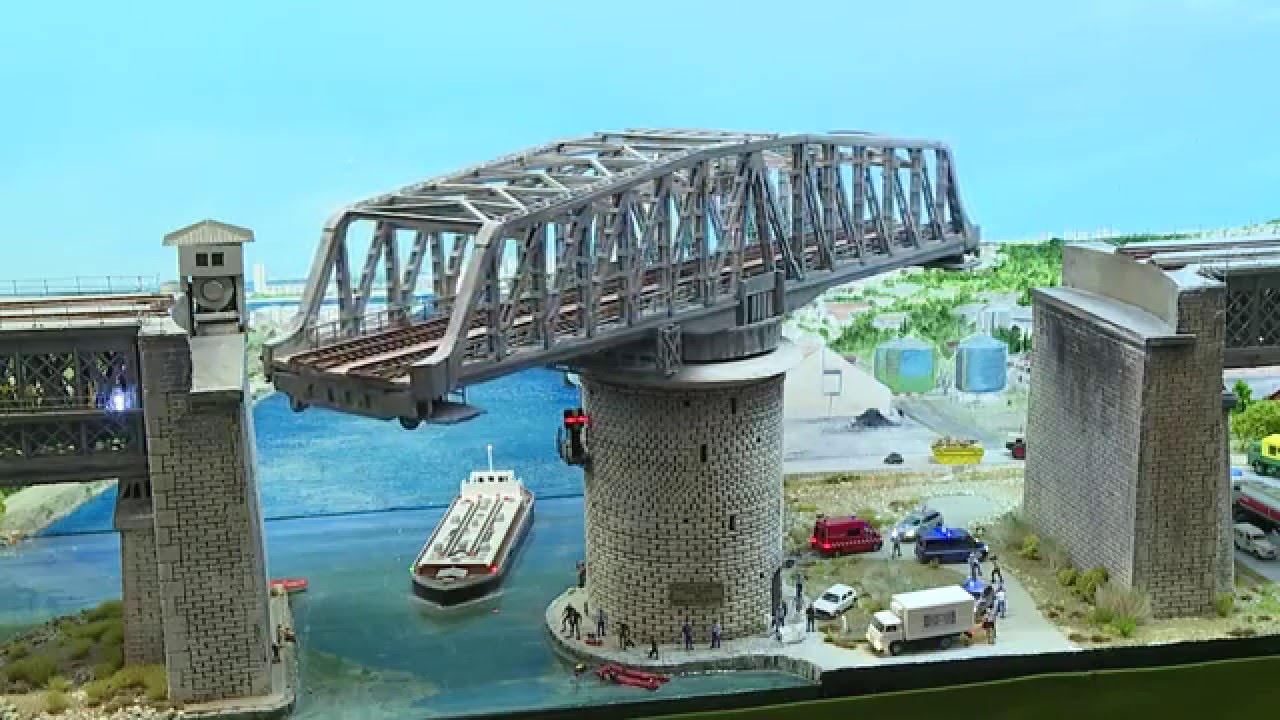
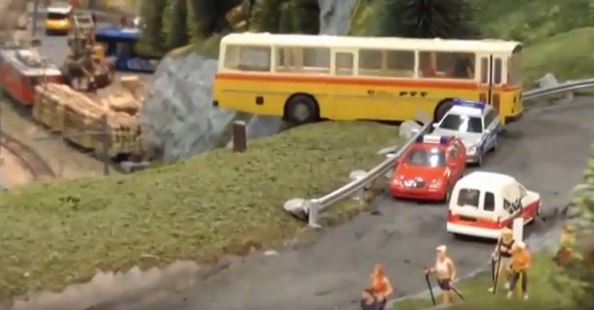 Here’s an interesting scene of a bus accident on the Obervaz Swiss Hom model railway at the AMRSS Glasgow Exhibition. Brakes must have failed?
 Across the American West there are hundreds of long abandoned mining towns that were once bustling “boom towns” where men in the late 19th century went to seek their fortune. The towns were often lawless; but sometimes had a jailhouse, most likely a saloon or two, and plenty of rickety timber boardwalks. There were mining camps, boarding houses, stores, and offices set up to cope with the influx of prospectors. In some places, like Animas Forks in the Colorado Rockies, the prospectors would depart each Winter and return in the Spring when conditions were less extreme.
One of the best-preserved “ghost towns” is Bannack in Montana. Another town worthy of mention is Calico in California. In the 1880’s it was a silver mining outpost, but in the 1950’s was purchased by Walter Knott who built a replica town on the family berry farm 10 years earlier. Just along the road from Disneyland, the town developed into an amusement park, to be known as Knott’s Berry Farm.
In the early 20th century (1907 and 1908) up to 5,000 men worked at the Montgomery Shoshone Gold Mine near Rhyolite, bordering Death Valley National Park. The boom town closed just 7 years after it was established and the mine closed down. The population was virtually zero by 1920.
Another town of note is Arizona’s Ruby Falls, a once hustle and bustle mining camp located near Mexican border in the Coronado National Forest about 70 miles southeast of Tucson. During the 1920’s the town was know for a string of double homicides. Ruby Falls prospered for several decades, but was abandoned in 1941. During the late 1960’s, it the town was inhabited by hippies.
The gold rush town of St. Elmo in Colorado was Founded as Forest City in 1880. However the last train left in 1922 taking most of the remaining inhabitants with it.
Unfortunately the inevitable boom and bust cycle was common to many western mining towns.
The one thing in common for all these mining towns is that they all had character and plenty of stories to tell. That’s why they make such interesting settings when replicated on a model railroad. After all, we all grew up watching Wild West movies that more often than not featured outlaws, saloons, railroads, and gold prospectors.
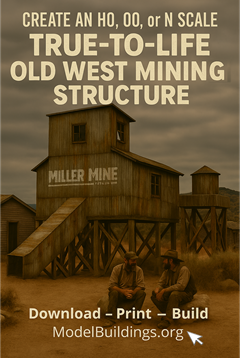
If you are interested in building a small mining or wild west town, there are two sets of downloadable plans available at http://www.modelbuildings.org/wild-west-scale-models.html and http://www.modelbuildings.org/mining-town-buildings.html
Alan sent in this info about his layout to share. The photos are amazing!

Hard to believe but the bus is a photo stuck on the backscene.
“When it comes to roads cutting across the layout and abruptly hitting the backscene, I blend it in by attaching a piece of thin card or even paper the same width of the road, painting it the same color then bending it upwards so it rests on the backscene. The road can then be extended by painting it disappearing into the distance. Hope this helps.”

In this case the Peco backscene had a road on it. Again the bus photo is glued on.
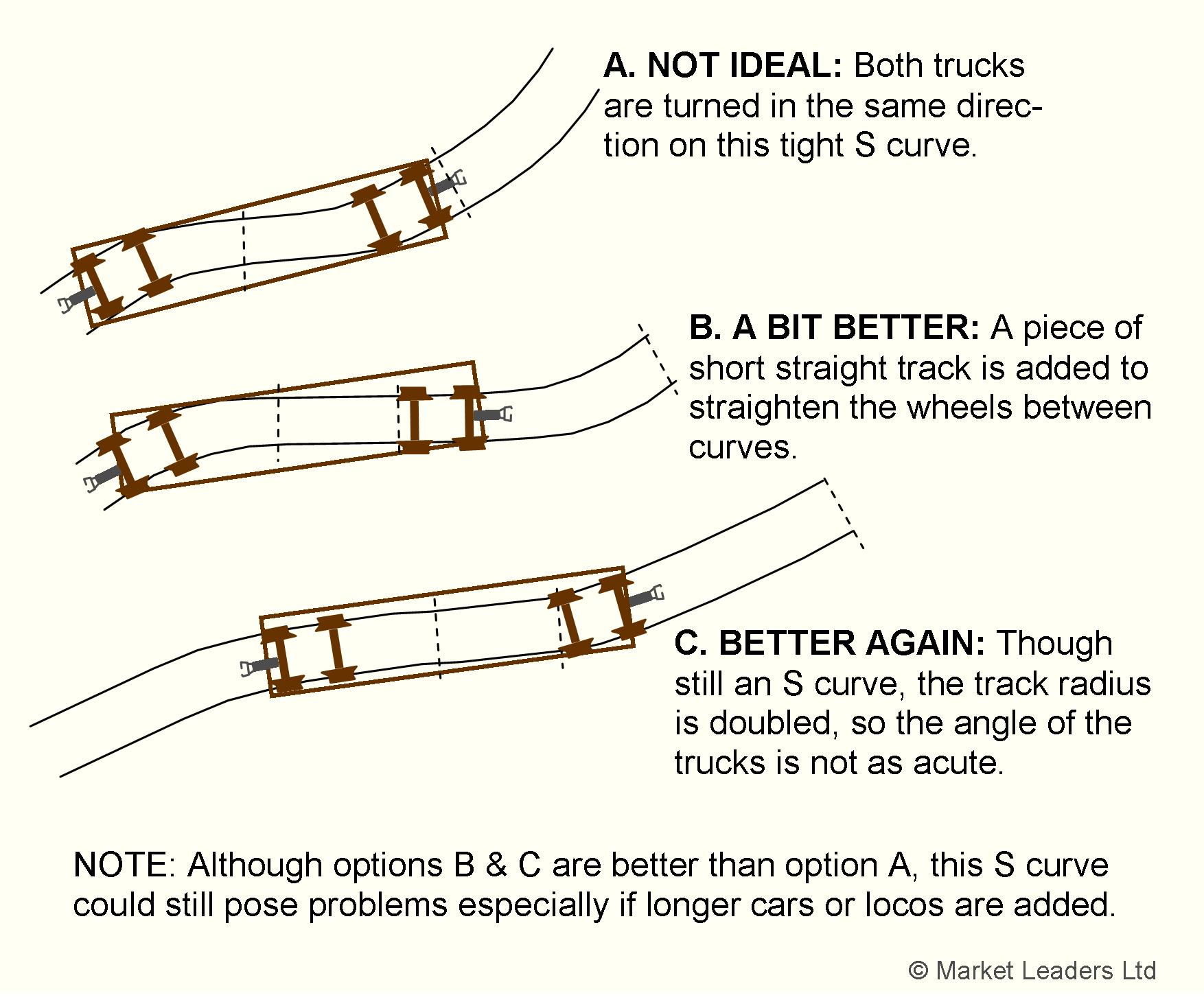 Curves look good and generally necessary to turn trains and keep them running without coming to a dead end, but curves use up plenty of room on a layout. And, the radius of the curves will affect the type rolling stock that comfortably operate without derailing and still look convincing when navigating the curve. Longer passenger cars, auto carriers, and large articulated locos will generally require a large curve radius.
S-curves are synonymous with derailments and uncoupling, because having curves going in opposite directions makes it harder for trains to stay on the track. The frame of each car needs to turns in one direction when entering the S curve, and then turn the other way when exiting the s bend. The coupler on the rear end will attempt to follow it through the movement. At the same time the following car will be taking a slightly different route as it won’t have entered that part of the curve. This will produce strong sideway forces on the coupler trying to pull it off the track. So, even though it can be entertaining to watch trains navigating S curves, they are fraught with potential problems.
Download your FREE report – 33 Track Planning Mistakes To Avoid
Share it with your friends.