Everything on model trains, model railroads, model railways, locomotives, model train layouts, scenery, wiring, DCC and more. Enjoy the world's best hobby... model railroading!

Making Oil Tanks

Here is another tip supplied by a member of the online Model Train Club.
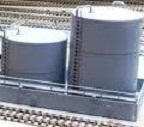
I used some old tins from the kitchen cupboard to make an oil tank depot. I found an old coffee tin and another one that contained drinking chocolate. They were the type that you press shut (not the ones you need a can opener for). 
I screwed the lids to the layout which meant I could easily remove the tanks at any time by just pulling them out from the lids (which stayed fixed to the layout base). I painted the tins and applied some graphics I printed out from the internet. However before I printed them out I used my computer graphics program to add a couple of ladders and some rivets to the design. They look so authentic.

Click To Add A Comment  Ask A Question

Making Putty For Models


   Styrene is a popular material to use for scratch building because it is versatile and inexpensive. However, you don’t want to throw all your offcuts away. There’s a product called MEK (methyl ethyl ketone) which is a plastic solvent welder, used to weld parts together using capillary action (another brand is Testors Welder). MEK works with polystyrene (not foam), and is slower drying than polyweld. You can pour some MEK in a glass bottle and then to make a putty paste by dissolve some scraps of styrene to make a putty (paste) to fill holes, imperfections, joints and other areas that could require filling before you start painting. 
WARNING: MEK is known to be carcinogenic (cancer-causing), so skin protection and good ventilation is absolutely essential.

Humbrol and Revell make liquid polystyrene cements.
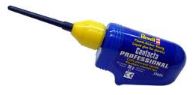
Testors also make both liquid and a gel type solvent based styrene cements. The liquid versions come in a small bottle with a long stainless steel needle like stem for easy control and to prevent evaporation.

If you are working in wood you can do a similar thing by mixing sawdust and wood shavings with PVA wood glue. This putty mixture can then be used for planks, wood siding, or for filling gaps or fixing imperfections.


More tips and ideas in the Model Train Club.
1 comment  Ask A Question

Sneak Peek Inside The Model Train Club

My new online Model Train Club is proving really popular and the feedback from members is very encouraging.
Randy has kindly made a video with a quick inside look around the club. I’ve put it on the blog for you to watch. Click here to read more about the Model Train Club.

Click To Add A Comment  Ask A Question

Make Advertising Signs From Your Computer

You only have to walk or drive up a road to see signs on shop fronts, advertising billborads, on vehicles etc. In everyday life signs are almost everywhere, so that can also add reality to a train layout.

Using your computer is a great way to make signs. Example: If you search google images for “Pepsi” you will get dozens of images of the logo, bottles and more. Select the image you want and save it as a jpeg. If you have a graphics program on your computer you will easily be able to resize the image and print it out. Even a simple graphic program like PAINT (which is free on most PC’s) will do. You can also design your own signs using these a graphics program. You simply choose the font size, style, font color, background color etc.

The next step is to spray a thin sheet of styrene plastic with an artists adhesive and then glue the signs to the plastic. Smooth it out to remove any bubbles. When it’s dry use hobby/craft/xacto knife and carefully cut the signs out.

You can then attach the styrene backed signs to any other plastic surface using styrene cement. You will be able to fit lots of signs on one sheet of paper, so that will save on printing costs. For best results you might want to seal the signs with a dullcoat matt varnish, but test a piece first to make sure the ink doesn’t run. From experience I have found it best to apply a couple of light clear varnish coats rather than one heavy coat which could run or be so thick it looks yellowish.

Click To Add A Comment  Ask A Question

UK USA Couplers

Kenneth has a question for readers on couplers:

"I hope to purchase an American Bachmann Loco 81811 Passenger Loco DCC Sound on board, which has American Type couplings fitted. Can anyone advise me how I can convert to UK Hornby/Bachmann type or fit the UK Ones. Any help would be appreciated. I am purchasing from a British Dealer."

Comment below.

Click To Add A Comment  Ask A Question

Point Motors and Switches

John would like some advise, so please comment if you can assist:
“My layout is N scale. I am installing 18 Peco PL-10 Point Motors and Switches, plus 1 CDU. I am wiring the + and – cnnections from the CDU via a Bus to the Motors and Switches. My question is can I connect the third wire which I am using yellow wire for to a separate Bus, or does each yellow wire need to be connected from the switch directly to the individual Point Motor? I have very little electrical knowledge.”

1 comment  Ask A Question

Workbench Extention

Don asks readers:
I have a layout on a 4x8 workbench. I now want to add on to this bench with another 4x6 bench. How do I connect the track so it can be separated if the benches have to be moved? The scenery I can get myself, but the track laying and alignment is something else. And how do you get the track without a gap?

Readers can comment below.

5 comments  Ask A Question

Brass Track

John asks readers:
 
"Recently I dusted off my HO trains and track, some of which are 50 years old.  The track I have is Code 100 and in a brass type finish.  I am seeing steel and silver nickel but no brass. Is there any brass track out there?"
 

Add your comments below.

2 comments  Ask A Question

Making Road Surfaces On Layout

If you want to save some money building roads try this. Use wet/dry fine grade sandpaper for sections of roadway. You simply rub a couple of sheets together to remove the perfect glassy finish and make the road even smoother. Even the dust adds to the look, but you might need to spay a light coat of matt varnish to stop the dust getting where you don’t want it.

Click To Add A Comment  Ask A Question

Train Roof Weathering

If you study real trains you’ll see the cars all have a different colored roof. This is due to natural wear and tear. The cars will be of different ages and have been on different trains, in different locations, and different weather conditions during their lifetime in service. Some will be covered in dirt, brake dust and even rust stains.
I line all my cars up and then add a little dark gray paint to a saucer (that’s what I use to mix my paints on). I then paint the roof of the first car. After that I add a dab of another color (maybe gun metal) to the gray paint and paint a second roof. I then add a dab of another color (maybe rust brown) to the mixture and paint a third roof. I continue this process until finished. I end up with the base color of each roof being different to the one next to it. I then do some additional weathering on some of them. This way all my cars look different.

More helpful tips in the Model Train Club

1 comment  Ask A Question

Making Plowed Fields For Train Layout

Corrugated cardboard is good for making plowed fields. Glue it down in the farm paddock with the corrugated side facing upwards. Then paint on some white glue and apply a sprinkling of soil-colored scatter. The final details can be a few indications of some weeds or dead growth. A little detailing is usually better than overdoing it.

More helpful tips and new tutorials monthly in the Model Train Club
1 comment  Ask A Question

Polystyrene Is So Versatile For Building Scenery

Styrene is a railroaders best friend because it has so many uses. It is cheap and quick to use. It provides insulation and using it is a quick way to add a 3D look to your layout. You can glue chucks together to form mountains and valleys and then hack away at it with a knife, saw, or file. If you make a mistake you can simply glue another piece on. You can often get styrene free from the likes of an electrical store as they will only throw it away.

Mountains are quick to build up with styrene and you can even cover them with newspapers covered with white PVA glue mixed with water. The other option is to cover the styrene with plaster before adding rocks, trees, scrubs, grasses and weathering effects.

Click To Add A Comment  Ask A Question

My New Online Model Train Club Goes Live

The Exciting News Is Out!
After more than a year of planning and development my brand new online Model Train Club is now LIVE.
You can have a sneak peek at http://www.modeltrainclub.org
The “Members Only” Model Train Club includes sections on:
  • scenery & layout construction ideas
  • benchwork
  • detailing and weathering
  • locomotives
  • maintenance and repairs
  • train operation
  • overcoming problems
  • planning and design
  • rolling stock
  • scenery construction
  • scratchbuilding and structures
  • trackwork
  • wiring and control
  • DCC and …
After you join the Club you will be able to access a collection of step-by-step tutorials, how-to articles, photo galleries, plus lots of videos with clever ideas and…
There is even a member forum where you can chat, share ideas and ask the experts questions and …
Model Train Club members can also access a f.ree collection of historical railroad books, product reviews, there are expert interviews, handy ideas and tips and answers to your model railroading questions and… much, much more!
It’s all in the “Members Only” Model Train Club.
When you join, the club will keep you up to date with every aspect of this fascinating hobby… and it’s ALL IN ONE PLACE!
And, even better, exciting new content will be added each month.
The online Club will save you time and money in creating a model train layout you’ll be supremely proud of… with all the help you’ll need at your fingertips!
I know you are going to like this. http://www.modeltrainclub.org

Click To Add A Comment  Ask A Question

Tender Derailing

Peter wants advice from readers:
“Hi guys. I need some advice. I recently purchased a 4-6-0 pacific from Bachmann. It comes with a rather odd HO locomotive to tender coupling set up. It looks like a type of fork coupling. The problem I am having is that once this is clipped into position the tender derails on slightest radius curve. I have tried every adjustment but no go!”

Comment below.

3 comments  Ask A Question

Derailments Railcar Jumps Track

Bob
“I’m getting pretty frustrated with my HO track. I have attached an oval loop, with an outside loop siding to a piece of plywood. I have soldered some of the joiners which seemed loose or not making a good connection. I am being very careful to get a good flow with the solder. I’ve been trained in electronics. 
My biggest problem is keeping the cars on the track. The locomotive alone will go around just fine. Add so much as one railcar, and it jumps track. Not necessarily the engine, but the car, or cars, oh yeah. The cars won’t even make one lap. Has anybody got an idea or two about why this may be happening? I have tried placing weights in various cars, but they still won’t ride the rails reliably. I have found and repaired a few obvious problems, but they still fail to keep these cars on the track. I am getting desperate…what do I need to do please?”
Comment below.

7 comments  Ask A Question

MTH Quality

 Rick wants to here readers opinions on MTH products:
“I purchased a MTH HO Mohawk. Igot it home and discovered one of the drivers was missing a screw. I returned it and bought MTH Dreyfuss and it runs great. I then bought a EMD diesel by MTH. After A few days the rear wheel plastic housing broke. I replaced it with another EMD. This one had a defective memory board. Out of 4 I have one that runs. I need two more,What brand would you suggest? Is there a problem with MTH quality control or am I just unlucky?”
Comment below.

Click To Add A Comment  Ask A Question

Power Problem

Michael wants advice from readers and asks:
“On both of my trains I have seperate transformers but on both I can’t keep either train running at the same speed. At one point on each track the trains slow down to almost a complete stop. The “O” scale I have new track which is about 14′ in length which I run my pre-war 259 Lionel. And the Standard scale track is about 18′ in length which I use the original track which came with the Lionel 10E handed down to me. On both tracks I have two lock-ons from each transformer. But when I try to add a third one I end up with no power at all. Thanks for any help I can get.”
Comment below.

1 comment  Ask A Question

HO Turnouts Derailments

 Jerry needs advice from readers:
“I have Atlas #4 turnouts and a brass USRA 080 W/ tender. The tender becomes derailed when it travels through the turnout. What am I doing wrong?”

Comment below.

5 comments  Ask A Question

SUBMIT YOUR QUESTION

ho scale house

Model Railroading Blog Archive