Everything on model trains, model railroads, model railways, locomotives, model train layouts, scenery, wiring, DCC and more. Enjoy the world's best hobby... model railroading!
John wants advice from readers to help solve the problem he is having with his Broadway Blueline locomotive:
“I have a Broadway Blueline engine running on DC with a DC master for sound, the engine stopped chuffing soon after I got it. I told Broadway and they sent me a new chip, however before the chip arrived it started chuffing again, so I left the old chip in. It keeps doing this on and off. One day it works the next it doesn’t. I don’t want to muck around with the chip unless I really have to. Do you think this is the problem?”
Background info: BlueLine Locomotives come DC Sound Equipped and DCC Ready. Sound effects in the DC mode can be operated by the PCM DCMaster Analog Control Module. For DCC operation, a simple 2 function decoder must be added. Adding any two-function decoder will give access to the DitchLites or Beacon funtions, all sound functions and programming so the locomotive will operate like any Sound Decoder-Equipped engine.
Comment below.
David plans to build a new layout and wants advice. I presume he has used the free Google Maps service in his initial planning? Here is what David has to say:
“I am gathering information for a new model railway layout and am going to base it on Ashford International in Kent UK. I have tried one company on the internet but only received a standard reply with none of the listings included Ashford.
Having spoken to Stanfords OS mapping service and obtained a screen print, I am not convinced they will show all the detail I need at 1:1250 and the number of standard A4 sheets needed it will work out to be quite a lot of money.
Can someone recommend any companies that would talk to me about this or supply plans. In fact would the rail track company have original plans that one could purchase. Where does the detailed track information come from?”
Readers can offer suggestions below.
Fred is having troubles with his model train sets and asks readers for help:
“My new ‘Pure Power Dual’ MRC transformer will not activate my Lionel engine’s whistles that came in the Polar Express set and the Pennsylvania Flyer Freight train set. The whistles work fine with the 80 watt Lionel transformer. The Lionel transformer has a ‘whistle’ button verses the MRC having a ‘horn’ button. I’m using the center rail and the inner rail for my connection. The train store suggested changing to the outer rail. I don’t think this would make a difference, right? I’ve tried switching transformer posts on the MRC, but no help. Does the MRC ‘horn’ button not activate whistles? Any help or suggestions would be appreciated.”
Comment below.
Ken has put a lot of thought into his questions so hopefully someone will be be prepared to give him some good answers. Good questions usually attract the best answers.
“I have a couple of old HO locomotives brought back to the living from boxes in the basement. They are both Athearn. One is a GE U33B, and the other is an EMD GP35. They were purchased in the 1970s.
I built a new layout using some old type 100 track and turnouts, along with some new.
Both of the old locos run on my track better than a new Athearn GP38-2 I just bought. The GP38-2 derails all over the track, and I can’t figure out why, since I don’t have the problem with the old locos.
As best I can measure, the flanges on the old units seem to be larger than the new unit. Can anyone confirm that?
Can I change out the wheels on the GP38-2? If so, to what?
I also have several Bachmann passenger cars that appear to replicate the wood clad cars from the 1930s give or take a decade or two. I would like to re-truck these cars and upgrade the couplers from horn hook. Can anyone suggest trucks, wheels and couplers? Would 36″ wheels help my derail problem with these cars?
I also have several boxcars, probably mostly Tyco, that I would like to re-truck and upgrade couplers. Can anyone suggest trucks, wheels and couplers?
At this point, I am more interested in function than realism, and not necessarily looking for the cheapest way to solve these problems.
Thanks for any help”
Comment below.
Mike asks a question that is fully answered in the Model Train Help ebook:
“How do you clean the track and how do you keep it clean?”
Comment below.
John has a question for readers on baseboard construction. He is planning to build his layout in the loft so will need to be fully aware of the load capacity of the loft. Safety always needs to be the number one priority when building layouts in an attic or loft space. John asks:
“I am just starting to build layout in my loft. What is your advice on baseboard material, chipboard, plywood, mdf, fiberboard, or something else.”
Comment below.
Dick has a question for readers with any knowledge of N-scale Kato Unitrack and asks for advice:
“When switching consists into trains, I often have cars derail, seemingly easily to derail, as I push them through turnouts. This problem can be pushing against the points of the turnouts or with the points. My Kato Unitrack turnouts are all No. 6, and some cars just do not like staying on track with a push, but the assembled trains can be pulled through theses turnouts fairly consistently.
Some of the wheels with larger flanges, as with Micro-Trains cars, have the flanges riding up on the frogs or the points of a turnout. This inconsistency makes prototypical operations a bit difficult, and I’m willing to accept that I may not have flawless track work. It has been on the base for about three years now, so some joints are not quite flat across the rail joints. I am aware that there are causes and effects related to how well the wheels follow the tracks through all these situations. Left to my own devices, I will eventually re-work the tracks into flawless roadbed so train operations work as they should. What suggestions might readers offer. Appreciatively, Dick”
Comment below.
Paul has a question (but I am not sure exactly what he wants). Someone might like to offer some suggestions and maybe Paul could use the comments link below to elaborate on his question so he can get a good answer instead of just a guess:
“Ten to fifteen years ago (I had no interest in trains at the time) I ran across a mint HO steam engine that was really nice. I bought it and another engine that was also new that was used to move other units around the yard. Now, the larger of the two had two stranded copper wires on the undercarriage (I assumed to somehow supply the power needed). The little one had no wires as I recall. Could someone offer an opinion about getting them moving.”
Comment below.
Gary wants to hear from anyone who knows of a stockist of trucks:
“I have built cars that were in an article in Garden Railroad. Where can I get the trucks? My local dealer does not stock them.”
Comment below.
Marvin has a question for anyone with knowledge of transformer output:
“I put up an elevated train in a room, approximately 12 by 15 (54 feet of track). The O train runs very fast by the station where the transformer is connected, but slows down as it gets to the other side of the room. I have a K-Line hobby transformer. It produces 0-20 volts AC. Is it too small to run a train on a track of this length? Or is there something else I can do?”
Comment below.
Chicha wants feedback from readers on constructing multi-level layouts:
“What pitfalls should one avoid when building a multi-level HO shelf style layout?”
Comment below.
Jerry has a question fopr blog readers and asks:
“Why are switches and switch motors such a problem? Most switches (code 83) are too delicate and under table switch motors are weak and don’t have the strength in the arm to throw the forks, and power supplies are almost non existent.”
Comment below.
Chuck sent in some thoughts relating to an earlier posting on the blog and comments:
“There was a question as to ‘is a program track necessary’. The response to the question was that signals are sent to the loco via radio signal and an actual program track would not be necessary.
First of all someone needs to understand DCC. A throttle or ‘cab’ as some call it, is either tethered or some work infrared and or radio wave, but the cab sends the commands to the command microprocessor which translates your command into a digital signal that is made for one decoder address. This process is very specific and sent to the decoder hidden in the digital AC power that is supplied the the track by the booster. It is not sent to the decoder via radio.
Now as to the need to a program track. I say yes, you need a program track. Reasons are many but firstly, any programming done on a layout means all decoder on the track that is being used as a programming track will be programmed, if there is only one or more. Secondly, while different systems allow ‘on the fly’ programming where the program is sent to one specific decoder and all the other decoders on the track ignore the new program, because it is sent ‘decoder address specific’, it works well when everything is new and track rails are clean of all oil film, dust, oxidation, good rail joints, distance from booster, size of wire used in the layout, the number of rail-to-power connections, wheel to rail connection (not the best in the real world), need I go on.
In short if you want to program a decoder, why take the chance of the program that is sent through the rail to a decoder, requiring a good connection, with all the variables. It is so much simpler the have a programming track long enough to have the unit being programmed, either connected the your layout, but isolated, through a turn out or separate of the layout. I say take the time and expense of doing it right not trying to cut corners and cause problems and/or grief.
Sorry, I just get so worked up by what is a simple thing and some make it out to be a major project, costing lots of money. At the most, a turnout, two rail isolator joiners, a double pole – double throw micro switch, a couple pieces of track, some wiring and if you want to be fancy a bumper for less then 25 bucks.”
Feel free to comment on this posting and add your own thoughts on the subject. Use the comments link below.
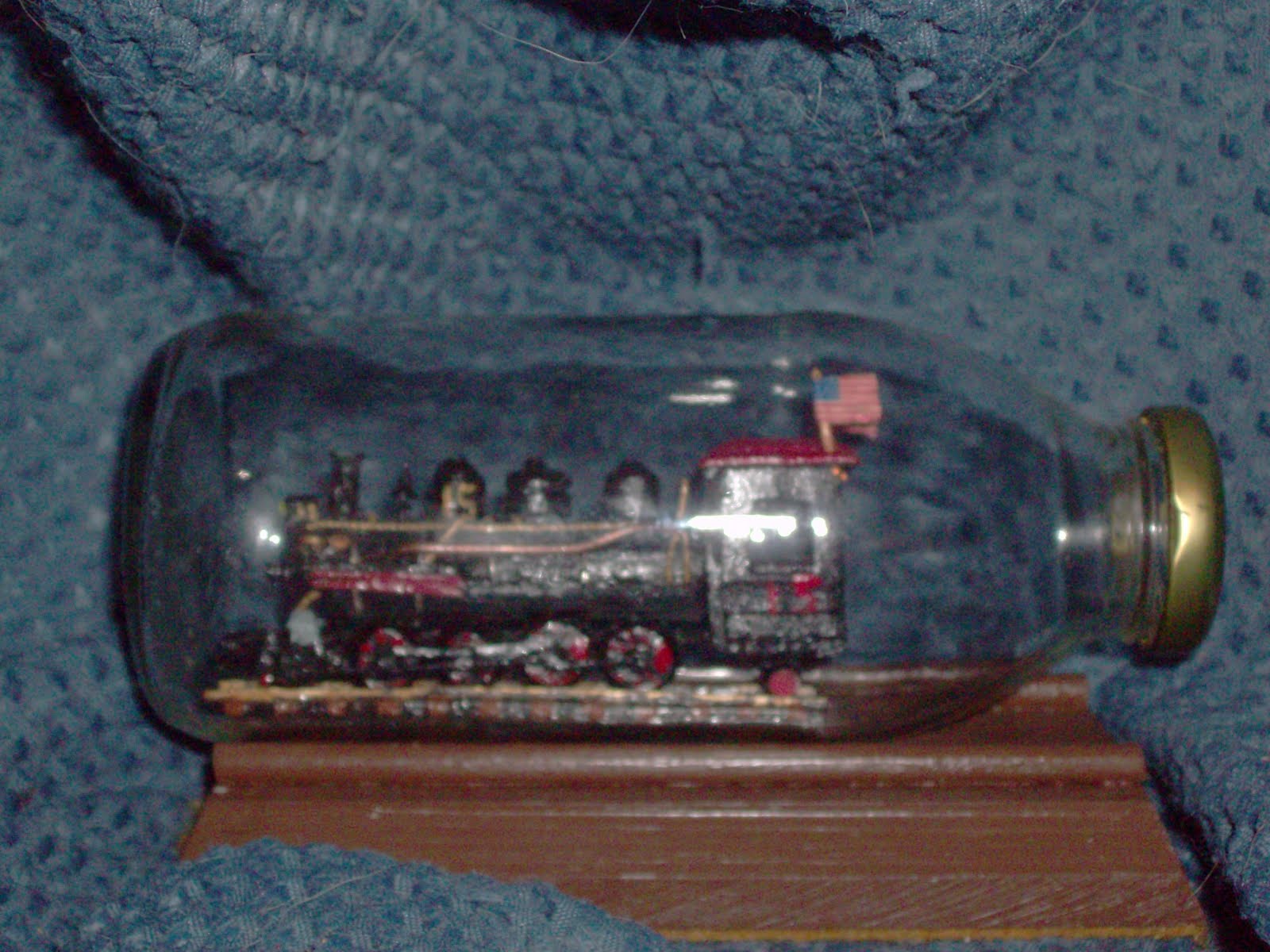
We’ve all probably heard of ships in a bottle, but trains in a bottle???
Shawn has kindly sent in some info for publication about how he approaches the hobby.
Shawn builds locomotives in bottles. Just a few examples are EBT #15, The General,1829 Stephenson Rocket, Porter Pusher, French 2-10-2. He starts by picking a locomotive and finding as much info as he can about the size and history of the locomotive. He gets pictures and scales them to the bottle size. Shawn builds the locomotive outside the bottle and then inserts it in bottle a piece at a time starting with track then wheels and up. Shawn had some bottles hand blown as this show off the model best. His scaling is between 1/120 to 1/150 (close to N scale). He uses silicon sealer to hold track to the bottle. Shawn then use both super glue and wood glue.
John has a question for readers on baseboard construction with a helix:
“If you are creating a gradient to take a track from normal baseboard level to a high level section and this gradient goes around a curve at one end of the layout (assuming oval form), then the track base is part of a HELIX!!!!
You cannot therefore use normal rigid baseboard material like 9mm plywood or chipboard.
What would other members suggest in this instance in order to twist the base material into the shape of a helix?”
Comment below.
Keith asks readers:
“I am about to model the layout Onion Pacific RR in Roberts book (the plans section). I am wanting to know if anyone can tell me what other turnouts can be used other than the Atlas snap switches as listed, ie. # 4,6, or 8. I am restricted to a table top of 10×5 and can’t extend. I would appreciate it if anyone out there can advise me as I am new to the hobby.”
Comment below.
Mike want to hear reader’s comments in reply to his posting:
“I have a Fleischmann HO Layout with Lenz DCC and several years HO experience. I am just now beginning an outdoor G Scale layout for our grandchildren. I have 3 Aristo Craft Locos (a Rogers and 2 Switchers) pulling about 4 to 5 cars each on Aristo Craft track (combination brass, stainless and some alluminum)powered by the Aristo Engineer Power Pack with remote control(s). I have track for about two 15 by 35 foot ovals and it is very difficult just to keep up speed beyond a crawl. This even though I have run several extra direct connections. When the rails become tarnished over time I expect it will be impossible to even send the train around.
I believe that a rechargeable battery system rather than rail power would be a more reliable way to run outdoor trains. I expect the rechargeable batteries would be a bit expensive but performance is more important than being frustrated with no power. I would like to start out with a reliable system that is reliable and expandable rather than invest further in rail power. I would also like to control sound remotely.
Does anyone have experience using the Aristo Craft Battery Powered system?”
Stuart asks readers.
“Which controller should I buy? I’m new to the hobby but I want dcc with sound. I am in my 60’s and am not as dextruss with my hands. My own thoughts is the Viessmann 5300. If I am spending this sort of money advise would be welcome.”
Comment below.