Everything on model trains, model railroads, model railways, locomotives, model train layouts, scenery, wiring, DCC and more. Enjoy the world's best hobby... model railroading!
Willem from South Africa (I think) has sent in this question for anyone with knowledge on how to program turnouts and asks:
“I just bought the Bachmann Wireless controller (36505 supposedly the new model) and some Bachmann DCC equipped turnouts. How do I program the turnouts onto the handheld controller? Neither the turnout or controller has instructions on doing this.”
Use the green Comments & Feedback link to add your thoughts to this posting. You simply register (if you haven’t already done so) and you can then join in the discussions on future postings. It takes only 2 minutes to register.
Ralph has sent in this question for readers:
“Does anyone know of N gauge that is to N track what on30 is to HO gauge to represent narrow gauge on a HO scale layout.”
Edward has an HO layout and has a question for you about attaching trucks:
“I’m building an old Ambroid kit (ST. Louis, Iron Mtn stock car) and am not sure of the best way to attach the trucks to the underbody – what size & type of screw, should there be an intervening washer, etc. The kit directions don’t give any info on this. Any help from someone reading this will be appreciated. Also any on-line links to websites/blogs about the kits.”
Tom has kindly sent in this tip for S Gauge (1/64 scale) enthusiasts:
“These are a couple ways to build a sturdy but light platform. If you buy standard metal wall studs at the home center, say 10 ft. long, use these as the main outside and inside horizantal supports. You can put standard wood 1×4’s between the metal studs for leg support.
For the decking, take a hint from the Aluminum patio enclosure people. The roof sections they use are 4inch foam with thin sheets of aluminum sheets glued to top and bottom. Incredible strength. In the railroad application, use 2 inch or 4 inch blue or pink foam board and sandwich between thin sheets of plywood. You can glue more foam board on the top for the landscape.”

“We all know it’s like working under your layout when you have age and knee problem. What I have done with my lay out 9ft X 5ft is I built it in two layers. The top is hinged to the bottom layer so when I want to work underneath all I have to do is hinge the top layer up, lock it in place with a strut at either end and I then can sit on a stool underneath and wire quite comfortably.”
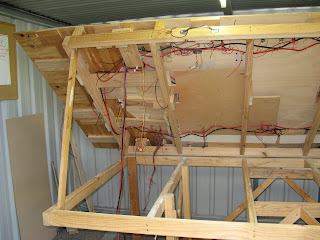
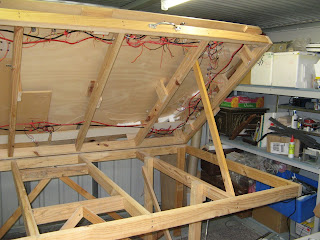
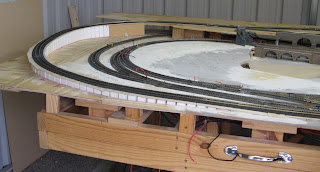
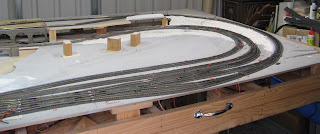
I’m sure this tip will be a big help for many, especially those who are getting on in years or struggle with mobility. Well done John for sharing this helpful tip. It is very thoughtful!
Edwyn has kindly sent in this model train tip for publication:
“Here’s a tip to help add ‘depth’ to a layout. If you are modelling, say, in HO and you have telephone lines running into the background, use N scale poles for the last 3-4 say. Their smaller size helps create an illusion of distance.”
If you have a tip to share with other model railroaders please submit them here http://www.model-railroad-resources.com/train-tips.html
We are all in this hobby together, so it is a good idea to help and encourage each other…especially new-comers who sometimes pull out of this wonderful hobby through frustration with lack of support or mentoring. This is a great shame, especially when there are so many well qualified and experienced model railroaders who would be happy to share ideas, but just don’t know how to go about it. Well… if you have the experience and are willing to help others, then this is your perfect opportunity to do so.
Submit your best Model Railroading Tip (s) at
http://www.model-railroad-resources.com/train-tips.html
Simply complete the form by entering your best model railroading tip(s) and I will publish the best suggestions on this Model Train Help blog site which is dedicated to helping others in the hobby. I don’t charge for people to access the site, so it is popular with many new-comers to model railroading.
Here is a sample tip received from a Richard T:
Building Tunnels Through Hills And Mountains
I made a big mistake recently when building a tunnel through a mountain and it caused me all kinds of problems. Please tell everyone as I would hate anyone to make the same mistake. I forgot to check that there was enough space for my biggest loco to run through the tunnel before I applied the paper mache to the chicken wire frame of the tunnel. You can probably guess what happened next. The loco was too high to get through the tunnel. I was so annoyed with myself as it was something I could have easily fixed and avoided hours of extra work and frustration. Please tell others!
Ian from Australia has a question for anyone who knows anything about cleaning brass trains and asks:
“I have several brass locos that I’ve collected over the years. Being an armchair
railroader – I have a new (couple of years ago) 4.5 x 11 metre Colorbond shed – but haven’t started a layout yet – the brass locos have been in storage and some are tarnished, or worse – a few that were in a tea chest which suffered rising damp are green! With all the boiler detail I can’t use a rub-on cleaner like Brasso, they’d need to be dipped or have something applied and removed with an old tooth brush. An ‘Easy-Off Bam’ TV ad showed a copper coin being dipped and coming out clean, but the labels on their bottles say not to use it on copper or brass. Any ideas from somone would be appreciated?”
Use the green Comments and Feedback link below to help Ian with his Brass Loco problem. It takes only 2 minutes to register (if you haven’t already done so) and then you can participate in future Model Train Blog discussions.
David from Australia operates Hornby trains and would like to hear from anyone who shares his interest. David is trying to locate Hornby parts and asks readers:
“I collect, restore and use Hornby 3 rail loco’s which where made through the 1950’s and 60’s.(HO/OO). Although the track, loco’s and carriages are easily obtained, motor parts and front boggie wheels are hard to come by. I can remove them from other trains, but it means one less useable loco, and they are becoming expensive and scarce. Does anybody know where I may be able to purchase these parts?”
If you can help David – simply click on the Comments & Feedback link below David’s posting. Then register (if you haven’t already done so. It only takes 2 minutes and then you can join the discussions on this Model Train Blog site.
Michael was having problem with the frogs on his layout and has found that Electrocure conductive paint forms a conductive pathway which solved his problem. Here is what Michael has to share:
“I have a tip that might be handy for other model railroaders. When older trains go over plastic frogs on points they sometimes hesitate. I painted the tops of my frogs with car rear windscreen heater repair paint called ELECTROCURE – an electrical conductor paint and it cured mine. Best wishes.”
Rick has emailed his thoughts regarding the bonus section in my Model Train Help Ebook on airbrushing and I am sure he won’t mind sharing them with you. Rick makes a really good point on avoiding damage from spray pressure on lightweight cars. Here is what he has to say:
“I’m glad to see you placing this segment on airbrush work in the book. I’ve done and still do some custom paint work and an airbrush can be a true gift if used properly. It can also be a curse if you think you can pick it up and use it like a spray can or brush. Your explaining the angle and spraying before and past the item being painted is a major benefit to all airbrush use. Also the paint thinning and proper air presure are of high importance. This is because if you don’t have an n-scale locomotive body secured properly it can be all kinds of fun chasing it around the paint booth to put the paint on, or having to completely start over, because it fipped over and messed up your paint job. Just some thoughts from learning trials.”
Thanks Rick for your useful suggestions. Airbrushing is a lot of fun and can take some time to master, but the results can be very impressive and rewarding. Airbrushing techniques can be effective on cars, structures, scenery and even backdrops.
Michael is experiencing a problem that most in the hobby will face from time to time. If he searches the blog he will probably find similar questions and answers dealing with the problem trains running erratically. If someone would like to give Michael some suggestions please use the green Comments link below Michael’s posting to add your thoughts. Here is what Michael asks readers:
“I have a DCC layout it all work OK for 10 to 15 min then the trains begin to stop and start in random places on the layout. Can someone help me?”
Don has a question for readers on paint colrs and supply and asks:
“I need tank car silver paint to redo several cars and don’t know what to purchase. Has anyone got any directions for me? Also, I would like to do several other cars, but I cannot find a source of correct colors and decals. Any help????? Regards, Don”
Richard is having a problem with track conductivity and wants to hear suggestions from others in the hobby. To have your say you can simply click on the green Comments & Feedback link below Richard’s posting. You then register if you haven’t already done so (it takes only 2 minutes) and then you can participate in future discussions on this site. Here is Richard’s model train question for you:
“I have a very basic problem with engines running smoothly, or at all, on the track. I am running mainly Hornby engines on a mix of Hornby and Peco track. I clean the track with a track cleaning block, and also the loco wheels as well as possible, but still very poor results. A new loco will run better for a short while. Any suggestions about how I can overcome this will be much appreciated.”
Rich has submitted this question for publication in the hope that some helpful model railroader will assist. Unfortunately Rich hasn’t given any details of the solutions he has tried so it may be a bit difficult for anyone to help him. Maybe someone might like to take a stab at answering and maybe Rich could use the Comments & Feedback link below his posting to add some more details so others will have a better idea on how they could help. Here is Rich’s question:
“My train set for the club use was working all too fine til today and now each engine is chugging 2 scale feet or just stops all together, we are using Kato double track and the wiring is also Kato, tried all we know and also some we learned from another member any other solutions that could help is wanted.”
Jim has a question for readers about track codes and asks:
“I had a model RR many yrs ago, I am 70 and starting over. My question is, why the different codes for track? Is one better than the other? Does prototype have these codes? Is it important to my n scale opperation? Thank you to anyone who can help me.”
To help Jim you can add your thoughts by using the green comments link below.
Alex wants to hear from any reader who has experience constructing waterfalls and asks:
“I’m in the process of finishing off a mountain scene and I want a double waterfall. I have a mountain built on a 4×8 sheet of plywood and want a water fall to a pond from the mountain to a pond. Then this piece of plywood is elevated 8 inches off a second 12×16 foot layout and I am trying to install a second waterfall to a second pond. I have the magic water but I don’t know how to put the waterfall together. Can anyone help?”
Larry asks readers for help:
“Does any one know where I can find a good repair manual for marx engines 666 999 333”