Everything on model trains, model railroads, model railways, locomotives, model train layouts, scenery, wiring, DCC and more. Enjoy the world's best hobby... model railroading!
Here is a question submitted by a keen model railroader retating to somke units. If you can offer some suggestions and would like to share your ideas, please click the comments tag below.
He is the readers question:
“I have a couple of questions for your readers regarding the smoke unit in my LGB Mogul ; Mine has burned out, lasted maybe two seasons. Apparently , unless the local switch is in the 0 position, power is always ” on” to the smoke generator per the instructions.
1. Q: Does operating the engine with out ” smoke fluids ” shorten the generator’s life span?
2. Q Do I really have to use LGB’s fluid exculsively? Has my use of Aristo’s fluid shortened it’s life?
I think that we are talking just refined kerosene here not rocket science. LGB also warns of use of power supplies other than theirs. Heck, I had Aristo and have used it for 5 years without a problem plus there are pleanty of excellent after market independent units on the market.”
Click the comments tag to share your ideas.
Here are 3 questions you might like to think about and offer possible solutions. These model railroading questions were submitted by readers to this Blog.
To add your comment or to answer this question, simple click on the comments tag below.
Model Railroading Question 1.
What is the best way to clean that green build-up that occurs on engines and track from the electricity?
Model Railroading Question 2.
Maybe a reader can help me with decals for australian trains, ie. oil tankers & general sign for city areas buildings etc that could be used in the setting up of a purely australian scene?
Model Railroading Question 3.
I have a large n scale layout with a lot of trains and I want to go dcc. What is the best dcc controller for me to use under $200?
If you would like to help one or all of these readers, simply submit your suggestions by clicking the comments tag.
Here is a question submitted by a reader regarding building a modular railroad.
If you wish to contribute your answer and share your ideas, simply click the comments link below and follow the simple instructions.
Here is what the reader has to say:
“I am about to start building a modular railroad. I planned on using a couple of dowels for lining up the modules together with hooks and eyes to keep the modules separating, or using flat or bent brackets with bolts and wing nuts in order to prevent movement. So far it has worked efficiently on my n-scale train.”
“I am about to build an HO scale modular set with 4 modules (due to space) and have been advised not to use dowels, but rather BRASS door slidingbolts. Is this a good way? What I am trying to describe is what is placed on the inside of a door to keep it closed and locked. It is NOT the mechanism wherein a key is required. Have your readers got any ideas on the matter?”
To offer a suggestion simply click the comments tag below and follow the simple instructions.
Here is a list of model railroading clubs in Pennsylvania, Rhode Island and South Dakota:
Pennsylvania
Track2, Allegheny Northern Railroad Club, Capital PenNScalers Harrisburg, Williamsport North Branch Railroad Historical Society Hughesville, Carnegie Mellon Railroad Club Pittsburgh, The AMRS Hazleton, Chelten Hills Model Railroad Club Elkins Park, DARN NTRAK, East Penn Traction Club Philadelphia, GATSME Lines Fort Washington, Great All Saints Model Train Display Pittsburgh, Keystone N Trak model railroad club Kulpsville, Keystone Model Railroad Historical Society Mechanicsburg, Keystone Chapter of European Trains Enthusiasts Marietta, Lehigh Valley Large Scalers Lehigh Valley – Allentown, Lower Anthracite Model Railroad Club – Shamokin, McKeesport Model Railroad Club, Nazareth Area Society of Model Engineers Stockertown, North Penn S Gaugers Lansdale, Penn State Model Railroad Club University Park, Reading Society Of Model Engineers Reading, Southeastern Pennsylvania HO Modular Railroaders Willow Grove, St. Alban’s Railroad Fellowship Newtown Square, Strasburg Model Railroad Club Lancaster, Western Pennsylvania Railroad Society Hickory, Western Pennsylvania Model Railroad Museum Gibsonia, Youngwood Historical & Railroad Museum Youngwood, Pennsylvania.
Rhode Island
Providence Model Railroad Club Providence, Rhode Island Central Railroad Providence, RI Providence.
South Dakota
James Valley Model RailRoad Association Aberdeen, South Dakota.
January 2008
A steam enthusiast from New Zealand recently paid one billion Zimbabwe dollars (approx USD$7,500) for two Garratt locomotives built for the Rhodesian Railways in 1953.
Until about ten years ago, the locomotives were in regular use and have been sitting around idle ever since. The Garratt’s were dismantled and shipped from Africa to New Zealand – a journey of three months.
It is expected to take two years to fully restore them and convert the locos from burning coal to oil.

The all-volunteer Monticello Railway Museum was founded in 1966 as “SPUR” (Society for the Preservation of Unretired Railfans).
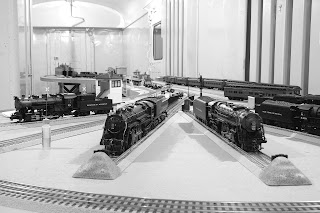

Model railroading offers so many different options, that it sometimes pays to stick with a theme. Perhaps select an historical era that you are interested in and then select your trains, building and scenery from that era. For example: a model train layout depicting California logging railroads in the 1920s might interest you.
Researching a railroading theme can be particularly enjoyable by adding to the fun and also making the model train layout seem more realistic.
Assuming you have a favorite period in railway history, then you might want to base your model railroad layout around that. The alternative is to cover a wider time frame for your model train layout. Think carefully about what time scale you want to model your train layout on.
Click the following link for more helpful model railroading tips and ideas.

When working on scenery ideas remember to carefully study photographs of prototype scenes. There is usually a lot of detail around the enginehouse area, but also remember to add details out along the main, including battery boxes by the signals, yard limit signs, telephone boxes, even a pile of boxes might add to the character and authenticity.

Remember too, there are often signs of maintenance being carried out on sections of the track. Track crews and their equipment can add considerable interest.
Add line shacks, bridge runouts with sand or water barrels, tool sheds, spare parts storage, track and turnout parts, piles of fishplates new ties. Details like these can all contribute to the feeling that real people are maintaining and running the trains over the tracks.
If you live in Australia or are thinking of visiting Australia you might want to visit some of these Australian model train shows in 2007:
New South Wales – Australia
September, 2007
Liverpool
Australian Model Railway Association
CONTACT: +61 2 9567 1899
Queensland – Australia
September, 2007
Graceville
9am-5pm (Sat)9am-4pm (Sun)
B.R.M. Queensland.
Graceville Primary School, Oxley Road, Graceville.
CONTACT: +61 7 3374 2288
Queensland – Australia
October, 2007
Toowoomba
10am-5pm (Sat)
Closed (Sun)
Darling Downs Model Railway Club Inc.
DeMolay House, Margaret Street, Toowoomba.
WEBSITE: www.ddmrc.com
CONTACT: +61 7 4638 1408
South Australia
October 2007
Tonsley Park
9.30am – 5pm (Sat)
9.30am – 4pm (Sun)
Noarlunga Model Railroaders Inc.
Mitsubishi Entertainment Centre, 1284 South Road, Tonsley Park SA 5042
COST: Admission $5.00 (Adult), $2.00 (Children/Concession) $12.00 (Family)
WEBSITE: www.nmri.web1000.com
CONTACT: Events Coordinator, Box 707 Morphett Vale 5162
Over 20 layouts plus static displays, Free parking, Free Door prize and Colouring competition.
Queensland – Australia
November, 2007
Holland Park
9am – 6pm (Sat)
9am – 4pm (Sun)
Union Pacific Model railroad Club
Holland Park Bowls Club 49 Abbotsleigh Street, HOLLAND PARK, 4121.
Queensland – Australia
November, 2007
Carina9am – 6pm (Sat)
9am – 4pm (Sun)
All Gauge Model Railway Club, Zahel Street, Carina.
CONTACT: +61 7 3395 3200
New South Wales – Australia
October, 2007
RockdaleAustralian Model Railway Assoc, NSW Branch Inc.
Clubrooms, Chapel Lane, next to Council carpark
New South Wales – Australia
October, 2007
Guildford
Sydney N Scale Model Railway
Gate 13, 4 Palmer Street, Guildford.
New South Wales – Australia
October, 2007
Bowral
Berrima District Model Railway Club Inc
Bowral Memorial Hall
CONTACT:+61 2 4861 4032
New South Wales – Australia
November, 2007
Hornsby Heights
St Luke’s Railway Modellers 19th Annual Model Train Exhibition. St Luke’s Anglican Church, 155 Galston Road, Hornsby Heights.
New South Wales – Australia
November, 2007
Campbelltown
Macarther District Model Railway Club
Campbelltown Civic Hall, Cnr, Queen & Broughton Streets, Campbelltown.
New South Wales – Australia
November, 2007
KURRI KURRI
Ambulance Hall in Kurri Kurri, with use of the Guide and Church halls next door
New South Wales – Australia
November, 2007
Blackheath
RSL Hall, Cnr Bundarra and Station Streets, Blackheath
CONTACT: +61 2 4758 7005
New South Wales – Australia
November, 2007
Wagga Wagga
Sturt Public School, Lake Albert Road, Wagga Wagga
CONTACT: +61 2 6931 1644 (ah)
ALL YEAR
1st & 3rd Sundays, 10.00am – 4.00pm, every month.
Blue MountainsValley Heights Locomotive Depot Heritage Museum
Tusculam Road,Valley Heights.
Admission: $7 Adults, $15 Family, $5 Child, Children Under 5 free,$5 Seniors.
Contact: 02 4735 8601
For more model train club information.
Nevada
Southern Nevada N-Trakers, Clark County, Nevada.
North Carolina
Cape Fear Model Railroad Club Inc Wilmington, Carolina Coastal Railroaders New Bern, League Of Non Aligned Modelers Raleigh & Boone, Carolina Model Railroaders Greensboro, Hinkle’s Lionel Trains Lionel collector and operator in the Charlotte, Neuse River Valley Model Railroad Club Raleigh, North Raleigh Model Railroad Club Raleigh, Piedmont and Western Model Railroad Club Valdese, Sipping and Switching Society of North Carolina Raleigh & Boone, Triad Live Steamers 7.5″ gauge Live Steam Club Farmington, Waynesborough Model Railroad Club Goldsboro, Wilson Area Railroad Modelers Inc. Wilson, NC.
Ohio
Burning River ‘N’ Society Cleveland, C.A.N.S. (Columbus Area N Scalers) Columbus, Central Ohio Model Railroad Club Columbus, Central Ohio N-Trak Columbus, Carillon Park Rail & Steam Society Dayton, Central Ohio S Gaugers Columbus, Cooke Road Train Crew Columbus, Crossroads Railroad Club Vandalia – Ohio, Cuyahoga Valley S Gauge Association Cleveland, Cuyahoga Valley and West Shore Model Railroad Club Olmsted Falls, Greater Cincinnati Garden Railway Society, The Hocking Valley Model Railroaders Lancaster, Janis Junction Model Railroad Club Columbus, Lake Shore Live Steamers Cleveland, North Coast N-scalers, Pittsburgh & Ohio Northern Railroad Club Ada, The Sebring Model Railroad Club Sebring, Swanton area railroad and model club inc. swanton, Travelin’ Trainmen of North Central Ohio North Central Ohio, Tri-State NTRAK Cincinnati, Youngstown Model Railroad Club Youngstown, Ohio.
Oklahoma
Central Oklahoma Model Railroad Club Oklahoma City, Claremore and Southern Railroad Club Claremore, Grenn Country Model Railroaders Green Country Model Railroad Assoc. Oklahoma, Locomotive Operators of Central Oklahoma, Northeast Oklahoma N Scale Tulsa, Oklahoma O Scalers Oklahoma City – Oklahoma, North Central Oklahoma Rail Road Club Ponca City, SouthWest Oklahoma Railroad Association Duncan, Southwestern Live Steamers.
Oregon
Aloha and Western Oregon Lines HO Model Railroad Club Aloha, Columbia Gorge Model Railroad Club Portland, Corvallis Society of Model Engineers Adair Village, Greater Portland LEGO Railroaders Portland, Over The Hill Live Steamers Chiloquin, Pacific Northwest Division of the Toy Train Operating Society Seattle & Portland, Rose City Garden Railway Society – Portland, South Coast Model Railroaders North Bend – Oregon, Pacific Northwest Livesteamers Molalla, Train Mountain Railroad Museum Chiloquin, OR.
Plan your model railroad layout to be easily accessible, so that you can quickly and easily fix problems.
What can go wrong? Regardless of how good your model railroad trackwork is – train derailments still happen.
Sometimes model train derailments are caused by a super-light flatcar being shoved behind a heavy boxcar, or a hopper with out-of-gauge wheelsets somewhere waiting to pick a switchpoint or be forced off the train track.
Model railroad layouts with S-curves can be a hazard for passenger cars. As well as train derailments, locomotives stall on spots of dirty track, or on turnouts that have insulated frogs.
None of these things are much of a problem as long as you can reach the spot of the accident. The trouble starts when you locate tracks and turnouts on your model railroad layout that are outside your reach.
On paper the placing of a critical turnout 36” or more from the layout edge doesn’t seem like a problem, but once the yard starts to operate, it can become your biggest headache.
For more model railroading tips on avoiding derailments.


My ebook has more helpful model railroad tips for you.