Everything on model trains, model railroads, model railways, locomotives, model train layouts, scenery, wiring, DCC and more. Enjoy the world's best hobby... model railroading!
Model Railroading Article By Bill Murphy
One of the more fun aspects of model railroading is planning and executing the scenery and landscaping that your track and engines will meander through – for some it is almost like playing God in that you can decide and create on any scene you desire.
From fanciful hobbit themes, alien worlds or realistic recreations there is nothing that you cannot create and display, all it takes is a plan, some materials, a little skill and some time.
First and foremost you need a plan or at least a concept.
– Do you want to duplicate an existing landscape?- Do you want a faithful historical recreation of a place now lost in time?- Are you more inclined to creating a never-before seen or unlikely scenario to wow the masses?
Making a choice on one theme for your layout and staying true to that theme is perhaps the most important keys to success. If you change your methods and style in the middle of your landscape the result will be inconsistencies that will detract from the overall impression you are trying to form.
Ideally those you invite to view your work will see a delightful scene and the harder they look the more detail enforcing that scene they will find. Nothing is more enjoyable then hearing those delighted squeals as a viewer notices ever more subtle details as they come closer and closer … and the key to that is consistency.
Once you have a plan for the theme you need to decide on track placement and terrain. Many modelers create the terrain and then try to force the track to follow through that, just as occurs in real life – but one of the advantages of modeling vs. real life is that you can consider all aspects and requirements up front. If you know you will have a bend or a switch at certain points why design rough terrain that you will then try to overcome with ‘grading’ in your models at those points?
Next you should collect your materials – some items you can find around the house, others you may wish to purchase from dealers such as www.oakridgehobbies.com and www.jttmicroscale.com or your local hobby shop but always stay true to your plan. Just because you find an amazing little miniature you long to use doesn’t mean it belongs in this model!
Common materials you will need include:
1. Tables or Stands
2. Plywood (preferably ¾” outdoor grade) for base if using stands
3. Glues
4. Twigs, ‘dirt’ gravel, crushed or powdered stones, herbs etc. for plants and groundcover
5. Paints of various kinds for touch-up, covering the base and backgrounds etc.
6. Poster board, wax paper, aluminum foil, tissues etc. for texturing and shaping
7. Styrofoam blocks and sheets for shaping
Optional items you may wish to use include:
8. Plaster of Paris and / or fiberglass
9. Talcum powder, pepper and salt, cayenne pepper – for texturing and colorants
10. Corkboard and cork ‘paper’
11. Roof repair tar (for road surfaces etc.)
12. Paintable caulks and adhesives for securing items in place
Are you looking for some creative ideas for making model railroad scenery? Visit http://www.themodelrailroader.com for some helpful ideas and tons of other information about model trains.
Model railroading has become a life-long hobby for tens of thousands of enthusiasts worldwide. Although many outside the hobby fail to understand the attraction, most people involved in with model railroading find it to be an absorbing and extremely satisfying pastime.
The reasons are many and varied. For those not already involved with the hobby here is a quick summary of what you might expect to gain from this wonderful hobby.
Along the way you’ll acquire valuable skills in carpentry, electrical wiring, problem solving and design.
You’ll discover creative opportunities that will bring to the fore your hidden talents when building scenery.
You’ll develop a hands-on knowledge of geography when making landscapes.
You’ll step back in time and learn how things operated in bygone days.
You’ll gain some engineering savvy when designing your benchwork so it won’t collapse, or examine how a level crossing operates, or a bridge is built.
You’ll enjoy the fun of creating realistic miniature replicas of life that can be enjoyed not only by yourself, but also by friends, family members, children and grandchildren to come.
To learn more about the hobby of model railroading simply visit http://www.model-train-help.com for lots of helpful tips, clever ideas as well as useful website links about model railroading.
Here is a short article about the history of Lionel Trains written by David Faulkner.
In post-Civil War America, trains were the only way to travel. The only other method commonly available was a horse and trap and that was most definitely not the way to travel in comfort. Joshua Lionel Cowen was amazed by the trains and their ability to transport people around the United States. He was fascinated by the technology and mechanisms associated with the locomotive and could not wait to pass his knowledge onto his children and other children at the same time. Old Lionel model trains were born as a result.
It has been over a hundred years since Cowen unveiled his vision and began producing toy trains and model railroad paraphernalia for people to buy. He meant them as educational tools as well as a forum for fathers to bond with their sons. He was based in NewYork at the time and managed to hire a few gifted craftsmen to help to create replicas of the locomotives that wound their way all over the United States. They believed that they were all investing in a limited business that would remain within the city. They never dreamed that the company’s popularity would span as far as it has, let alone the fact that children and adults alike would be clamouring to buy Old Lionel model trains now!
Every child from the turn of last century had a train. It was a standard to own one in the early 1900s because children actually had very few toys. Those they did have were precious. As a result, old Lionel model trains are now widely available in antique stores and old children’s toys stores all over the country, but they are also very valuable and you can end up spending over the odds for them. The reason that they are so popular is because they were highly detailed and proved to be of high quality over the years. Not only did old Lionel model trains stand the test of time, but also they can actually tell us a lot about the trains and the toys of the era.
Most train collectors, including those that have model railroads today will be happy to tell you the value of an old Lionel model train because they are usually very knowledgeable about them. They are actually pretty similar to gold dust where they are concerned. You can find old Lionel model trains on the Internet for extortionate prices these days but, not surprisingly, collectors are willing to pay well over the odds for them. You could also trawl around garage sales because there are usually one or two there, sold by people who have no idea of their value. That is the best way to pick up old Lionel model trains bargains!
You can also find more info on http://www.modelrailroadshelp.com a comprehensive resource to know more about model rail roads.
Although train whistles can be annoying if you live or work near a railway track, they are an important safety device essential for warning of potential dangers.
Four “toots” is the most common train whistle you’ll hear. The four “toots” consists of two longs, a short and a long whistle. This whistle sequence is the one used when a train is crossing a road where cars or people might be present.
“Whistle boards”, commonly an “X” on a small plate on a post, indicate where the engineer is to begin to sound this signal. The law (rule) is that this signal is to be commenced a quarter mile in advance, or 20 seconds in advance of occupying the crossing or other structure.
As well as being a warning device, whistles also serve as a communication tool between train staff. Various combinations of whistles are used by the engineer to tell the conductor or brakeman of various conditions.
The train whistle is also used as a protection device when approaching tunnels and bridges. The engineer is required to sound the whistle where there are impaired side clearances.
A succession of short “toots” is sounded in an emergency such as people, vehicles or livestock on the track. Other trains hearing this signal must stop until it is safe to proceed.
The way the train engineer sounds the wistle has different meanings:
By Michael Ball
Modelers of HO trains model after specific railroad periods of the United States and Canada. From almost the onset of American railroads the 40 foot boxcar has been in existence. It began to disappear from the railroads in the 1960s.
Refrigeration was changing from the old ice method to the modern thermal air-condition cars that were self cooling. Also, the 40 footer was beginning to be too small. The larger 50 & 60 footers were taking over and they even experimented with 86 foot boxcars. The big railroads wanted to haul more goods and reduce the tonnage they had to haul. It took 125 40 foot boxcars to equal 100 50 foot boxcars. The reduction would be 25 less 40 foot boxcars times their empty gross wait.
This was certainly an advantage for the railroads let alone the maintenance of the smaller boxcar. With this in mind the majority of the model railroaders I know still prefer the 40 foot boxcar. They like the era from the late 1920s though the early 1960s. They are also very colorful and interesting. Many of these nostalgic colorfully designed boxcars are gone unless they might be in a railroad museum. There were so many different designs and logos to see.
The hobbyist still has the opportunity to find many of these colorful boxcars that are manufactured by several model railroad producers of freight cars. Some examples are Kadee, Intermountain, Athearn/Athearn Genesis, Accurail, Bachmann, Walthers, Red Caboose, Bowser, Roundhouse (Roundhouse is now makes only the pre twentieth century cars), Branchline, Life-Like, etc. There are several more that sell kit form freight cars as do some of the aforementioned companies. You can even get wood kits but they are not common.
Now for the types of 40 foot boxcars there are more than you may possibly think. The types of construction and usage varied. It all depended where the railroad was mainly located and types of products, food and perishables that were being shipped. From perishables, staples (wheat, Corn, Barley, Soy, etc.), equipment that needed to be enclosed, parts, manufacturing equipment that was relative small and the manufacturer did not want the tools and or equipment dinged by flying debris, ice, snow and heavy rain, and typical Midwestern hail storms.
Typically soft goods like flour, sugar, fruit, dairy products, and processed meats were hauled in 40 foot reefers. These boxcars are smaller in size than the standard 40 footer. The majority of these reefers were wood as were most of the other types of 40 foot boxcars. This changed however, as time went on to metal reefers.
There are multiple types of 40 foot steel boxcars. There are the following types:40′ Superior Door Boxcar; 40′ Double Door Boxcar; 40′ Ribbed Boxcar; 40′ Modern Boxcar; 40′ Express Boxcar; 1937 AAR 40′ Boxcar; 40′ 12 Panel Boxcar; 40′ AAR Modified Boxcar; 40′ PS-1 Boxcar; 40′ Boxcar w/Youngstown Doors; 40′ Double-Door Boxcar; 40′ High-Cube Boxcar; 40′ Ribbed Boxcar; 40′ Steel Boxcar w/6 Panel Doors; 40′ Steel & Wood Ice Bunker Reefers; 40′ Steel & Wood Boxcar. This includes several types of 40′ stock cars.
In all they all had a specific purpose for the railroad as well as the user. Many of the reefers were labeled with the name of the product and producer of the goods being carried. There was Rath Black Hawk Meats, Swift, Carnation Dairy Products, Needham Meats, and major carriers such as Pacific Fruit Express. The Pacific Fruit Express Company (PFE) owned the largest number of reefer cars of any of the different reefer users. Union Pacific owned the second largest number of PFE reefers and pulled more reefers than any other railroad during that period of the 40′ Boxcar/Reefer era.
As time has gone on the boxcar has almost disappeared from the railroads. However, the need for boxcars has now become critical. The Piggy Back and Double Stack Containers is not necessarily the means needed for some goods. The boxcar may indeed have a come back on the railroads of today.
The model train scale you choose to model in will depend on what you want from a layout and the space you have available. So, think carefully, before you choose which scale you want to model, because depending on your available space (and budget), you can achieve different things with each train scale.
Think about whether you want to see long trains running quickly through a town or countryside scene. Or, would you prefer a small compact model train layout featuring a branch line terminus and small goods yard with lots of small shunting moves? With model railroading there is a lot to think about before you choose which train scale you will model.
Happy Railroading!
 The flywheels on the locomotive are another important feature. Flywheels are solid-metal cylinders mounted in line with the motor. Flywheels at one or both ends of the locomotive motor ensure a smooth take-off by slowing down the initial rotation of the motor. Flywheels help achieve a smoother stop when the electricity is turned off. They also help the locomotive operate more smoothly and negotiate dirty track better.
 When buying a new or used locomotive always feel its weight. Locomotive weight is important to ensure that the wheels connect and stay firmly on the track. This is achieved through solid metal frames.
For more model railroad information on locomotive wheels and flywheels have a look at the Model Train Help Ebook.
When buying a new or secondhand model train locomotive always carefully check the wheels. When not connected to a gear, the locomotive wheels will move easily when prodded with a finger. The wheels on a locomotive may move just a little and then go stiff. If that happens it is usually an indication the wheels are connected to a gear. That’s a good sign.

When buying a new or used locomotive careful check the motor because it needs to be of good quality, to turn smoothly, using the least amount of electricity.
If the locomotive is slow to start, then it may not be worth buying. You may be better to save up to buy a better quality locomotive.
Here is a question from a model railroader in New Zealand who has just purchased a pilot train; an ON30 gauge Bachmann 28 ton Chey loco and rolling stock. He is working on a layout that could be 20-30 yards long and will be based on 19th century trains a lot of which came from the USA. Here is his question which fellow model railroaders might like to offer some help with:
“Where/who is the best source of 19th century, ON30 gauge, logging type trains,
rolling stock, buildings, scenery and DCC equipment?”
The model train enthusiast is also looking for “distressed” buildings and model trains which look as though they have had some service and been around for some time. This is for reality purposes.
To answer this question simply click on the comments tag under this.
Here is a model rail question from a fellow railroader. You might like to offer some ideas.
“I am thinging of a layout fitted onto a 4 x 8′ board. The only problem I have is it would be difficult to move around. If I make it 2 4 x 4′ boards it appears to work better. The boards would sit on 6 wooded posts: two for the left end, two for the center where the two boards are connected, two for the right end. Of course everything would have to be connected after the move. This should be not a problem as how often do you move house. Any thoughts from your blog readers would be appreciated.”
To offer an answer to this model railroading question simply click on the comments link below.
Here is an opportunity for experienced model railroaders to share their ideas with others involved in the hobby. An N gauge enthusiast has this question:
“What precautions / technique are needed to ensure N gauge points are not gummed up by ballasting when using the accepted ballast -diluted PVA method?”
If you would like to offer an answer to help this fellow model railroader, simply click on the “comments” link below and submit your answer to the moderator for publication.
There are several model train shows and exhibits planned for 2007 in most states and around the world. Here are four upcoming events:
The 2007 National Model Railroad Association National Train Show® will be held at the Cobo Conference/Exhibition Center July 27 – 29, 2007 Detroit, MI. Each year this big event is held in a different city and state in North America. Detroit, MI will host the 17th Annual National Train Show® which will showcase all aspects of model railroading including the industry’s newest and most unique products and services from manufacturers and retailers from the U.S. and around the world. The event will cover 180,000 square feet of space, including over 45,000 square feet featuring extraordinary operating model train displays.
The Great Scale Model Train Show will be held at the Maryland State Fairgrounds Timonium, MD Saturday June 23, 2007 9am – 4pm and Sunday June 24, 2007 10am – 4pm. Another model train show will happen at the same venue on Saturday October 13, 2007 9am – 4pm and Sunday October 14, 2007 10am – 4pm.
And in New Zealand…
An annual event organised by the Christchurch Model Railway Exhibition Society Inc with trade stands and in excess of 20 layouts of various scales and trade stands catering for both the serious modeler and those wanting a family day out. This New Zealand train show will be held at the Pioneer Stadium, Christchurchon Saturday 6th & Sunday 7th October 2007.
Here is a question from a model railroading enthusiast about Bachmann steam locomotives. RJ asks “How do you fix/repair a stalled/stuck drive gear set, on an older Bachmann steam locomotive?”
This is an opportunity for you to share your ideas and thoughts. Simply click on the comments tag below to add your answer.
Cleaning model railroad track is one of the best ways of improving model train performance.
Several track cleaning methods are available to the hobbyist including using Goo Gone®. This product is a general cleaning agent that seems to remove much of the grime that build up on railway track.
Goo Gone® is a combination of Citrus Power and scientific technology designed for tough cleaning problems.
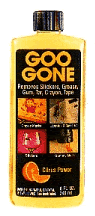 Goo Gone® has minimal impact on the environment and is safe to use on almost any surface.
When cleaning rails use a small amount of Goo Gone® on a rag and just wipe. If the railroad track is rusted or corroded use fine sandpaper or a track cleaning block after sanding the rails. Then wipe with Goo Gone® or other cleaners.
Some hobbyists also use Goo Gone® on the wheels of their locomotives. Goo Gone® or fine sandpaper can be used to make the wheels bright and shiny.
As well as using Goo Gone® on model railroads, the product can also be used on: carpets, upholstery, clothing, tile, glass, grills, appliances, vinyl, wood, draperies, autos, boats and fiberglass.
The manufacturers claim Goo Gone® is effective on: gum, tar, crayon, fresh paint, tree sap, oil and grease, blood, ink, asphalt, scuff marks, tape and tape residue, makeup, lipstick and mascara, adhesives, candle wax, kitchen grease, shoe polish, soap scum, bumper stickers, duct tape and bicycle chain grease.
A keen model railroader named Keith, has offered to share his ideas on weathering track to give a rusty appearance on Gauge 1 and other thoughts on this fascinating hobby we are involved in. Here are his thoughts. If you would like to offer your ideas on this subject, simply click on th comments tag and submit your thoughts to the blog moderator for publication on this blog.
“Thanks for the model railroading tips and info you have sent me. My own model railroad journey has gone through Gauge O then Gauge N back to O and now into Gauge1 live steam. All this has been over a period of nearly 30 years and almost entirely British outline until recently. “
“The Gauge 1 will eventually be run outside, I am planning about 70 yards of track per loop and eventually 3 tracks wide plus a steaming bay and sidings for rolling stock marshalling. In this scale a scale mile is just under 60 yards. “
“I am using Cliff Barker Code 180 stainless steel track which is supplied as separate 1 or 2 yard rail lengths and moulded UV stabilised sleepers. For realism I am rusting the rails by acid etching, thorough washing then covering with fresh degreased mild steel and leaving this to rust outside for a few weeks before removing the rusted steel and assembling thetrack. The moulded plastic chairs can be painted in suitable rust colour enamels for realism.The rust stains the etched surface and this appears to be quite stable although it remains to be seen how durable this is outside. The nice thing is that the colour has to be right as it is real rust and it has that dry matt appearance of rusty rail.”
“The running surface can be buffed back to bright steel using wire wool.This technique may be adaptable for nickel silver railin other scales. “
“For locos I already have an Aster Flying Scotsman, an Aster Schools class, an Aster Prussian T3 tank loco,an Aster BR86 tank loco and an Aster Lion andhave on order an Accucraft Canadian Pacific Royal Hudson which is due for delivery during the summer. I also have a few items of rolling stock both British outline and German epoch 1 and have ordered 6 carriages to go with the Hudson. “
“I am developing a real taste for North American railroads and next on my wants list is a Burlington Pioneer Zephyr set proper diesel electric in Gauge 1. Just to confirm what a nut I am I have also started to build miniature buildings in 1/32 scale from real brick, slate and stone to go on the outdoor railway. “
“My big problems are time and money as Gauge 1 is incredibly expensive and layout building on this scale requires lots of pre-preparation, planning, materials and continuous time to build the basic structure. From then on lots of the work can be done gradually. At my current speed I expect it will besome time in 2008 before I am ready to run a train. Happy model railroading from a fellow nut.”
The Aztec Annihilator is a system for cleaning dirty track (HO). The Annihilator was engineered for ease of use and minimal maintenance. Aztec are the first to admit that the car was not built to look utilitarian but instead to be a functional piece of rolling stock.
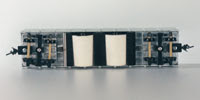
The custom painted 40ft gondola is gray with black “M.W.” and dimi data. No road or end numbers are provided. The modeler can apply decals (not included) in the railroad of his/her choice. To finish off the car the hobbyist might want to cover the mechanism with a piece of cloth (not supplied) to simulate a tarp.
The Aztec Annihilator can be run in a train and go unnoticed without hitting scenery or derailing.
A hard black anodized aluminum chassis holding two free rolling canvas rollers at a slight angle to the railhead, a magnet and a fluid reservoir (1/2 oz. capacity) is housed in a 40 ft gondola equipped with Kadee® couplers.
There is a valve to regulate the amount of cleaning fluid dispensed to the front roller. The rear roller is run dry and mops up loosened grime. A clear plastic lid covers the reservoir allowing you to see when it is running out of fluid. Turn valve about one quarter turn for ten seconds or so. Turn off and run for 10 to 15 minutes (or change times to suit).
This stealthy lightweight tips the scales at a mere 7-3/4 ounces soaking wet. The Aztec Annihilator will clean in either direction but works best with the magnet to the rear.
 Although I don’t personally recommend any particular brand of model trains or accessories, I do from time-to-time mention some of the products available for use on a model railroad layout.
The MRC Symphony 77 has more than 25 different sounds, with sound-on-sound combinations and controllable speedrates for diesel and steam. The MRC Symphony 77 has steam or diesel modes, a choice of horns, whistles, bell sound, rail clacks, an air release, brake, dynamic brake,water pump, fan, coal being shoveled sound, conductor, and even a crossing gate sound effect.