Everything on model trains, model railroads, model railways, locomotives, model train layouts, scenery, wiring, DCC and more. Enjoy the world's best hobby... model railroading!

Low Cost Ballast Ideas For Trackwork

When viewing a model railroad layout the eye tends to focus on the scenery, buildings, the trains and track. Making the trackwork look realistic is therefore critical to any layout, because it defines from where your line is coming to where it is going.
Apart from the track itself, ballast is the other major component of the trackwork and can take considerable work (and money) to achieve the ultimate effect.
Fortunately there are many very good ballasting products specifically produced for model railroaders, but these can prove reasonably expensive, considering the quality required to complete most model railroad layouts.
Masonry sand is an option worth considering for those working on a tight budget. The good thing about masonry sand is that it is available in a range of pigments with different degrees of coarseness. If the desired color is not available, the masonry sand could still be used as a base coat with regular ballast laid on top.

Masonry sand is generally sold to builders, so is likely to be available from a hardware store, or building supplies depot. The sand generally comes in minimum size bags of approximately twenty-five pounds. Although this sounds a large quantity, it will soon be used up when spreading it around track areas of an average sized model railroad layout.

One big difference between builders masonry sand and regular track ballast is the price. The masonry sand is considerably cheaper to buy.
A quick word of warning. Some masonry sands do contain iron which would be the same as soldering a wire between the rails. A strong magnet will detect any iron in the sand and could be worth using before buying the masonry sand.
Test the product in store using the magnet. Sand sticking to the magnet is a sure sign of iron content. If this happens do not buy the sand and instead test the magnet on another color.

Click To Add A Comment  Ask A Question

4 Model Railroad Layout Considerations

When building a model railroad layout there are all kinds of things to consider in the planning stages.
Some points relate to practicality and others depend on personal preferences regarding the visual look and type of operation required.
Among the things that need to be considered when planning a model railroad layout include:
1. Do you prefer realistic scenery or lots of tracks?

2. Do you prefer mainline running or lots of switching?

3. Do you prefer trains running through countryside or cityscape?

4 Do you prefer prototypical operation or just running trains for the fun of it?
If you know exactly what sort of model railroad layout you want, you’re probably not a beginner. From experience you’ll know what you like and don’t like on a model rairoad layout.
It doesn’t matter whether you are new to the hobby or an old pro, the same rule applies. Think carefully about what you want from a model railroad BEFORE you start to build the layout.
Careful planning can save a lot of time, money and stress.

Click To Add A Comment  Ask A Question

Police Investigate Theft From Model Train Show

I hate to report bad things, but this should be a wake-up call to everyone involved with model train shows.

La Crosse police in Wisconsin recently investigated thefts from five vendors at the March 2007 Model Railroad Show held at the La Crosse Center.

According to reports, around $700 worth of model railroading products were stolen from the vendors at the train show.

Police report missing models included three locomotive engines ranging in price from $164 to about $300, a stock train car worth $100, a $50 scale model hardware store and two bags of kits valued at $20.

Although 99 percent of visitors to model train shows are genuine, there is always the potential for some thief to spoil the fun for everyone. So, if you are displaying your trains at model train shows, take care.

Click To Add A Comment  Ask A Question

Track Cleaning Devices

Here is an unusal track cleaning device called the Noch Snap On Track Cleaner. The cleaning brush is built into a strong plastic frame that clips onto an axle of a model train piece. It apparantly works in the forward or reverse direction and is suitable for HO models in DC or AC track systems.

Click To Add A Comment  Ask A Question

Different Track Cleaning Option

Clean track is essential for any model railroad layout because the power for the locomotives motor comes from the track up through the wheels. Keeping the wheels clean is therefore critical as good performance depends around 90 percent on clean locomotive wheels and 10 percent on clean track. Both track and wheels affect smooth running on a model railroad layout.

The Model Train Help Ebook discusses this in more detail and covers several methods for track cleaning and gives many helpful tips on keeping the track clean.


One option not mentioned in the ebook is the Gaugemaster electronic track cleaner. According to Gaugemaster, “The 12v D.C. controlled output from the controller is passed through the unit. Connection between unit, power source, controller, and track is completed via six terminal connections. The unit superimposes a harmless high frequency signal over the output from the controller. When a poor contact between loco and rail is detected the unit switches on, ionising the gap and burning off the dirt, switching off again when contact is restored.”
Personally, I haven’t tried the Gaugemaster track cleaning system so I can’t personally recommend it, but it is another track cleaning option to consider. Also, worth nothing is that Gaugemaster offer the track cleaner as a single track cleaner or a twin track cleaner.

Click To Add A Comment  Ask A Question

What Is Kit-Bashing On A Model Railroad Layout?

When building a model railroad layout many modelers buy the buildings for the layout either pre-built or in kit form. Some modelers also prefer to scatch build everything rather than buying pre-made or ready to assemble kits.

For most model railroaders it really depends on time, money and whatever skills they have.
The ready to assemble kits and ready made kits generally have that “plastic” look that needs touching up and weathering to add realism.
Another option many modelers choose is “kit-bashing.” It sounds like a complicated term, but it is really very simple to explain.
Kit-Bashing is when you buy a kit that is ready to assemble, but instead of following the supplied instructions, you modify it and add your own ideas.
You might decide to put the kit together in a different way or perhaps combine the parts from two or more kits together. Alternatively, you might add some other items, or delete items and create a different structure from the basic kit. When you do that you will have a kit-bashed model to go on your layout. That’s what the term “kit-bashing” basically means.

Click To Add A Comment  Ask A Question

Model Railway Society To Celebrate 70 Years

The UK based Nottingham Society of Model and Experimental Engineers Society was formed in 1929 and for nearly seventy years has attracted modelers of many disciplines. The current membership numbers about 120.

For almost forty years the Nottingham Society of Model and Experimental Engineers Society occupied a site within Nottingham City boundary and there operated a 7¼” gauge ground level track and a multi-gauge 3½” and 5″ raised track. A well-equipped workshop in separate premises was most useful for members without facilities at home.
In 1992 the Society decided to leave both track and workshop premises and transfer to a new site at The Nottingham Transport Heritage Centre sharing this with Great Central Railway (Nottingham) Ltd.
Since 1992 members of the Society have spent thousands of hours constructing brand new running tracks in 3½”, 5″ and 7¼” gauge together with workshop, storage buildings, platform, traversers, tunnels, steaming bays with inspection pit, turntable and numerous ancillary items.

The two smaller gauge tracks are aluminium rail on cast concrete supports and fully fitted with anti-tip rails. The 7¼” gauge track is of steel rail section with some very fine point work.
Both tracks have easy gradients, none more than 1 in 80 and their total running distance is approximately 700 metres (around 2300 feet) each.

Click To Add A Comment  Ask A Question

Shunting, Shunting, Shunting.

The operation of an industrial line focuses on shunting, shunting and more shunting. Some model railway layouts have a continuous loop to allow the trains to run uninterrupted. However, true shunting railway layouts do not offer this possibility, which is more realistic.

When building an industrial line model railway layout, also think about the types of industries your line will service. To add variety and interest to your model railway layout it usually pays to include several different industries.

In real life some industrial areas are tightly packed, busy working areas, so you’ll want to squeeze in a lot of railway track. That’s one reason why industrial model railway layouts can be fascinating to build and operate.

A quick tip to get more shunting without overloading the scenery, is to give a single plant more independent connections.

Click To Add A Comment  Ask A Question

Butcher’s Shop Home To Model Railway

The UK based Carshalton & Sutton Model Railway Club was founded in December 1960 by a small group of friends interested in model railways. They originally met at the rear of a local Butchers shop, where the first 00 model railway layout was built. Some of the wood for this was well seasoned, as it had once been the floor boards in the bar of the old ‘Cock Hotel’ Pub at the top of Sutton High St.

During 1961 the Carshalton & Sutton Model Railway Club made two moves. First the model railway club moved to a local hall and then to a scout hut where the Tramway layout began to take shape.

In 1966 the Carshalton & Sutton Model Railway Club moved into a house which the club had for nearly 14 years. The Carshalton & Sutton Model Railway Club expanded to fill the house adding ‘TT’ and ‘O’ gauge (Trolleybuses) to the model railway layout. Also by then the ‘OO’ layout (HO) had taken over the whole of the upstairs, passing through the petition walls to run from room to Room.

Later a Narrow Gauge Section was formed, which was first working in 4mm and later in 7mm scale. The Carshalton & Sutton Model Railway Club then explanded to encompass ‘O’ gauge and ‘N’ gauge railway sections. The Carshalton & Sutton Model Railway Club members built an extension on the rear of the premises to allow room for the expanded model railway layout.

Click To Add A Comment  Ask A Question

GP30 Diesel Locomotive Stands Proud

GP30 Diesel Locomotive in Chicago Burlington & Quincy markings.

The GP30 was first released in 1961 to compete against General Electric’s “U-boat” locomotive series, and it was among the first of the second generation diesel locomotive designs. This Life-Like Proto 2000 HO scale locomotive is one of the finest GP30 models ever released. It features a finely detailed body with hand-applied details, directional lighting, detailed cab figure, a 5-pole skew wound motor with dual flywheels for flawless performance and authentic Chicago, Burlington & Quincy markings. Model measures 7″ in length.

Click To Add A Comment  Ask A Question

Pioneer Zephyr Is Something Different

The Pioneer Zephyr in N scale is a rare treat, indeed. This limited edition model features a powerful 5-pole motor with brass flywheels; eight-wheel drive; all-wheel electrical pickup; directional markers and headlights; intricate body details such as fluted panels, flush fitting windows and steps; detailed cab and lighted passenger car interiors; removable side skirts; working diaphragms; authentic Burlington markings for Zephyr No. 9900. DCC- and sound-ready, this model runs on an 9″ radius.

Click To Add A Comment  Ask A Question

Old Beer Barrel Factory Nice Addition To Model Railroad Layout

Although we don’t sell model railroading parts and accessories, we do from time to time feature some good examples of model railroading products worth considering. Here is a product that would appeal to many in the hobby. It’s the Woodland Scenics Clyde & Dale’s HO Scale Barrel Factory
This old beer barrel factory looks great with its definitive architectural design and weathered look. Individually crafted details like the propane tank, dock-high loading areas, exhaust vents and ladders add an industrial feel. The water tower adds the romance of “yesteryear”, when factories had their own water towers for operations.
If you have a model railroad layout that would take an industrial building then this type of building could be worth considering.

Click To Add A Comment  Ask A Question

New Paint Schemes For Atlas RS-1

The N scale Atlas N RS-1 Locomotive will not have DCC ready frames, but it will have a new paint scheme in August 2007.

The RS-1 was introduced by ALCO in March of 1941 with the delivery of the first of two units to the Rock Island. Combining the accessibility of a switching locomotive and the higher-speed tracking of a road unit, the RS-1 started a revolution in locomotive design that was soon embraced by all of the major diesel-electric builders. Despite ALCO’s own introduction of higher horsepower roadswitchers, the 1,000 h.p. RS-1 had a production span of 19 years (1941-1960) with 623 units.

Click To Add A Comment  Ask A Question

New Releases In Hornby 2007 Collection

Most of the new models for Hornby 2007 range of locomotives are DCC Ready or DCC Fitted.
Hornby introduce the rebuilt Patriot class 4-6-0 locomotive. Originally designed by Sir Henry Fowler, the Patriot class 4-6-0 locomotive had a redesign by the then Chief Mechanical Engineer of the LMS railway Sir William Stanier, gaining the LMS family appearance in the process.

There is also the Royal Scot class 4-6-0 locomotive by Hornby. The original Royal Scot class 4-6-0 locomotive was designed by Sir Henry Fowler. The list of upcoming Hornby model train models includes a late LMS livery, two early BR liveries and a late BR livery.

Another new Hornby loco is from the London Midland region design. Stanier’s 2-6-4 tank locomotive was a suburban workhorse throughout the LMS network. 206 of the 2-6-4 tank type locomotive were built. Hornby has three different options; LMS livery, early BR and late BR liveries.

Click To Add A Comment  Ask A Question

Big Boy Of Model Railroading

The HO 4-8-8-4 Big Boy with DCC & Sound Union Pacific has: a boiler backhead with printed gauges, individually applied piping, valves, generators, operating eccentric cranks on both sides operating in correct direction, adjustable cab windows, headlights and number boards with directional light change, five pole, and skewed armature motor with dual flywheels for smooth operation.

The HO 4-8-8-4 Big Boy with DCC & Sound Union Pacific also features: Pivoting front and rear engines for negotiating 22″ radius curves, see-through running boards, smoke unit ready with no soldering required.
The Genesis 4-8-8-4 Big Boy, like the 4-6-6-4 Challenger before it, is the culmination of design andtooling, integrating the latest innovations in electronic technology. The Big Boy model has been developed from the outset as the finest operating miniature representation of the prototype available. Giving life to all the details are authentic sounds that are channeled through a factory installed DCC and soundboard with speakers. The DCC decoder automatically senses what type of power supply is in use (conventional DC or NMRA compliant DCC) and adapts its functions. The modeler doesn’t have to do a thing.
The HO 4-8-8-4 Big Boy has functions and sounds available to DCC users including: Bell, Whistle, Water injector, Air release, Blower hiss, Fire box door, Lighting direction, Coupling, Brake squeal, Conductor’s voice, Sand release, Cylinder cock/flange squeal.
A handheld wireless controller is included for use with conventional DC power supplies. With it, modelers can control six sound functions as well as speed and direction.

Click To Add A Comment  Ask A Question

How To Cut Flexible Track

Flexi track is a popular option for many model railroaders but sometimes it needs to be cut to fit the layout.

The following are three different methods for cutting flexible track:

1. A mini tool fitted with a cutting disc can be used for cutting track as it generally results in a clean cut. This can be finished off with a rub with a small file to clean the cut in readiness for a fishplate.
Mini tools are also useful when for cutting track that is already glued or tacked in place, and for cutting isolation gaps into existing trackwork.
2. Track saws are marketed by several companies and are easy to use and can provide a clean cut. It is often easier to cut the track using a wood block with two grooves cut into it at the correct width for the scale to hold the rails when it is sawn.
3. Another option worth testing is using mini bolt cutters. These can easily cut through trackwork leaving a clean cut that requires virtually no cleaning up in readiness for attaching a fishplate.
Bolt cutters have an advantage over something like a razor saw in that they don’t usually wear out as easily and will last for years if treated correctly.
However, be careful of buying cheap quality tools as they often don’t last or do the job properly. Also, be aware that mini bolt cutters may not be suitable for the larger scales.

Click To Add A Comment  Ask A Question

Brick Walls On A Model Railroad Layout

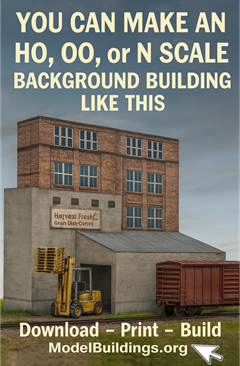
Most model railroads include at least one building with brick walls. Many in the hobby find that brick walls are not the easiest things to model realistically.

One option is to use card models for buildings with the brick walls already printed or to print out a brick pattern and glue the sheet of paper on the walls. Although this can work okay, this technique is without any surface texture and can require additional retouching to add a look of authenticity.

Plastic model kits of building often have brick walls moulded into surface and for scratch building there is embossed plastikard available.

These surfaces provide the contours for brick and mortar, but they are of a plain, a semi gloss color and need extra work to make them look realistic.

For anyone who has modeled brick walls they will know that to acheive a realistic brick wall appearance there needs to be variations in the brick color and mortar lines.

Here is one way of doing it. Start by mixing a suitable color such as “brick red” or “stone gray” and apply it with a brush or better still, an airbrush. Gloss or enamal paints may work best for this part of the process. The next step is to apply a variation of the color onto the bricks. Again, an airbrush can give a subtle effect.

Then paint individual bricks at random in a variety of colors using a fine brush. The colored bricks could vary in range from white through to black including various shades of brown. After you have finished the wall will look too artificial and the colors will look too bold, but don’t worry.

The next step is to soften this effect to give a more realistic appearance. Do this by spraying on a thin translucent coat of brick red paint. An airbrush is best for acheiving the desired effect.

You are then ready to start applying the mortar. The wall will need to be laid horizontal for this task. A mixture of stone gray and white paint is often the right combination for the mortar color. The key is to thin the colors down and using a fine brush applying a drop of this into a corner of the mortar line (as accurately as possible into the recess). When thinned down enough, capillary action will carry the paint along the recess to follow and fill the mortar lines.


If some of the mortar paint sits on the brick faces simply wipe it off with a cloth before it dries. The wall will now be ready to be weathered according to the age and location you are modeling. You could use weathering powders or pastels for the desired weathering effect.

Finally, fix the weathering with an airbrushed coat of matt varnish.

Click To Add A Comment  Ask A Question

Planning To Build A Model Railroad Layout

It pays to start with a plan when building any model railroad layout, but keep in mind that most decisions will be made as the model railroad layout develops. Having a plan does not mean that you must decide at the outset precisely what needs to be done in which order. A plan is a general direction in which you are heading remembering that most of your purchases and construction will go in the same direction.

When building a model railroad layout there needs to be some flexibility to change facets of the layout plan, construction methods or components of the model railroad layout depending on how things develop and your level of skills.

For example, you might decide to change from building a mining scene to building an agricultural or town scene. You might plan to get more track sections to add a siding, or another steam locomotive, a diesel or more freight cars depending on how thing develop.

You might come to the conclusion that if you add too many cars when you still have limited trackage, your train will overcrowd your lines and hamper easy operations. On the other hand you might blow your budget in the first few months of construction, or find some extra money to add an extra feature or locomotive to your progressing model railroad layout.

I guess, what I’m really saying is – have a plan of action but stay flexible in your ideas.

Click To Add A Comment  Ask A Question

SUBMIT YOUR QUESTION

ho scale house

Model Railroading Blog Archive