Everything on model trains, model railroads, model railways, locomotives, model train layouts, scenery, wiring, DCC and more. Enjoy the world's best hobby... model railroading!
1872- Early 1900’s
Train travel was the mode of transportation for even U.S. Presidents in the early 1900’s. Presidents from Ulysses S. Grant to Franklin D. Roosevelt traveled largely by train. For them, as for virtually every American, the railroad offered the fastest, safest means of travel.
In August 1845, the town of Scarborough (the UK’s oldest and one of its most popular seaside resorts), welcomed its first ever tourists to arrive by train. That historic first steam journey was on the world’s most famous steam icon, ‘Flying Scotsman.’ More than a century and a half later, ‘Flying Scotsman’ lead the celebrations to mark the 160th anniversary of the event.
It was 160 years ago that more than 15,000 people turned out for the opening of the York to Scarborough railway line. Residents lined the streets of Scarborough, to be serenaded by singers and entertained by brass bands, welcoming the very first steam train to Scarborough’s newly constructed wooden platform.
The steam trip to Scarborough, by ‘Flying Scotsman’ runs along the 42-mile route to the coast. It has been the backbone of the local tourist economy for 160 years.
A slice of New Zealand history has been marked with the last remaining Toll Rail electric locomotive (EW 1805) being handed over for restoration. The EW electric locomotives started work in 1952 and most were retired in the 1980’s. The EW locos have been replaced by Ganz Mavag electric units.
Construction of the Florida based Miracle Strip Model Railroad Club layout began in 1981 when a few of the original club members were offered space in a local hobby shop.

HO in scale, the layout has seen numerous revisions; it even was disassembled and stored in sections when the hobby shop closed. The members reassembled it in the current building on Eglin Parkway. The Miracle Strip Model Railroad Club layout fills a 16′ x 44′ area.
The layout in theme is termed by the members as “freelance”. The scenery favors a 50’s and 60’s look. Any era rolling stock is permitted.
The current revonation incorporates a “double deck” and a new yard, which will accommodate over 200 cars.
Notable features of the Miracle Strip Model Railroad Club layout include:
Handpainted Backdrop
Up-to-Date Railroading with DCC (Digital Command Control)
A 16″ x 4′ Built from Scratch Trestle with Waterfall
Loads-In, Loads-Out Powerplant and Coal Mine with Visible Shaft
Helix with over 400 feet of track Logging Community
Modular HO Model Train Layout Popular Addition
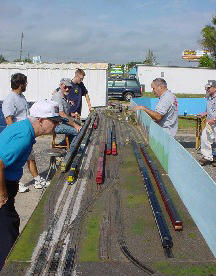
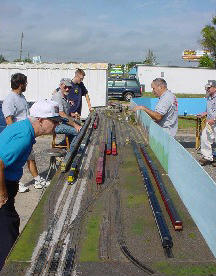
The Miracle Strip Model Railroad Club’s modular HO layout started as a four corner, 8′ x 8′ layout. Individual club members have contributed their personal modules to the project, and it has grown to a layout size of 15′ x28′. It packs efficiently in the club’s travel trailer for setup at varied locations.
Other individual members of the Miracle Strip Model Railroad Club, anxious to work in other scale models besides the club’s HO standard have created modules in N scale.
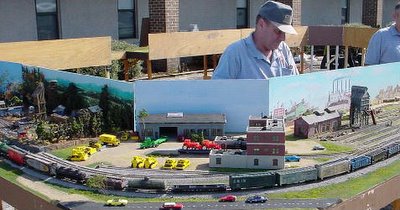
The Miracle Strip Model Railroad Club’s permanent layout building is located at 1255A Eglin Parkway in Shalimar, Florida 32579, USA.
 Model Railroading has been called the Worlds Greatest Hobby, and rightly so. But could it be a descendant of the worlds oldest hobby? About 500BC the emperor of the Q’in (pronounced ‘Chin’. Chin is where the name China came from) dynasty wanted to view all the different regions of his empire. But of course it was impossible for him to be in all the regions of his empire at once. So he commissioned some artists in his empire to visit each region and make models of each region, so that he could view them all from inside his palace in the forbidden city.
Once each diorama was completed, it was placed on a map the empire that was carved into the floor in part of his palace. And so each day he would travel through his whole empire, admiring the beauty of his kingdom. The dioramas were called ‘penjing’.
China in 500BC didn’t have the benefit of Woodland Scenics scatter and trees, or similar materials, and so the dioramas were made from real dirt and rocks, and small trees that were alive.
The art of Bonsai owes it’s existence to these penjings, and it would seem that maybe the ‘art’ of Model Railroading does too!
(Information Source: Better Homes and Gardens, July 2004 issue)
First you need to consider the factors that determine the length of the train you can run on your model train layout:
THE DRAWBAR PULL, or traction, of your locomotive is affected by its weight, contact with the rail, traction tires, motor and the power available. This pulling power is measured in pounds and ounces at the rear coupler or drawbar of your locomotive.
DRAG OF YOUR CARS depends on the number of axles, lubrication of the bearings and if there are track pickups on any of the wheels. The weight of each car is also a factor.
RADIUS OF THE TRACK CURVES is another factor to consider. The smaller the radius the more the drag. A reverse curve, without a straight line between, causes even more drag. Also remember that a clean track will reduce the drag on curves.
GRADE OF THE TRACK can be a major factor affecting the pulling power of a locomotive. Grade is the ratio of distance forward compared to the change in height. A forward travel of 100 inches with a rise of one inch is a 1% grade. A rise of two inches is 2%, three inches is 3% and four inches is 4%. You wouldn’t want anything steeper than a 4% otherwise you could experience all kinds of problems. (no more than a 2% grade for garden railroads).
So, the number of cars a locomotive can pull will depend on a number of factors.
As a summary here is are some important guidelines to get the best from your train set: Aim to have a heavy locomotive with adequate power available.If you want to run really long trains then it’s best to have clean track that is level or with only gentle curves. Keep your trains well maintained. The wheels on the locomotive should be keep clean, traction tires clean, bearings lubricated (including side rod linkage on steam). Have the locomotive motor checked regularly. Rolling stock should have clean wheels and lubricated bearings. Couplers should move freely to maintain alignment.
Model railroading is a wonderful hobby and great way to make friends. There are numerous model railroad clubs and organizations you can join where you can meet with like-minded people from all walks of life who share your passion for the hobby of model railroading.
As a member of a model railroad club you’ll have the opportunity to share ideas, get expert advice, attend model railroad conventions, build a model railroad as a group project, and even take train trips together.
For rail yards you may want to use a finer grade of track ballast to give the impression of more lightly laid lines, while on the mainline you might want more coarse track ballast.
I’ve compiled a list of some common railroading terms with simple definitions. You might hear some of these railroading terms mentioned from time to time. The railroading terms I’ve listed here are reasonably universal, but some may vary depending on where you live.
Part 10 in this series includes another six railroad terms:
Draw Bar Forces
The longitudinal forces at the couplers between locomotives or cars. These forces can be draft or buff, depending on train operation.
Dual Control Switch
A switch equipped for power or hand operation.
Dummy Hose Coupling
A device designed to couple unused air hose for protection against damage and to prevent foreign matter from entering the train line.
Effective Securing Device
A device applied to secure a manually operated switch. It is vandal/tamperproof and designed to protect railroad workers.
Electrically Locked Switch
A hand-operated switch with an electrically controlled device to restrict the movement of the switch.
Emergency Application
A reduction in brake pipe pressure at a rate sufficient to cause control valves to move to the emergency position.
Happy Railroading!
In 1937 there were an estimated 788,672 miles of railroad in the world.
At least 44 people lost their lives during the building of the New York City’s subway, with thousands of other workers left injured.
The highest speed recorded on any national railroad is 515.3 km/h (320.2 mph) by the French SNCF high-speed train.
It is possible to have pre war and post war model train motors for many brands of model trains (like Lionel, American Flyer and Ives), rebuild and made to run like new. However, the armature core needs to be intact for an experienced repairer to do the job successfully.
A sign that one of the armature coils may be open circuited is when the brushes on a model train give off a lot of sparks.
A model train motor may need an armature rewind when the motor runs very hot and slows down after a just few minutes of operation.
A tell-tale sign that the armature has been damaged is when the armature wires look dark in color relative to the other windings on the armature.
Another sign that the armature has a problem is when the field winding over-heats. This could be an indication that the current flowing through the series circuit made by the field and the armature has a very low resistance.
1928
The first Diesel-electric passenger locomotive built in North America was a two-unit 2-D-1-1-D-2. It represented a joint effort between Westinghouse, Canadian Locomotive Co., Baldwin and Commonwealth Steel Co. Each unit had a Scottish-built Beardmore V12 12″ x 12″ engine rated 1,330HP @ 800 rpm. Max. safe speed was 63 mph.
Flemington in New Jersey is home to “Northlanz”, which has 8 actual miles of HO track and 100+ model trains running at one time. 25 years went into sculpting 35 foot mountains and building 40 foot bridges. It features thousands of handmade buildings and over 10,000 freight cars. Incredible!
Another model railroading place worth a visit is the Pasadena Sierra Pacific Club, located in Pasadena, CA, which operates the Sierra Pacific Lines. This is one of the largest HO Scale operating model railroads in the world covering almost 5000 square feet. The model railroad has over 30,000 feet of hand laid steel rail. The 1700 foot single to quad track mainline with ten cabs allows for operating of up to ten 30 foot trains (up to 60 cars long). Yard panels throughout the model railroad allow for operation of another 15 to 20 model trains. Worth a visit!
Quick Model Train Tip:
Ballasted track adds more scenic realism to a model train set layout. However, you need to make sure that the electrics are all sorted out and that all the rail joiners are tight fitting before you start ballasting. Otherwise you may find that after you have ballasted your track, some sections of model train track wont work properly.
This model train set blog will list various railroad terms over the next few postings. Here are some more:
Demurrage
Tariff charges assessed for detaining freight cars beyond their specified time limit.
Derail
This track safety device is designed to guide a car off the rails at a selected spot. Its purpose is to protect against collisions or other accidents.
Dispatcher
The person in charge of all movements (and issuing Form D’s) within a designated region. Abbreviated as Dspr.
Disturbed Track
A section of track with a temporary speed restriction due to track maintenance or a defect.
Draft Force
Pulling force (tension) on couplers and draft gear during a slack-stretched condition.
Draft Gear
This is a cushioning device that transmits draft or buff forces between the coupler and the locomotive or car.
NTRAK is an international grass roots association of model railroaders which has created a set of standards that anyone may use to build N Scale model train modules, or model train layout sections. These sections join together to form large portable model train layouts.
These modular train layouts have the flexibility to fit into areas of different size and shape, from warehouses to small bedrooms. Modelling small sections enables even those who live in townhouses or apartments to enjoy the hobby model railroading.
NTRAK also connects together with model railroading enthusiasts who follow the NTRAK Standard the world over.
“N” Scale model trains get their name from the rails they run on, which are spaced nine millimeters apart. N scale model trains are about half the size of the more common “H.O.” (half “O”) scale model trains, and only a quarter of the size of the Lionel “O” scale type model trains.
The smaller N Scale model trains allow greater amounts of scenery to be created for a more true-to-life look. Smaller, more portable layouts are easily created with N Scale, and much longer model trains are possible than in most other model train scales.
Ottawa Valley Garden Railway Society members are building an indoor On30 model train layout for winter operations.
Track plans from a number of magazines were searched for ideas to include in an urban switching layout with lots of industry and a waterfront. As early cars and trucks rather than horses and buggies would be preferred, the era of 1920 to 1930 is being considered.
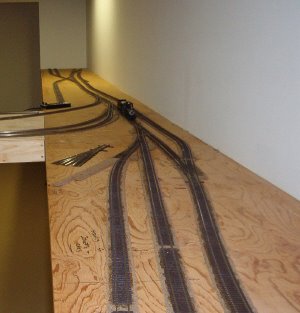
After months of discussion, it has been decided to build the Key Harbour terminal of the LAKE NIPISSING RAILWAY (LNR). The railway is to link its two long established sister companies: the Georgian Bay Navigation Company and the Lake Nipissing Navigation Company.
This photo shows that laying roadbed and track has commenced.