Everything on model trains, model railroads, model railways, locomotives, model train layouts, scenery, wiring, DCC and more. Enjoy the world's best hobby... model railroading!
Jim Davis of Kemptville, Ontario started the JPandF Scenic Railway in June of 2000. He and his son Terry laid about 75 feet of Aristo-Craft track on a bed of stone dust, 10 inches wide by 10 inches deep.
The next year, a pond and stream were added and more greenery planted. Over the next three years, a two foot quarry stone wall was built and filled, to allow another 100 feet of track to be laid. Buildings, small trees and home-made, metal bridge were added.
A line through a basement window to a 30 foot staging area was also built. This is to save time setting up and taking down.
The gargen railway is track powered and radio controlled using an LGB power pack and Aristo-Craft trackside Train Engineer. Motive power and rolling stock are a mixture of USA Trains, Aristo-Craft and Bachmann.
In July 2005 the Ottawa Valley Garden Railroad Society (Ontario, Canada) hosted the fourth annual American Invasion of Ottawa. It was a tremendous success with thirteen visitors from six different states taking part.

This photo shows a club member (partly visible on the right with the water bottle) steams the shay with its ore train out of Bell en route to Blue Mountain Mine.
As the name implies, the Win N Trak Model Railway Group focus on the hobby of model railroading in “N” scale (1 /160). This Winnipeg (Canada) based model railroad club uses the international modular layout concept developed by “NTRAK”. The NTRAK concept employs standard track locations in order to allow modules built by members to be joined together to create model train layouts of various sizes and shapes.
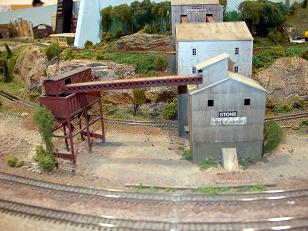
A “standard” module is four feet long by two feet wide, and with the standard track locations, it is modeled with a miniature scene done to the owner-members taste.
Win N Trak owns several of the key components, such as the “yard”, power sources, and throttles. The yard is an important part of each setup as it allows members to put together and store their trains between runs on the N scale model train layout.
The model train layout takes from 2 to three hours to assemble, including the matching and connecting of the modules, the electrical components, and the cleaning and testing of the completed setup. Teardown, at the end of each show, takes up to one hour.
What is a Module?
Modules are the central concept of NTRAK. A module is a 2-foot deep by four- or six-foot long section of a model railroad. Other dimensions are possible, but these are the most common.
There are three standard tracks on an NTRAK module. The two main lines and a branch line. The main lines are designated (from the front of the module) Red and Yellow. The branch line is designated Blue.
Building a module limits the expense and effort required to participate in the model railroading hobby. You can start off with a simple 4-foot module, a locomotive and some rolling stock at a minimal cost. As your interest and skills grow, you can add a module (or modules) or perhaps custom-detail a locomotive or even a whole train! The best part is that you can start enjoying the hobby of model railroading right away!
 Every year Win N Trak model railroad club in Canada raffles off a small layout to raise funds for the N scale model railroad club. A portion of the proceeds goes to a charitable organization. This year, the club is supporting the Winnipeg Children’s Hospital.
The raffle winner will receive the layout as well as a Life-Like starter set.
This year’s draw will take place on April 17, 2006 at 7:00pm.
Many model train enthusiasts make their own realistic miniature trees using a variety of materials including branches and twigs from real trees.
For others however, the option of purchasing ready-made trees is an attractive option. This is where someone like Vance Altman of fsmtrees.com (First in Scaled Miniature Trees) can help out.
This is what Vance has to say, “I supply a top quality sage brush tree armature from mother nature. These allow the modeler to add foliage for a prototype tree or use as is for a Great looking Oak tree for winter scenes or dead trees”.
Vance adds, “Our scaled Sagebrush tree armatures are stand-alone realistic oak trees or add tree foliage for superb model tree scenery. Some have knarly twisted trunks and knots that look like a real natural miniature tree. These Scaled Miniature Trees are natural pieces of real wood Armatures for model train layouts or dioramas”.
Vance supplies quality trees for all scales, N, HO, HOn30, S, O. with delicate realistic branching.
Vance has also kindly allowed me to publish the following tree making tutorial from his website.
Sagebrush Tree Construction
This tutorial will go through a step-by-step process to create realistic looking miniature trees for use in wargames, dioramas, and model train layouts.
Materials:
Sage brush
Poly fiber
AquaNet hair spray
Flock
Clothes pins or small clamp
Straight pins
Side cutters
Description of Materials:
The trickiest part of making this type of tree is finding the correct materials. Sagebrush can be found in several places including specialty hobby shops, online shops, and simply out in nature. Since I do not know of any sage growing in my area, I opted for the next easiest (unfortunately the most expensive) method of obtaining this material. A local hobby shop specializing in trains carries sagebrush for $2-3 per armature. The cost is quite a lot considering there is still a lot of work, which needs to be done to get a tree out of the deal. I do, however, prefer the look of the finished product over anything that can be bought or of any of the other attempts at tree making I have done.
The cheaper the hair sprays the better (usually). What is basically needed is a spray adhesive. Real spray adhesives such as those from Elmer’s should work as well, but I haven’t tried them. I use Unscented Aqua Net hair spray that I picked up from K-Mart and have had good results.
As with my other terrain products I use Woodland Scenics flock to add ‘leaves’ to the trees. I use Burnt Grass Fine Turf as the foundation for the trees with a touch of Green Grass Fine Turf to add a bit of highlight.
A pair of clothespins or a small clamp work well to hold the armature while working with it. When connecting two clothespins in an L fashion they also serve as a convenient stand to keep the tree upright when drying.
At the base of each tree I poke a straight pin in to help hold the tree in place when ‘planted’ on the layout. After the pin is stuck in the end is clipped off with a pair of side cutters.
A simple pair of side cutters or anything else that will cut a straight pin will work just fine.
Tree Construction Steps:
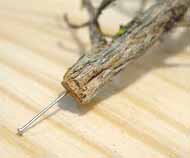
Prepare the armature. Stick a straight pin into the base of the tree to add stability when ‘planted’. Clip the pinhead off after inserting the pin.
 Pull a very small amount of poly fiber from the bag. About 1/2×1/2×1/4 inch section will do. The sections do not and should not be exactly the same size -just keep them fairly small.
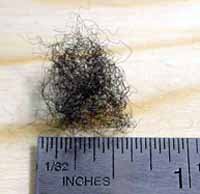
Pull the piece apart so it is the density of a three-dimensional spider web. Be sure to pull the fiber out in all three dimensions rather than making ‘sheets’.
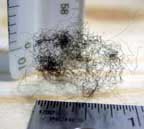
Starting at the bottom of the armature, place the fiber on a single branch of the armature. Try not to span multiple branches – each branch should get its own fiber.

Continue the process working your way from the inside and bottom of the armature to the outside and top. Continue until all desired branches have been covered with fiber.
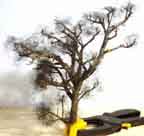
Be sure that the fiber is not too dense. It is tempting to have a very ‘full’ looking tree at this point, but after the flock is applied it will be far too thick. Over a bag or in some other environment set up to catch the overshoot, spray the fiber with the hair spray until the spray beads up on the fiber. Be careful not to blow the fiber from the branches – try to spray in bursts instead of one constant stream.

Carefully and slowly sprinkle on the flock. Darker flock can be applied to the bottom side of the fiber then apply some lighter to the top of the tree to give it a bit of a highlight. It is very important not to overdue the flock.
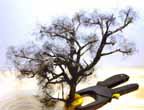
You should still be able to see through the tree after the flock has been applied. Set the tree aside to dry and admire the creation!
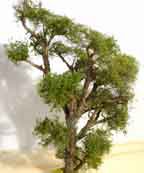
Tap off the extra flock into a container. You can use a small pair of scissors to trim offsome of the excess fibers that are sticking out that are out of place.Give the tree another light coat of hairspray to help keep the flock in place. Doing three or four trees at a time can speed up the process a bit and look nice all out together.
This trees making tutorial for model train layouts is kindly supplied with permission of Vance Altman at http://www.fsmtrees.com/

The Echo Valley Railway Guild in Saskatchewan, Canada has its model train layout located in the basement of a local school.
The current layout is located at Davin School and interestingly enough, the original layout was also in a school. However, the first school was unfortunately closed and demolished.
The club’s current model train layout is a representation of the Crow’s nest pass area of southern British Columbia and Alberta. The CP line and the Kaslo and Slocan Railway are modelled.
These photos from The Echo Valley Railway Guild show a narrow gauge trestle and Sirdar.
The Kaslo and Slocan section is is done in HOn3.
Ft. Mcleod  (Mcleod) is modeled from which the line proceeds around the room passing through Crowsnest, Moyie, Sirdar, Nelson. To do this the line passes under the peninsula and circles twice around the room.
The Echo Valley Railway Guild strongly support the hobby of model railroading. It with other model railroaders has taken on the task of producing a regional and two divisional NMRA conventions. The guild opens it’s doors to the school children at least once a year. Together with the Regina Model Railroad Club, The Echo Valley Railway Guild have sponsored a model railroad show.
Constructing a custom built scale building or structure can take considerable time and requires a good eye for detail, a steady hand and a lot of patience.
Highly detailed scratchbuild models are not built over night. Some takes days even weeks to complete. However, for many model railroaders custom building their own structures is not an easy option. Sometimes it is due to a lack of time, some lack a steady hand to complete the detail, and others simply prefer to buy ready-made structures and add their own detail and weathering effects. It really depends on individual circumstances, skills, preferences, time available and what you are trying to achieve.
The interesting thing is that many model railroaders are not aware that there are skilled designers who specialize in custom building as an occupation.

These photos are a sample of what a professional designer can create.
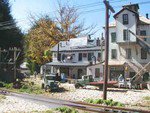
The photos are kindly supplied by Vance from Trains HO. Vance is a pro at custom building HO scale buildings and structures, highly detailed for HO train layouts. Have a look at his HO scale model train website and see some more of the brilliant buildings and structures he has created for other model railroaders.
Model railroaders sometimes experience lighting problems with street lights & other accessories being too dim or erratic. More often than not the problem can be traced to the transformer/power pack.
Dim lights are usually a result of too many items drawing power at once. One option is to invest in more powerful transformer/power pack or to buy an inexpensive unit and use it only for accessories while a second more powerful unit runs the model trains.
The track plan belonging to the H.O. Model Engineers Society focuses on the 1950’s in south central Ontario (Canada) with Hamilton as the hub. The major railway subdivisions represented include Canadian National Railway’s Oakville Subdivision from Oakville to Hamilton and the Grimsby Subdivision from Hamilton to Merritton, near St. Catharines. The Dundas Subdivision is also represented as one leg of the Bayview Wye leading to the hidden staging yard. The Canadian Pacific Railway operates on the Goderich Subdivision from Guelph Junction to Hamilton, as well as trackage rights on the Oakville Subdivision. The Toronto Hamilton & Buffalo Railway operates on the Welland Subdivision from Welland to Hamilton, which includes the New York Central Railway, as well as trackage rights on the Oakville Subdivision. The cities of Buffalo, Toronto and London are represented by common hidden staging yard, which feeds traffic to the modeled portion of the layout.
A digital command control system for train operations is being used (Digitrax), along with a computerized model railroad interface (C/MRI) system designed to operate the centralized traffic control system from a dispatcher’s panel located in an adjacent room. Train movement is monitored by the dispatcher and will be controlled from signal lights along the right of way. A variable speed, fast time digital clock used on the previous layout, is used to control passenger and freight movements. High frequency two ways radios are used to communicate between the dispatcher and all train crews. Both freight and passenger cars are switched into trains or industries based on a computerized car forwarding program, (Shipit) which selects appropriate rolling stock for specific customers and prints switch list orders for the conductor of each train crew.
Most of this technology was in place on the Delta layout and will continue to create prototypical operations on the new layout. The new layout is far from complete, but the club is attempting to use as much of the new model railroad technology available to create a realistic 1950’s era transportation system.
Model railroad Club With Checked Past
The H.O. Model Engineers Society was formed in February 1948, and started its first scale model railway in 1950, in the basement of a restaurant at Main Street and Park Row in Hamilton, Ontario. A few years later the club moved to the basement of a member’s home in Aldershot and then moved to a two-car garage on Gage Avenue North in Hamilton, where a much-improved layout was built.
In 1961 the club moved once again to the basement of Booth’s Hobby Shop on Concession Street on Hamilton Mountain, where a new layout filled a 25′ X 50′ room. At its peak, it required fourteen engineers and two dispatchers to run a full schedule with fast time clocks.
By the late 1970’s construction on the layout was almost dormant and in 1979 it was decided to dismantle the layout and move.
In the spring of 1980 the Society began construction of a new layout in the basement of the Delta Bingo Hall, at the intersection of King Street and Main Street East in Hamilton. This renovated grocery store was just a few blocks from the location of the first layout. The 42′ X 52′ layout required ten engine crews and a dispatcher to operate trains over the 500 foot long mainline. The era was 1967, Canada’s Centennial Year, and the geography depicted Hamilton to North Bay with the scenery showing all four seasons.
In late 1996 the owner of the building decided to renovate it back into a grocery store. The membership was devastated! The layout was dismantled in early 1997.
A new home was finally secured in June 1997 at the Stoney Creek Plaza. After fifteen months of extensive and expensive renovations to the basement area, it was subdivided into four areas: a 18 X 20 museum of railway artifacts, a 18′ X 24′ library/lounge, a 6′ X 60′ workshop and 42 X 62 model railway layout. Construction of the layout began in September 1998.
This model train blog will list various railroading terms over the next few weeks. Here is another six:
Crossover
This is a combination of two switches connecting adjacent tracks. When lined, the switch combination allows movements to cross from one track to the other.
Crow’s Nest
A box-like cupola structure raised above the roof of a caboose for visibility along the train while it is in motion.
Current of Traffic
The assigned timetabled direction for movement on a main track.
Cycle Braking
The process of applying, releasing, and reapplying train brakes to control speed without completely recharging the train brake system.
Dead Engine Device
Located near the locomotive control valve this device is used when a locomotive unit is handled dead-in-train (see below). Abbreviated as DED.
Dead-in-Train
Hauling locomotive or locomotives in a train without the MU cable and air hoses coupled (hauled like a car).
Happy Railroading!
Roadbed track has the advantage of having a reasonably realistic appearance without the mess involved in adding loose ballast and then having to glue it. The disadvantage is that roadbed track is more expensive than standard track. Another drawback is that the various makes of roadbed track are not always compatible with each other. Also, you are limited by the modular set track nature of the roadbed pieces.
Roadbed tracks are particularly good on temporary model train layouts because they are generally more stable. If you intend to set up a model train set on the floor (not recommended), then roadbed track is the better option because it is slightly raised up. If standard train track is put on the floor, especially on carpet, then no matter how clean you think it is, grit, hairs, fluff, cotton and things you never knew were on the floor will get inside and ruin the mechanism.
About 25 years ago Bill Taylor had a dream. He wanted to build an outdoor live steam railway in the woods around his home in Charleswood. Bill was an avid model railroader and had a 750 sq. ft 1000 foot HO model railroad in his basement that started in 1969. Bill also liked going to the N.M.R.A. “National” conventions and each year a side tour to a live steam railway would be featured.
Today Bill Taylor is President of THE ASSINIBOINE VALLEY RAILWAY. The AVR is 1.5″ (1.6″) scale 7.5″ gauge and is located on a seven acre site immediately west of Assiniboine Park (nicknamed “The Route Of The Hazel Nuts”).
The railway started in 1995 and currently has 56 members. Club members spend most Saturday afternoons working. The club currently has 3 diesel locomotives, one box cab under construction and several steamers under construction by various members and about 18 cars plus 10 more under construction. The AVR use aluminium rail on wood ties on ballast and sub-roadbed construction with a ruling radius of 50’.
A massive 5,400 feet of track is on the ground. The main line is 3700’ with seven passing sidings. There is a turning wye and movable 12 foot lift for unloading.
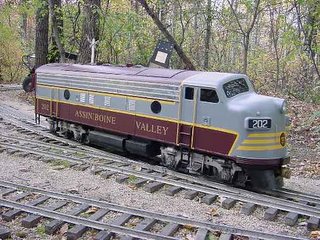
The picture above shows #202 is now re-painted in old CPR colours and lettered for the AVR. Was first run in her new colours at the October open house in 2005.
Club members have built a 24’ x 12.5’ station that serves as a club room and will store up to 12 pieces of equipment in an attached dog house. A four track car barn measuring 31’ x 10’ has been built for additional rolling stock and miscellaneous storage, along with a 14′ x 10′ maintenance building.
The live steam railway winds through an aspen and hardwood forest making for an enjoyable ride. Main line will allow travel in both directions for a total run of 7400’ and a time of 25 minutes plus waits for opposing traffic. An automatic CTC signal system which also operates the switches is being planned.
The AVR Club operate five open house weekends for the public on the 2nd weekend of June to October, plus a Christmas light run every evening in December (with 984 riders in one night). Club members give about 15,000 rides per year and welcomes visitors.
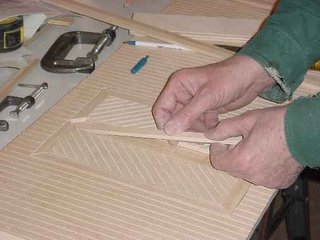

Above photos from THE ASSINIBOINE VALLEY RAILWAY show CAR #572 and an earlier construction shot of mounting the door details into the side of the car.
THE ASSINIBOINE VALLEY RAILWAY is located at 3001 ROBLIN BLVD., WINNIPEG, MANITOBA, CANADA and has an excellent railroading website.
Whether you choose standard train track or roadbed track is over to you and your personal preference. It also depends on the nature of your model train set layout and what looks best, works best and what fits with your budget requirements.
When using standard tracks on a model train set layout, seperate ballast is laid. Whereas, the plastic roadbed sections look like real railroad ballast and feature interlocking tabs that help hold the train track sections securely in place.
The Redstone Model Railroad Club was founded in 1958 as the Redstone Model Railroad Association. Located on Redstone Arsenal, the club has been an active center for model railroading activity in the Huntsville, Alabama area for almost forty-four years. The club layout is the Alabama Tennessee and Northern Railroad, an HO scale notional railroad that is set in the southeastern United States.
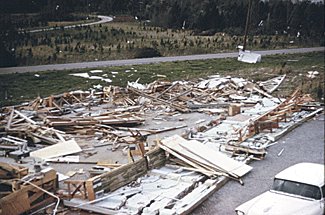
Then came that fateful day, April 3, 1974, when the building and layout were destroyed by one of several tornados that devastated the area that day. Building 3541 was leveled; 16 years of work gone. In the photo at left, benchwork is visible on the right side, along with the entire southeast wall that was blown outward. More benchwork can be seen to the left. Debris was scattered over several hundred feet and very few items were salvaged from the area.
Members had meetings at the Redstone Recreation/Service Center on post for several months.
In November of 1974, seventeen charter members and three junior members filed for Certification of Incorporation of Redstone Model Railroad Club, Inc. The purpose of the corporation was to organize and promote greater fellowship between model railroaders and advancing the hobby of model railroading. This action started the “rebirth” of the Alabama, Tennessee, and Northern Railroad. The Army provided another building in the fall of 1975.
Making a Realistic Logging Car from an Athearn 40 Foot Flatcar
Perhaps no railroad cars were subjected to abuse more than the gondola and flatcar. How often have we seen bent and swayed back gondolas and looked down, from and overpass, on the gnarled flooring of flatcars. As these cars reached the end of their useful life on major railroads, many found their way to short lines and logging railroads to serve a few more years.
The Redstone Model Railroad Club has a downloadable PDF file on its website showing how to age and weather an out-of-the-box plastic flatcar. Ray Long has put together easy to follow, illustrated step-by-step instructions that will produce a well used piece of rolling stock that would likely be found on a logging railroad or short line. Ray shows you how to weather the finish and to distress the wood flooring with realistic results.
Visit the Redstone Model Railroad Club website and see what they are up to.
Help With Your Model Train Sets:
October 22, 1949
On this date the Danzig-Warsaw express derails in Poland with more than 200 people killed.
Model train track comes in sections (called sectional track) for convenience and ease of use. You can purchase model train track in different lengths and shapes, straight and curved. Some model train track snaps together, and some model train track is made on plastic roadbed sections.
Sectional track is what most model railroaders start with simply because the sectional track is easy to use and it’s what usually comes with the model train sets.
G Scale railroading is becoming increasingly popular because it combines the realism of trains with a natural environment.

The Vancouver Island Garden Railroad Club (Canada) is a perfect example. The club was formed for like-minded people to share their ideas and interest in garden railroading. These photos show a couple of different garden railroads belonging to members.

Several other photo can be seen at the Vancouver Island Garden Railroad Club website.
Continuing this series, here are some more railroading terms of interest:
Bulletin Order
A BO is used to notify railroad staff of changes in instructions, procedures, or rules affecting the movement of trains.
Cab Signal
This signal indicates track occupancy or condition and is located in the engine control compartment. The cab signal is used in conjunction with interlocking signals, and with or in lieu of block signals.
Cab Signal System
A CSS system permits cab signals and the cab warning whistle to operate.
Camp Car
This is an on-track boarding/bunk car or vehicle used to house railroad staff.
Computer Controlled Brake
A computer based electro-pneumatic system (CCB) that controls air brakes on locomotives and cars.
Control Operator
Employee assigned to operate a CTC or interlocking control machine or authorized to grant track permits.
Control Station
The location or Dispatch Office where the Operator is on duty. The remote control signal appliances or switchesare operated from here.
Controlled Point
A station specified in the timetable where signals are remotely controlled from the control station. Abbreviated as CP.
Controlled Siding
A circuited siding where both ends are governed by signals under the control of an Operator or Dispatcher. Abbreviated as CS.
Controlled Signal
Controlled by a Dispatcher or Operator, this is a fixed signal, capable of displaying a Stop indication.