Everything on model trains, model railroads, model railways, locomotives, model train layouts, scenery, wiring, DCC and more. Enjoy the world's best hobby... model railroading!
The Worthing Model Railway Club (formed in 1964) holds an annual exhibition with the 2006 event planned for September at the Boundstone Community College, West Sussex, UK.
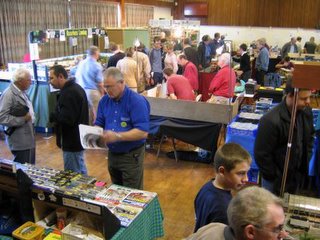
The model railway club has several layouts including:
WITTS END (available for exhibitions)
GAUGE: 0-16.5
STOCK: Scratch built
PROTOTYPE: Narrow gauge
DESCRIPTION: Country terminus with limited goods facilities and a small loco shed
SIZE: 16′ x 18ins (20′ x 6′ to include safety barriers and maintenance area.
WELLS GREEN TMD (available for exhibitions)
GAUGE: OO 4mm
STOCK: Highly detailed 4mm scale locomotives.
PROTOTYPE: Crewe International Electric Maintenance Depot.
DESCRIPTION: A small electric depot based upon current EWS operations in the North West, featuring highly detailed AC electric locomotives in an authentic grimy, gritty atmosphere. The depot concentrates on undertaking routine maintenance to locos, and includes a locomotive washer, and a scrapline containing electric locomotives surplus to EWS’s requirements. A fueling road for diesel locomotives also enables many different varieties of loco to appear.
SIZE: 5′ x 1′ plus 3′ x 1’6″ fiddle yard.
NINE MILLS
(pictured: Fiddle Yard construction)
GAUGE: N Gauge 9mm
STOCK: Ready to run, modified ready to run and kit built. 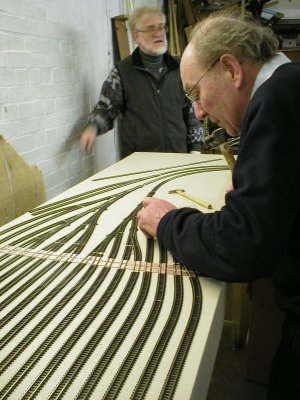
PROTOTYPE: See description for full details.
DESCRIPTION: It is an N gauge layout built to 9mm gauge and features handbuilt points in the main viewing area, although for ease of maintenance, it is planned to replace these with proprietry units at some stage in the future.
It is a ficticious MPD located in the Banbury, Oxfordshire area which gives members the excuse to run Midland, Western and BR Standard rolling stock as well as Inter-Regional trains from the Southern and Eastern regions. In other words, something for everyone.
The period of this layout is depicted as being in the early post-nationalisation era when rolling stock of the “Big Four” (LMS, GWR, SR and LNER) could be seen alongside the new BR colour schemes.
The layout, as it stands, may be operated in its present state although future plans will enable this layout to be shown in its present form or as a continuous run. The estimated date for the continuous run is 2005, unfortunately, the rebuilding is at a stage where we cannot now show the original layout.
SIZE: Approx 20′ x 2′ (undergoing upgrade to new size 20′ x 8′)
NORTHLANDS WOOD
GAUGE: OO Gauge
STOCK: Propriety ready to run stock.
PROTOTYPE: “Modern image”
DESCRIPTION: The layout is a double track “tail chaser” with a large through station where the track splits into 4 lines to provide a variety of services. The station is based on a modern refurbished station but not based on any particular location. Because of this a wide varity of motive power may be seen.
SIZE: 12′ x 14′
The Worthing Model Railway Club has an informative website that is well worth visiting.
The Piney Woods Model Railroad Club is an informal, but tight knit group of modelers in the East Texas area. The area covered by the group ranges from the Houston area to the corridor to the North(Tyler and Longview), and from Rusk and Jacksonville in the East to the Mexia/Teague/Lake Richland Chambers area to the West. Members range in age from those still in high school to those who have retired!
The layouts range from the 1920’s to modern day in both N and HO scale. The Piney Woods Model Railroad Club meetings consist of operation sessions utilizing a 4 turn waybill system. Most members utilize the Digitrax systems, however Easy DCC and NCE are also used on members layouts; as well as DC.
The Erin Mills Model Railroad Club in Ontario, Canada, holds its February Clinic Day on Saturday, February 18, 2006. The first one will be on tree stumps and the second will be a small laser kit.
The clinic on tree stumps will include making the moulds (demonstration) and then using them to make the actual stumps and them demonstrating how to use these stumps on your model train layout.
All parts required for the laser kit will be included along with instructions. Paint and Glue will also be provided. Attendees are asked to bring along his or her own modelling tools to complete this project.
The model railroad club clinic will cover all aspects of constructing a laser wood kit, from painting and erecting to adding finishing touches.
The clinics will be held at the Sheridan United Church, 2501 Truscott Avenue in Mississauga, Ontario, Canada.

A quality transformer, when treated properly, should have a lifespan of 30+ years. (Pictured: Lionel CW-80 80-Watt Transformer)
The golden rule is to ALWAYS operate the transformer within its rating. It is also important to keep the transformer dry and avoid damp areas (take particular care in basement locations).
When not using your train layout unplug the transformer. Don’t walk away and leave it plugged in and unattended as it could start a fire. If a transformer gives off a burning odor, or expels smoke, heed these warning signs and immediately replace it or take it in for servicing.
A loud BUZZING noise coming from a transformer could be due to the transformer’s core laminations moving. Servicing would be needed as this vibration can cause damage to insulation in contact with the moving metal.
A transformer’s circuit breaker can trip occasionally. If this happens simply unplug the transformer and let it cool off. The transformer will usually work again after it has cooled down. However, if the transformer continues to trip without a load, it will need servicing to fix the problem.
One more thing; NEVER use a transformer with a damaged, split, or cracked power cord. If in doubt have the transformer serviced immediately.
The Fairy Queen steam locomotive is all gloss and shine. A bronze chimney spewing out thick smoke from its crown into the air, which thins to a misty vapour as the engine warms.
The Fairy Queen broad gauge steam locomotive was built in 1855 by Kitson, Thompson & Hewitson, of England for the British firm East India Railways. The petite engine worked from Howrah to Ranigunj (121 miles). After a complete overhaul in Perambur Workshop of the Southern Railway, it panted back to life in 1997.
The Fairy Queen made several trips between New Delhi and Alwar, India (89km of railway track) between 1997 and 1998. It now runs as a tourist train.
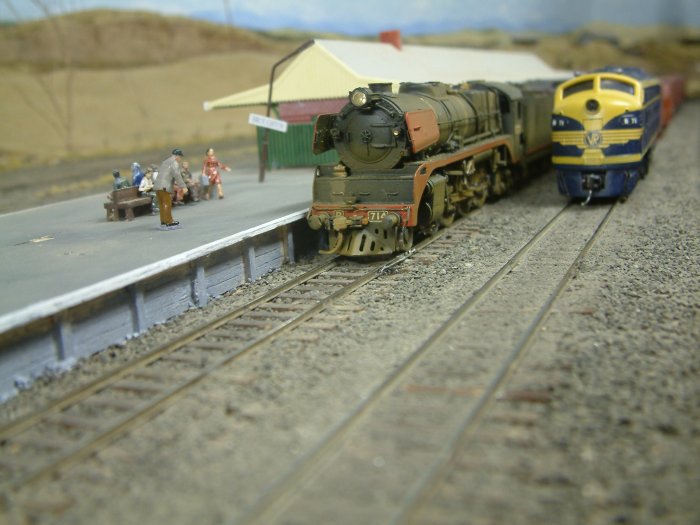 The Eltham Model Railway Circle (Melbourne, Australia) was formed in 1980 and started with a small end to end layout. The model railroad has progressed to a fully operational layout. By the Mid 1990’s the club began construction of an exhibition layout. The exhibition layout had it’s first public Showing at the Strathmore Model Railway Exhibition in August 1999.
The Eltham Model Railway Circle now has a large permanent layout as well as an exhibition layout called “Layout Murranbilla”.
Layout Murranbilla is 20ft long by 8ft 4inches wide. The layout breaks down into 8 modules, each 5ft 10 inches in length and 2ft 6inches wide. The legs are made from tublular steel that are fitted into larger square tubing screwed into each corner.
The layout is built on the open type timber frame, with decking only where necessary for a solid base for the trackwork. Hand holds have been cut into the sides to allow easy carrying.
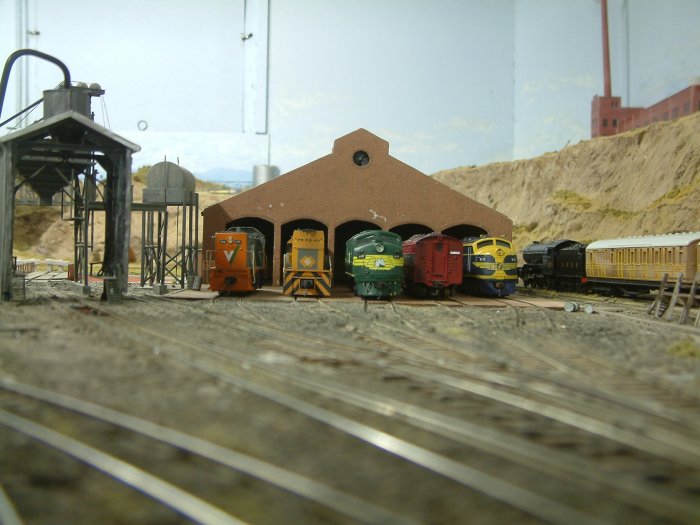
Power to the track is by way of two commercial battery chargers modified to give a split potential power supply using the two transformers in parallel. This allows the running of one common rail and a common return wire for the whole layout. The controllers were originally purchased from the Melbourne Model Railway Society and were modified by removing the jug style of element from the circuit and replacing this with series connected diodes. This allows for a smoother operation of locos by varying the voltage rather than the resistance.
To see what The Eltham Model Railway Circle is up to – be sure to visit the club website.
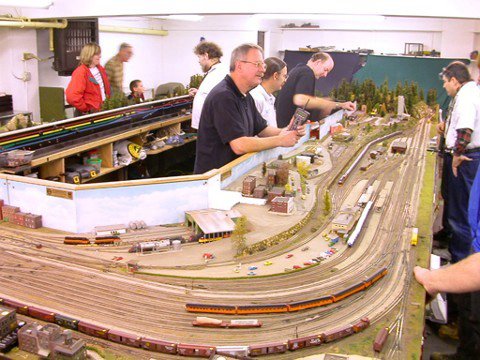
The Seattle based United Northwest Model Railroad Club has an N scale (1:160) layout. (An N scale locomotive would have to be magnified 160 times to equal the real thing.)
The present 24′ x 12′ United Northwest Model Railroad Club layout breaks down into modules for easy take-down and tranport. For Club Members it has been a work in progress for almost 20 years. The club has plans to extend the layout by 12′ bringing it to 36’x 12′.
The United Northwest Model Railroad Club layout doesn’t follow a particular prototype or era, but instead incorporates the best elements of Pacific Northwest railroading.
The layout has operational DCC on the outside “low line” main. The system is North Coast Engineering.

Here are some more interesting aspects of the United Northwest Model Railroad Club layout:
Yard and Engine Facilities – One end encompasses the massive yard and engine facilities, where we build and break up trains.
Mountain Area – The other end is a mountainous territory containing bridges, tunnels, loops, and a valley.
Mainlines – There are two mainlines, one that is known as the “High Line”, and the other that is referred to as the “Low Line”.
Club members usually operate passenger trains on the twisting and grade-filled High Line, and run longer freight trains on the flatter Low Line. The model train layout also has a host of other smaller switching opportunities to keep everyone busy and entertained.
The Northwest Model Railroad Club has its own excellent website to explore.
Good soldering is important to any model train layout, because poor electrical connections result in higher electrical resistance with heat generated when power is applied to a poor electrical connection. Over time, this heat has the potential to damage wire insulation and wire enamel on a model train layout.
To avoid electrical connection problems, on a model train layout, it pays to regularly inspect wire connections. A solder joint that is a dull silver color, or one that is just a “big blob” of solder, will sooner or later cause problems when running model trains.
All solder connections should be clean and shiny and use only a small amount of solder. If a solder joint is suspect, take a soldering iron and apply fresh solder to the joint. This will help improve the connection and keep your model trains electrical system in good working order.
Derailments and accidents can happen frequently with model train sets for any number of reasons. Regardless of how good the trackwork is on your model train sets – derailments still happen. Sometimes train derailments are caused by a super-light flatcar being shoved behind a heavy boxcar, or a hopper with out-of-gauge wheelsets somewhere waiting to pick a switchpoint or be forced off the track. S-curves on model train sets can also prove a hazard for passenger cars.
Sadly, train accidents on real-sized prototype train tracks are far more serious than on model train sets.
There were at least two railway accidents in 1944:
January 16, 1944
A train crashed in Torro Tunnel in Leon Province, Spain. More than 500 were killed.
March 2, 1944
A train stalled in tunnel in Salerno, Italy, suffocating passengers. 521 die.
When assembling sectional model train track do not force the track pieces together. Make sure both ends of the model train track are lined up with the metal rail joiners and fit snugly with little or no gap.
If your model train track has molded roadbed make the tabs lock securely between track sections. Make sure there are no gaps at the end of the rails when assembling the model train track.
This model railroad posting will list various railroading terms over the next few weeks. These railroad terms relate to braking:
Brake Cylinder
A cylinder containing a piston and piston rod. When compressed air is admitted into the cylinder, it forces the piston outward, which applies the brake. When the compressed air is exhausted, a release spring coiled around the piston rod inside the cylinder returns the piston to its normal position, which releases the brake.
Brake Cylinder Release Valve
The valve that bleeds brake cylinder pressure then, if held open, will also bleed auxiliary and emergency reservoir pressures.
Brake Force
Refers to the ability of a train to stop. Brake force is usually based on tons per brake ratio, with the effect of increasing braking power when the tons per brake ration is reduced.
Brake Pipe Gradient
This is the difference in brake pipe pressure between the locomotive and the rear car of the train.
Normal Gradient:
The gradient level when the system is fully charged.
Inverse Gradient:
A temporary condition that exists when brake pipe pressure is higher at the rear of the train than at the front end of the train. This can happen at the beginning of a service brake application.
False Gradient:
Again, a temporary gradient when the system is less than fully charged.
Brake Shaft
A shaft on which a chain is wound and by which the power of a hand brake is applied to the wheels.
Brake Shoe
Friction material shaped to fit the tread of the wheel when the brakes are applied.

Scenery on the Housatonic Model Railway Club layout is mainly fall (autumn) colors with a walk-around plan designed for scenery and operations.
Founded in 1972, the Housatonic Model Railway Club was started to further the enjoyment of the model railroad hobby, primarily through the building and operation of an H0 scale model railroad. The model railroad club layout broadly followed what the Housatonic Railroad (which was swallowed by the New Haven around 100 years ago) might have looked like in the 1950’s, had it remained independent.
The Housatonic Model Railway Club hosts the Station Stop model railroad show and sale at the Fairfield Ludlowe High School in Fairfield each March. The show features operating layouts and displays by model railroad dealers.
The West Somerset Railway recaptures the era of the branch line country railway in the days of the steam train. Enjoy 20 miles of glorious Somerset scenery as the steam train gently rolls back the years on its journey beside the Quantock Hills and the Bristol Channel coast. Just sit back in your seat and watch the steam and countryside drift past the window.
The Railway has all the atmosphere of a Great Western Railway branch line. There are ten restored stations along the route, each having its own charm and character; many have signalboxes, engine sheds, museums, displays, steam engines and other rolling stock to see.
You might hear some of these railroading terms, so if you’re not already familiar with them, this will be a handy reference.
Blue Signal
A blue signal warning that workers are on, under, or between equipment. It can be a blue flag, blue light, or blue tag depending on whether it is day or night.
Bolster Stop
This device limits the lateral movement of a drawbar (when properly fitted).
Bolt-Lock Switch
A hand-operated switch equipped with a pipe-connected locking device that is designated to shunt the signal system before the switch points are operated.
For more model train help and helpful model railroading tips and secrets you might want to read the Model Train Help website
Happy Railroading.
Coffs Harbour is a major center on the New South Wales (NSW) north coast of Australia. The railway line linking Sydney with Brisbane runs right through the town.
In the 1970s there was a demand for a shunting locomotive to be allocated to the town. Coffs Harbour was a major loading point for bananas a little locomotive was kept busy shunting bananas.
While the banana shunter was rarely used on the jetty there was plenty of work in the yard. When the government locomotive was unavailable the Maritime Services Board shunter that did most of the work down on the jetty was used to shunt Coffs Harbour railway yard as well.
This model railroad blog will list various railroading terms five or six at a time over the next few weeks.
Bleeder
This valve bleeds (releases) air from the auxiliary air tank reservoir on a car.
Blended Braking
Uses a mix of service braking and dynamic braking.
Block
A length of track with defined limits on which train movements are governed by block signals, cab signals, or Form D’s.
Blocking Device
A lever, ring, plug, or other control method to restrict the operation of a switch or signal. The abbreviation “BDA” means Blocking Device Applied and “BDR” means Blocking Device Removed.
Blocking of Cars
The assembling of cars in proper groups.
Block Signal
This is a fixed signal which is displayed at the entrance of a block to govern use of that block.
Block System A block (or series of consecutive blocks) within ABS, ACS, CTC, or interlocking limits.
The nine original members of the La Mesa Model Railroad Club (which has 85 members now) – started getting together to share their hobby in 1961.
Then in 1982, they started building their ultimate project: a replica of the Tehachapi Pass railroad, a 70-mile steel ribbon that climbs over rugged mountains to link Central and Southern California.
The La Mesa Model Railroad Club recently celebrated the completion of a scale model of the most famous part of the 129-year-old railway, a section that includes the Tehachapi Loop. The rail loop was considered an engineering marvel when it was built in the 1870s and is listed as a California Historical Landmark and a National Historic Civil Engineering Landmark.
Members use photographs and maps of the actual locations to develop the scenery and tracks on the model train layout. The scale model railroad is 1/87th of the actual size with some extra shrinkage in a few areas to make it all fit into its space.
This model train set blog looks at a variety of topics of interest to model railroaders and train enthusiasts.
Model railroaders can get frustrated with derailments and accidents that happen with model train sets. Sadly, real train accidents are far more serious and cause tragedy and mayhem.
These are two of the more serious train accidents from the 1960’s:
May 3, 1962
160 people were killed in a three-train collision north of Tokyo.
November 9, 1963
Another train crash in Japan kills 161 people. It involved a freight train and two passenger trains in Tsurumi, outside Tokyo.