Everything on model trains, model railroads, model railways, locomotives, model train layouts, scenery, wiring, DCC and more. Enjoy the world's best hobby... model railroading!
Most model trains run on low voltage. Unlike the AC electrical circuit in your house, the electricity that moves your locos is DC, ie. Direct Current. The supply to your layout comes by plugging a power pack (also called a transformer) into a wall socket that takes the AC supply, steps it down to the 12-15 volts needed to run the trains and up to 18 volts for the accessories.
The model train transformer converts the output to DC, filters the DC to purify it, then outputs the supply from the terminals on the back of your controller, along a couple of wires to the tracks where it is picked up by your locomotives wheels, turning the motor within. The throttle control varies the voltage to the rails, changing the speed of the motor and consequently the rate your locomotive moves down the track.
DC electricity is directional, so the electricity flows along the wires in a certain direction, and the locomotive moves in the direction set by the directional switch on your controller (or left and right if your controller has a centre off type control knob).
There are, however, exceptions to using DC for trains… if you have Lionel or Marklin, they operate on controlled AC power with 3 rail track.
The Central Alabama Model Railroad Club was formed in 1968 and is located in it own building in Prattville, Alabama. Since its inception the model train club and it’s members have been strong supporters of the National Model Railroad Association by supporting the building fund and by hosting Southeastern Regional Conventions in the past.
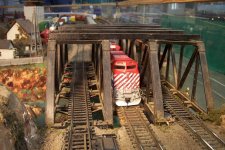
All trains originating on the Central of Alabama line are determined by a computer program that insures the proper type of car is set-out or picked up at the different industries along the right of way.
There are several trains from other railroads that have traffic rights on the Central of Alabama line and are included in the computer program. All train orders generated by the computer must run in sequence to insure that cars are available when needed or picked up when loaded by the industries served by the Central of Alabama line.
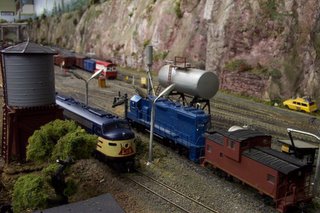
This model train layout operates with extensive use of walk-around throttles from Aristro-Craft, and several fixed location Model Rectifier hand-held throttles are used in areas of the layout.
The Central Alabama Model Railroad Club layout is fully scenic and features an outstanding painted backdrop that is a perfect match to the scenery and was painted by the wife of a former member. The backdrop includes trees lining the roads, casting their shadows across the highways and byways.
Presented here are photos of sections of the Central Alabama Model Railroad Club layout. To see more fascinating photos of this excellent model train layout be sure to visit the Central Alabama Model Railroad Club website http://www.camrrc.org
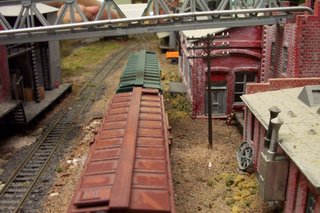
Look at the excellent detailing in the above photo. Photos are published with kind permission of the club. Photos are copyrighted by Central Alabama Model Railroad Club, Inc.
It all began on April 4, 1949, when 16 model train enthusiasts gathered together at a local hobby shop and formed the Glendale Model Railroad Club.
Then in 1968, work started on the present railroad with the laying of 3,000 feet of rail encompassing 400 feet of a single track mainline and three classification yards, all on a framework measuring 25 by 40 feet.
Over the next two years miles of electrical wiring installed to provide not only for operation of the trains, but illumination of trackside signals, street lights and the buildings that comprise the cities and towns. In addition, the trolley and branch lines materialized, a narrow gauge railway was built and more scenery began to cover the framework of the layout itself.
The Verdugo Valley Lines portrays operations of the Southern Pacific Railroad between downtown Los Angeles and the city of Bakersfield over 100 miles to the north. Intermediate stations represented in miniature are: San Fernando, Saugus, Lancaster, Mojave and Caliente. As a visitor views the layout, the foreground from right to left is occupied by the Los Angeles Union Passenger Terminal and supporting coach yards, roundhouse, diesel facilities, Taylor Yard (the massive facility that in real life stretched for more two miles along San Fernando Road), the Glendale station and finally, at far left, the city of Burbank.

The diesels above are being serviced at Los Angeles Union Passenger Terminal on the Glendale Model Railroad Club layout. Visitors can see this scene from just inches away–it is right up by the front aisle.
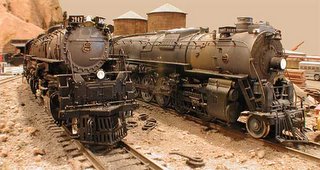
The two locos above are spotted at our Taylor Yard area. Notice the rattlesnakes between the tracks!
The Glendale Model Railroad Club has its own website http://www.gmrrc.org/ and the street address is – Glendale Model Railroad Club, 619 Hahn Ave.Glendale, CA 91203
Charlie Comstock is a keen model railroading enthusiast who has his own model train webpage.
On his webpage called “Charlie’s Railroad Page” he has included several photos worthy of a good look. Among them are these two showing scenery construction using stryofoam sheets.
Here is an snippet from Charlie’s website:
Hillmovers Construction Co. has finally commenced operations around the hamlet of Shelburn (between Bear Creek and Mill City). Although far from finished the basic ground contours are in place and some trees and buildings temporarily placed to help show how it will look when done.
I’ve continued using .060″ styrene sheet for backdrops and just located a supplier that is quite cost effective. Since my backdrops are typically less than 16″ high I can slice each 4×8 sheet into 3 strips getting 24′ of backdrop from each sheet.
These photos show the scenery under construction.


Visit Charlies webpage at:
http://www.bcsj.org/rr/index.shtml
The Osoyoos Desert Model Railroad has 2000 square feet model train layout has more than 500 houses and over 4000 hand painted miniature people.

The Osoyoos Desert Model Railroad is Canada’s largest Marklin lay-out, with more than a dozen computer controlled trains running through very detailed landscaping with European style towns and houses.
Well worth a visit if you British Columbia.
I came across an excellent model train site for you to look at. It is called http://www.stevestrains.com It has some excellent photos of the model trains in action including photos of the family cats.
Steve is modeling the P. H. Glatfelter Paper Plant in Spring Grove, Pennsylvania. This plant, once served by both the Western Maryland Railway and the Penn Central Railroad has been in operation well over 100 years. Their original and still main production plant is in Spring Grove and to this day still relies heavily on the railroads for their products. Today the plant is served by Yorkrailway Inc, a subsidiary of GWI (Genesee and Wyoming Inc.). Yorkrailway is the combination of Yorkrail and the Maryland and Pennsylvania RR’s.
 Here is something you don’t see often, a VERY clean PC GP-38. Must not have been any switchers available today, so the crew gets a higher horsepower ride. We will follow this guy for a bit.
The PC crew at work again switching the Paper Track. Cars on both ends means lots of work to be done and chances are, the boxcar in front of the engine is a buffer car since Steve can’t take power into the building. This way we use the buffer car to reach in and grab the cars we need.
Visit Steves site and take a look at some of his other photos.
The Lionel Trains 671 Turbine was introduced in 1946 and was available with various modifications until 1949. The earlier 1946 version featured a smoke bulb which was used to generate both illumination and smoke.
This Lionel Trains 671 Turbine consisted of two separate pieces. There was a steamer with a “6-8-6” wheel arrangement and a whistling coal tender.
It is best to choose a model train set scale that best suits your needs and gives you the effect you are looking for in your model train set layout.
O scale model trains and S scale model trains are large when compared to the more popular HO scale model trains.
O scale is 1:48 size with 1¼” track gauge and a minimum radius of 2 foot (24 inches).
S scale is 1:64 size with 7/8″ track gauge and a minimum radius of 22½ inches. As you can see S scale model trains sets are smaller in size than the larger O scale model train sets.
Around 42 percent of freight is now carried by rail in the USA. With increasing fuel costs, more and more people are shipping that way. 2004 set a record, and 2005 will likely break it, according to the Association of American Railroads.
The number of small rail companies actually has risen in the past 25 years, thanks to deregulation that allowed larger rail companies to dump track sections that weren’t profitable.
Model railroading is a fun-filled leisure activity that provides plenty of scope for the creative individual with a technical bent. It incorporates a variety of interesting activities from building, maintaining, upgrading and operating a model railway.
What kind of world you create, where you create it, and how much time you spend in it… is entirely over to the individual model railway enthusiast. We are all different.
HO scale is 1:87 size with 16.5mm track gauge and a minimum radius of 15 inches.
HO scale train sets are an excellent size to appreciate the detail and running performance without being too cramped. Also, many many train enthusiasts say that HO scale train sets are ideal for running their model trains using a digital setup.
If you’re looking for model trains that require lots of switching operations then train enthusiasts will generally agree that HO scale trains are an excellent choice.
S scale model trains were first made in England during the 1930’s. At that time model railroaders were looking for a smaller scale that would take up less space but retain the advantages of detailing and the heftiness of modeling that the O scale afforded.
At the time, many felt that the HO scale model trains were too small and that a more desirable gauge would be somewhere in between the larger O scale model trains and the smaller HO scale model trains. That’s how the S scale model trains came to be.
Model railroaders can get frustrated with derailments and accidents that happen with model train sets. Sadly, real train accidents are far more serious and cause tragedy and mayhem like what happened in Pakistan in 1990 and 1991:
January 4, 1990
More than 210 people killed and hundreds injured when an overcrowded 16-car passenger train struck a standing freight train in Sindh Province, Pakistan.
June 8, 1991
A train carrying 800 passengers from Karachi to Lahore slammed into a parked freight train at Ghotki, Pakistan, killing more than 100 people.
Model train set gauges and scales can be confusing particularly when the names sound almost the same. OO gauge and O gauge fall into this category and can trip up beginner and even experience model raliroaders at times. So, here is the difference explained once and for all.
OO Gauge Model Trains
OO Gauge has for many years, been the most popular model train scale with British Railway Modelers. OO gauge has a ratio of 1:76 equaling a scale of 4mm to the foot. It is considered to be the standard for many model train set enthusiasts in the UK and is a popular model train scale with beginners buying Hornby or Bachmann model train sets.
OO Gauge Scale Model Trains Specifications: 4mm : 1ft 1/76th Scale Track Gauge: 16.5mm
Because OO gauge is so popular in the UK there is a wide range of OO gauge accessories available in the UK. There is also a good secondhand market for OO gauge in the UK which can considerably reduce the costs of the hobby.
1830
The first regularly scheduled steam-powered rail passenger service in the U.S. begins operation in South Carolina with a U.S. built locomotive “The Best Friend of Charleston.”
A plant know as “Sea Foam” has great potential to make delicate, realistic looking trees. Depending on where you live it could be sold under a variety of different names. I’ve even heard it called ‘forest in a box’. Ask at model railroad shops and hobby suppliers.
Sea Foam on its own looks like small scale trees, but looks a little artificial and boring without some work. It tends to come slightly curved, so some manipulation will be required to get a proper tree shape. Try assembling a tree from various sprigs of Sea Foam rather than using just one piece. Use a larger piece as the main trunk and to which you will add sprigs for branches.
When joining pieces of Sea Foam together, you may need to strengthen the joints with fine brass wire. To add a greater girth to the bottom of the trunk wind a few pieces of irregularly torn masking tape around the trunk and seal it in with a mixture of wall filler and white glue.
When you’ve finished creating the basic tree skeleton, give it a quick spray with a dark greeny-grey/brown color aerosol paint. When the paint has completely dried, the foliage can be added by spraying the skeleton with spray adhesive or hairspray. The skeleton can then be dipped into fine ground scenic foam of the color of your choice. Alternatively you can apply foliage matting (like from Woodland Scenics) to the tree skeleton.
Another low cost idea is to use dried kitchen herbs for creating scale leaves. Different herbs and combinations of herbs create different effects. Dried herbs like Oregano, Thyme, and Parsley can be easily glued to the Sea Foam branches with spray adhesive. Put some old newspapers under the branches when you sprinkle the herbs over the tree foam. This way you can catch any herbs that don’t stick and reuse them on other branches.
After giving the tree skeletons a thorough coating of the herbs give them a coat of matt Varnish. The matt varnish will help seal the herbs and remove the stickiness of the spray adhesive. The trees can then be left overnight to dry.
After the trees are fully dry, some modelers then like to apply a coating of a white PVA wood glue/water mix by using a spray bottle. This can be done by hanging the trees upside down on some string and again left to dry over night.
If possible, plant the trees on the layout permanently. A couple of suggestions:
1.Use a small length of brass rod (1mm would do) which is glued into the base of the trunk and a small hole pre-drilled in the ground.
2. Or you could simply drill a small hole in the baseboard and then fill it with glue. The trees can then be inserted and the glue left to dry.
Note: Although Sea Foam is reasonably delicate, it is strengthened by the various coatings that are applied. The trees should be sufficiently flexible to withstand the odd brush with a careless hand or wrist. Also note, that some dried herbs can go brown over time, so you may want to add some green paint to the trees.
Looking now at O gauge it has a ratio of 1:48, or 7mm to the foot. Many modelers are attracted to O gauge because of the impressive detail on the rolling stock although the costs can prove prohibitive for many railroaders.
Realistic looking scenery is important on model train set layouts. To model weeds, hay, straw, and grass get some “binder twine” from a farmer/horse owner. The twine is a natural (unlike the new plastic stuff) material that takes paint/stain well. It also weathers naturally. Hang some outside for a year and it will look like fall weeds, let it lay on the ground and it will get a grayish color. The twine can be cut in very short lengths and used as some ground cover.