Everything on model trains, model railroads, model railways, locomotives, model train layouts, scenery, wiring, DCC and more. Enjoy the world's best hobby... model railroading!
Take a visit to Derya Ferendeci’s model train layout and you’ll be transported through a miniature world of trains, towns and villages, prairies and mountains across North-Western Turkey in the mid-1970’s, at a time when steam was king.
Several classes of steam locomotive which served on the Turkish State Railways are represented on Derya’s Model Train Layout.
They include classes 44.0 (German BR55), 45.0, 55.0 (German BR57), 56.0, 56.1, as well as the 56.5 (the class 52 German war locomotives), the class 56.7 (Ex German class 44uk – ex-SNCF) and the class 37 (Prussian T18/BR78) and class 57 tank engines (BR85).
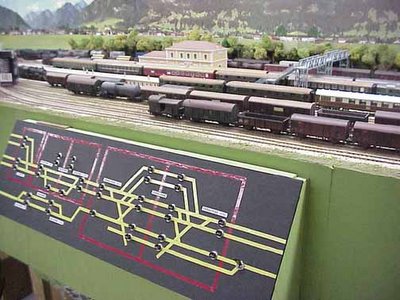
The above photo shows the main control panel at Kemalpasa.
Kemalpasa is an important division point on this part of the TCDD (Turkish State Railways) as it is a base for several dozen big steam locomotives.


These photos show a step-by-step illustration of the scenery for the new extention on Derya Ferendeci’s model train layout.
If you are not planning a visit to Turkey, then visiting Derya Ferendeci’s model railroad site is the next best option http://www.ferendeci.com/trains/
Fort Bend County, Texas, has been a hot bed of railroad activity for more than 150 years. These days a suburb of Houston, Fort Bend County is crossed by some of the most active rail lines in the US, including the former-SP “Sunset Route”. Living in various communities in this area, the members of the Fort Bend Model Railroad club are blessed both with the opportunity to see a lot of full-size trains in action, and to model railroads in N scale indoors as a way to seek relief from those long hot coastal-Texas summer days.
The Club has a large NTRAK layout composed on many modules, tied together by the theme of railroading in Fort Bend County in 1951. When all the modules are used, the layout is about 40 ft. x 24 ft. in size, with a center island with 9 12 ft. tracks used for staging.

Here’s the central piece of the module: the Imperial Sugar Factory and company-town buildings as they appeared in 1951. The reconstruction is based on extensive research and interviews.

Looking due west from the east end of the Sugar Land module (near the old crossing tower), some of the lower details of this module are visible. That’s the California Zephyr approaching in the distance.
These photos kindly supplied by the Fort Bend Model Railroad Club http://www.fbmrc.com/
Ponderosa North Model Railroad Club describe themselves as a round-robin club. Why? Because, the club does not have a permanent home – but rather it moves from members house to another members house on a monthly basis. This happens each month with the exception of the summer months of May – August, as it gets a bit hot in Phoenix.
Ponderosa North Model Railroad Club members share knowledge and experience with one another, displaying and critiquing each others model making. Members also view prototype train videos, help each other in building our home layouts – laying track, wiring, building scenery and running the trains in a prototype manner. Members also like to go rail fanning on the two transcontinental main lines as well as the dozen or so short lines in Arizona.
The club has a modular layout that is housed at club members homes. This layout is a working layout that is run at model railroading events like Railfair & the Great American Train Show. Work is normally done at these events to show both a running of trains and a demonstration of how to work on a layout providing visitors with help building their own layout.
The Ponderosa North Model Railroad Club has an excellent website that is well worth inspecting http://www.arizonarails.com
One of the biggest problems a model railroader can have is couplers that cause a car to derail or not couple correctly. Where you use the Kadee or McHenry couplers here is a very inexpensive tool you should not be without. A coupler test track.

The set up is easy. Take the roadbed as is, you don’t need to split it. Just lay down the roadbed with white glue. You will want to trim the edges. While the glue is setting up, about 2/3 of the way down cut out a section of roadbed for the uncoupler magnet and the metal plate down.

Read more about coupler test tracks at The Ponderosa North Model Railroad Club website http://www.arizonarails.com/coupler_test_track.html
Slim Gauge Guild Model Railroad Club in Pasadena, CA, has two layouts located in a 2000 square foot basement.
The Model Railroad Clubs HOn3 layout is based on the Denver and Rio Grande Railroad and the Rio Grande Southern. On the HOn3 layout the club tends to model specific prototype scenes.
The Sn3 layout is more freelanced. The club loosely models the Colorado and Southern for their mainline and northern California lumber companies for their highline.
Well weathered Sn3 Oil cars. The tank in back is painted on backdrop.

Santa Fe F7 passing the water tank at Colorado City yards Sn3.
The HOn3 track at Windy Point
The Slim Gauge Guild Model Railroad Club in Pasadena has its own Model Railroad Club website http://www.slimgaugeguild.com/
The RIT Model Railroad Club (RITMRC) was founded in early 1996 to promote the hobby of model railroading and to preserve the history of Rochester’s railroads.
Since 1996, the RIT Model Railroad Club has been concentrating on a permanent model railroad project. The HO scale Rochester & Irondequoit Terminal is an ongoing project being constructed using each members areas of expertise. Located in Room A-420 in the Student-Alumni Union, the model railroad features the latest in Digital Command Control (DCC) technology, working wayside signals, and highly detailed models and scenes inspired by the Rochester area.
In 2004, the club embarked on its second most ambitious project to date: a 40’x12′ modular HO scale layout. This yet-unnamed modular layout, based on the latest NMRA standards, allows RITMRC members the continued opportunity to design and construct a model railroad from the ground up. Also powered by Digitrax DCC, this modular layout is portable, allowing RITMRC to travel outside of the RIT campus and show off its modeling talent.

Amtrak Train 65 departs Rochester bound for Toronto. The train is crossing over the top of the historic High Falls. A coal drag heads east towards Rochester yard. That coal is destined for RG&E’s Russel power plant.
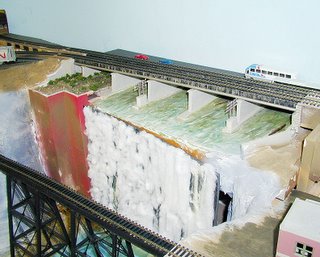
This earlier photo shows the construction in progress at High Falls.
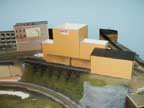
The above photo show how a club member (Otto) built a mock-up for the Genesee Brewery out of colored mat board. The mock-up helps determine size relationships for when the club goes ahead and builds the actual structures.
Secrets of the brewery revealed in this mock-up shot. The brewery does double duty as providing an additional customer for switching, as well as disguising the exit/entrance for the Buffalo staging yard through the backdrop. The mainline curves behind the brewery.
The RIT Model Railroad Club (RITMRC) has its own website http://www.ritmrc.org
The RIT Model Railroad Club (RITMRC) is well worth a visit.
A model train enthusiast can build a model train set layout in the solitude of his or her basement, attic, shed or garage workshop… or they can sit in a sun lounger and watch model trains weave around their garden… or the model train enthusiast can join a local model railroading club and share their model train ideas and experiences with others.
The opportunities for the model train enthusiast are endless!
‘We don’t stop playing because we grow old, we grow old because we stop playing’
George Bernard Shaw
N scale train sets are growing in popularity with model train enthusiasts. N scale model train sets have the advantage of taking up less space than the HO scale model train sets. N scale model trains are in fact 54.5 percent the size of equivalent HO scale model trains. This means that you can build an N scale model train set layout in an area about 30% of that area needed to build a similar model train layout in HO scale.
If space is an issue then an N scale model train set could be the answer. N Scale model train sets allow for more complex and realistic model train layouts in limited space. Curves can be made much more gradual with N scale model train sets. The smaller size of N scale greatly reduces the need to utilize unrealistically sharp curves to reverse the direction of the train on a layout.
As the name implies, the Indian Pacific Train travels from the Indian Ocean all the way to the Pacific Ocean. This famous ocean to ocean train trip across Australia is one of the world’s longest and greatest train journeys.
This train journey from Sydney (on the East Coast) to Perth (on the West Coast) covers 4352kms. The Indian Pacific Train travels from the spectacular Blue Mountains to the treeless plains of The Nullarbor, where the train travels the world’s longest straight stretch of railway track (478 kilometres).
Passengers experience three nights aboard the train as well as scheduled stops at Broken Hill, Adelaide and gold rich Kalgoorlie. A remote outpost on the Nullarbor Plain called Cook, population 2, presents a further opportunity to stretch your legs.
The Indian Pacific passenger train first ran in February 1970 from Sydney Central to East Perth linked New South Wales, Victoria, South Australia and Western Australia but by-passed Adelaide, the capital of South Australia. The Adelaide rail terminal (with standard gauge connection) was opened in May 1984.
It doesn’t seem to matter whether you’re 5 or 95… or somewhere in between. The personal satisfaction of building and operating a realistic miniature train layout is rewarding and fun… no matter how old you are. Model railroading is a truly rewarding leisure activity that will keep most model train enthusiasts busy and entertained for hours…if not a lifetime.
The shortest distance between stations on the London Underground is 0.26km (0.16 miles) is Leicester Square to Covent Garden on the Piccadilly Line.
As well as working on their own home layouts, the Prince William County Model Railroad Club members collaborate on an award-winning modular club layout displayed at events in Virginia & Maryland. The club occupies part of the Historic Quantico Depot in Quantico, Virginia where members are building an HO layout.
The club has its own website that includes several “how-to” pages with clever ideas like these:
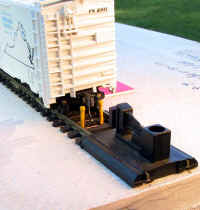
Broken couplers are a problem for many model railroaders and are often caused by hitting the bumpers too hard. This problem was solved by the addition of two small nails just before the bumpers. Placed exactly two and a half ties from the bumper, the nails were inserted so they caught the axel of the car and kept the coupler from hitting the bumper. This not only saved many couplers, but lowered the frustration level also. In the photo the nails have been painted yellow to make them easier to see.
Having a “finished” look is important to every layout. Here’s a good view of the painted and dappled fascia board, the complementary skirting and the recently added trim. A nice presentation makes every layout look better.

The riverbed has been painted in preparation to adding the water. Since the water will be clear, the bottom of the river will need to be painted darker in the middle, lighter on the sides.

To visit the Prince William County Model Railroad Club http://www.pwmrc.org/
Flying Scotsman is arguably the best-known steam locomotive in the world. Model Train manufacturer Hornby produce replica models of ‘Flying Scotsman’for model train enthusiasts to add to their model train sets.
The A1 4-6-2 is presented in LNER livery with four teak coaches to represent the period of non-stop running between London and Edinburugh over the summer seasons of the 1930s.
The spectacular A3 Class ‘Flying Scotsman’ this year joins the impressive stable of Live Steam locomotives from Hornby.
Hornby even have a complete ‘Flying Scotsman’ model train set containing everything needed to just set up and run including: a transformer, controller and track
The 40+ member Apple Valley Model Railroad Club (AVMRC) is located in a 100 year-old historic Hendersonville Depot . The HO model railroad represents the Hendersonville and Western North Carolina.

In its heyday, a 22,000 gallon water tank stood on the other side of the tracks with underground pipes to two stand pipes in between Track #1 & #2. Just far enough apart for two Mikado steam locomotives to be serviced at the same time. At its peak, six passenger trains a day stopped in Hendersonville collecting and discharging passengers for our City, while making their way from as far away places as Cincinnati and Charleston.

This section of track is still claimed to be the steepest Class #1 railroad in the United States at the 600’ elevation in less than 3 miles between Saluda and Melrose. While passenger service ended in 1968, thousands of tons of freight particularly coal and wood chips traveled over these track and through the Hendersonville station with as many as 6-7 trains a day up until 2002. At that time the current owners, Norfolk Southern Railroad, elected to re-route trains South by selecting different routes thereby by-passing Hendersonville.

Except for occasional local deliveries to area industries the tracks at the Hendersonville Station sit quietly beside the station providing a nostalgic reminder of the hustle and bustle of years gone bye.
The Apple Valley Model Railroad Club has its own website http://www.avmrc.com/
If you ask model train enthusiasts “what appeals about the hobby?” you’ll get a variety of answers. For some model train enthusiasts, it is a way of re-creating a fond childhood memory. Others; simply enjoy building a world in miniature with all its detail and realism. Then there are those model train enthusiasts who love solving the technical problems of building and operating an electronic control system.
There is a big choice when it comes to power packs for model train layouts. Power packs come in a variety of designs to suit individual requirements. All power packs contain a few basic components, including a transformer to provide the 12 volts, a throttle to vary tile output voltage, and a direction switch to control the polarity of the circuit. Power packs also have screw terminals for the track (which is DC) and AC accessory connections.
Larger units may include a larger power supply as well as additional electronic features such as: operating modes, pilot lights and meters, and multiple terminals for accessories such as add-on walkaround throttle units. These units make it easier to operate your train, enabling you to follow it as it moves around the track, rather than standing in one spot and watching it.
The Black Diamond Lines Model Railroad Club began back in July 1981 as a group of model railroaders who gathered in the back of a local Antioch, California hobby shop. Later that year, the group decided to make things official and were incorporated as a non-profit organization.
The Black Diamond Lines models in HO scale, which is a ratio of 1:87. This means that if a model is 1 foot long, it represents a real-life object that is 87 feet long. (One foot, in HO scale is actually 0.137 of an inch.)
The layout occupies approximately 1500 square feet of space, with a track elevation range from 46 inches to 82 inches above the floor.
All track is hand-laid on real wooden ties. All turnouts (switches) and crossings are hand made in place, which represents a lot of time and skill. Club members prefer hand laying over flex track and pre-built turnouts as they feel it has a more craftsman like quality.
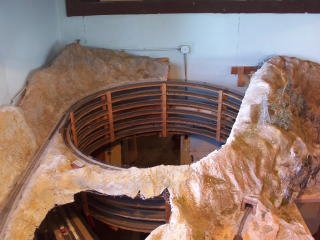
Though the double stack train is not visible, this photo shows the clubs Helix. It has 5 1/2 revolutions of 36″ radius. In a small amount of space the train will gain or lose 22″ of elevation. Grade is held at 2%.
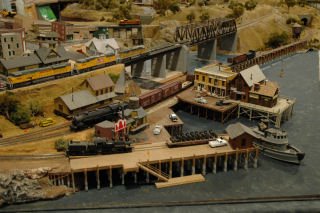
The Black Diamond Lines Model Railroad Club layout also includes a new waterfront area.
The Black Diamond Lines is an active, operating HO scale model railroad club located at 425 Fulton Shipyard Rd, Antioch, CA. The club website can be viewed at http://www.blackdiamondlines.org
Black Diamond Lines Model Railroad Club will be celebrating its 25th year of operation in 2006.
Like many model train clubs, members of the Black Diamond Lines Model Railroad Club build their own switch machines. This gives them flexibility that a purchased switch will not always be able to provide….and it keeps the cost down.
On the club website they go through the construction and installation process of a machine . The switch machines consist of the base, motor, threaded rod, three (3) cherry switches, two (2) diodes, flat head machine screws with nuts, 3/4″ x 3/4″ alum angle 1/16″ thick, and a square piece of plastic with an eyelet in it. Off the green wire are the diodes that direct power to the motor.
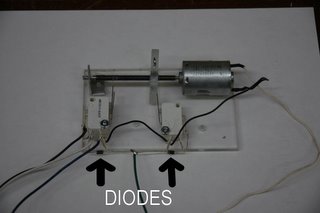
The base is plexiglass, 1/4″ thick, 5″ by 3″. Plexiglass is easy to work with, non-magnetic, but is pricey. Luckily the club was given a bunch of it. Here the base has the motor siliconed to it and the threaded rod has been pressed onto the motor shaft. The end of the screw is supported by the alum angle.
Before securing the motor the base, remember to put the plastic on the threaded rod.
 For full directions and more interesting photos visit the club website http://www.blackdiamondlines.org/switchmachine.html
The site also shows how to wire the switch. The cherry switch has three connectors on it. The connector on the side is connected to one of the diodes. The other end is connected to the green wire. This is the power wire from the control panel. The other diode attaches to the green wire and to the outside connector on the bottom of the other cherry switch.
The black wire from the motor is connected to the left connector. A jumper wire is attached to the right connector on the bottom cherry switch. The right connector on the single cherry switch is not used.

Take a look at the club website. The Black Diamond Lines is an active, operating HO scale model railroad club located in Antioch, CA.