Everything on model trains, model railroads, model railways, locomotives, model train layouts, scenery, wiring, DCC and more. Enjoy the world's best hobby... model railroading!
Many beginners to the hobby of model railroading are confused with the difference between standard gauge and narrow gauge tracks.
Standard Gauge railroads have a width of four feet eight and a half inches between rails whereas Narrow Gauge railroads have a width of three feet between rails.
1838
Five of the six New England states have rail service, as do such frontier states as Kentucky and Indiana.
The first train arrived on December 26, 1913, and the last train left on January 5, 1988. The original train station had been consumed by fire so the MCS was hurriedly put into operation before the finishing touches were done.
Since then the building has remained unfinished, because it was too busy functioning until after World War II, and after that it didn’t make enough profit to cover expenses.
As at June 30, 1941, the US Railway Mail Service employed 20,584 officers and employees, of whom 19,486 were postal clerks.
The command station on a model train set is the brains of any DCC system (besides the engineer!). The command station is basically a dedicated computer that communicates with all other parts of the DCC system.
The command station processes the signals from one or more throttles, and transmits them to the track via a ‘booster’. The throttles connect to the command station either directly via the socket on the unit or via a ‘network’ for more than one throttle.
Take care when selecting the brand and model of command station for your model train set, because it is the key to selecting the type of throttle controls as well as system features that can be expanded on.
It doesn’t matter how long a model train enthusiast has been involved in the hobby, most come up against questions that need answers. Trouble is; those answers are not always easy to find. Searching the internet, although helpful, can prove to be a big time-waster, because many model train websites consist just of useless links to other sites.
Sheer frustration is what motivated me to write my Model Train Help ebook, as like so many other model train enthusiasts, I found finding answers slow and tedious. I thought to myself, if I’m experiencing these frustrations, then so must lots of fellow enthusiats. So, I decided to rectify the problem by answering, in simple easy-to-understand English, many of the question facing model train enthusiasts, both experienced and beginner.
I then set about asking model train enthusiasts what their most pressing questions were. Here are some of the questions they came up with – all of which are answered in the ebook:
If I install a larger motor in my locomotive will I be able to pull more cars?
What’s wrong when a part of the track will not work? How do I go about fixing it?
Should I replace my horn-hook couplers with knuckle couplers?
What is rust-busting, a talgo truck, “head-end” traffic, a green wave for freight trains?
What is meant by “code”, as in code 40 track? Is a locomotive change-over the same as shunting?
Which rails should I use – brass, steel or nickel-silver?
How do I make plastic buildings look real?
Why do some buildings look translucent?
Should electric feed wires be included every couple of feet or should I solder rail joiners?
What is a bridge rectifier and what does it do?
When I buy a track switch, what is meant by ‘No. 4 turnout’ or ‘No. 8 turnout’?
Running techniques for a locomotive on a reversing loop. What about stopping the loco on the loop and throwing the switch?
What is a decoder and can I run an analog locomotive on a DCC system without a decoder?
Can I just put a decoder in my old analog engines?
Are ‘O-gauge’ and ‘O-scale’ the same thing?
Is there a right and wrong way to cut track?
If I have limited space what should I leave out from my layout?
What is a classification yard and how does it work? What are the yard options?
Should I have a run-around track and dedicated lead track?
What’s a Capacitor Discharge Unit and a Solenoid Motor and what do they do?
What’s the difference between DC and DCC?
What do I need to start or convert my analog layout to a DCC system?
What’s the difference between service mode and operations mode?
Can I control turnouts with DCC?
What’s a booster? Will the ampere rating of a booster and power supply limit how many locos I can run at the same time?
What causes a train to short out on a turnout?
That’s just a small sample of what is included in the book. So, if you need answers to these or other model train questions then have a look at my website for the Model Train Help ebook.
Happy Railroading!
Narrow gauge equipment maintains the scale, but runs on a smaller gauge of track. Narrow gauge track is seldom used on main line railroads. Narrow Gauge track was generally laid in areas where rail traffic was light, curves may have needed to be tight, and cost was a major issue. Most popular in mining spurs, logging spurs, and scenic tourist rails where low speeds were usual.
Napa Valley Model Railroad Historical Society, Inc. was formed in 1955 for the purposes of constructing an HO Scale layout and to advance the hobby of model railroading in the Napa Valley and surrounding areas.
The model railroad club’s early layouts included small portable layouts in the Main Exhibition Building of the fairgrounds during the fair, and a layout in the old West Napa, Southern Pacific station.
In the early 1960’s the model railroad club had its first “permanent” layout and by the mid 1960’s club members began building a large layout in the basement of a barracks at the Veterans Home in Yountville.
In 1970, the Napa Valley Model Railroad Historical Society model railroad club moved back to the fairgrounds in Napa to its current location in a two story 40′ x 40′ building.
The Napa Valley Northern layout occupies this 3600 square foot “L” shaped room. The 1600 square foot second floor serves as a meeting area, library, and workshop for the model railroading club.
The Napa Valley Model Railroad Historical Society has a railroad line running from Napa north through Lake County, with northbound connections to Portland, and southbound connections to Stockton.
The layout has over 1500 feet of track. The time period is from 1940 to present. The observer will see various types of prototype and freelance rail equipment and buildings around the layout. Because of space limitations, areas are not reproduced in their exact geographical configurations.

Above: Napa is the largest area on the railroad. It consists of a large clasification yard (Known as Nelson Yard), an engine servicing facility, an intermodal yard and industrial area. The industries are switched by the Napa Union Terminal Company (NUTCO). Included are Union 76 Refinery, a scrapyard, a pipe plant. Future developments are milling and printing companies.

Above: Just down a dirt road a bit, back on the mainline is Yellow Jacket, a small maintenance area. Here, SP 2405, an ALCo C415 pulls a local on by.
If you are visiting California, then be sure to make contact with the Napa Valley Model Railroad Historical Society. This model railroad club has an impressive layout as you will see when you visit their website http://www.nvmrc.org/
DCC stands for Digital Command Control.
It is a system that allows model railways to independently operate multiple locomotives, functions (speed, sound, lighting, direction, movement) and accessories rather than control of sections of track. This is achieved by locating a decoder in the locomotive that listens to information in the track.
I have added a new section on analog and DCC operation in the newly released 3rd edition of my Model Train Help ebook.
Happy Railroading!
An Analog model railway is simply a conventional model railway with conventional analogue controls [DC or AC] to provide a power feed to a piece of track. Any locomotive that is on that piece of track will respond by moving forwards or backwards. The speed and direction of a model train is controlled by varying the voltage and polarity on the rails. The higher the voltage , the faster the locomotive moves, the lower the voltage, the slower the locomotive moves.
In model railroading, narrow gauge models use the lower case letter “n” to follow the scale and then the track gauge in scale feet. Example: HOn3 means HO scale (1:87 proportion narrow gauge 3 feet between the tracks.). HOn2 would be HO scale narrow gauge 2 feet between the tracks.
There are few narrow gauge railroads still in operation. Some have been converted to the standard railroad system. Others have been dismantled and turned into scrap. Even though narrow gauge railroads were inexpensive to build, off loading and on loading became too much of an expense. Each time a narrow gauge railroad met a standard gauge railroad, shipments would have to be unloaded and reloaded.
The terms scale and gauge are two of the most confused terms in the model railroad hobby.
The SCALE proportion is expressed as a fraction of a real life-sized railroad. As an example, HO scale model train set is 1/87 the size of real life-sized railroads.
For model trains, track GAUGE is the width between the inside running edge of the rails. For toy trains, track gauge is the measurement from the center of the two outside rails.
No they don’t, but there are two main types: standard gauge and narrow gauge. In the US, Canada and most European countries, trains run on “standard gauge.”
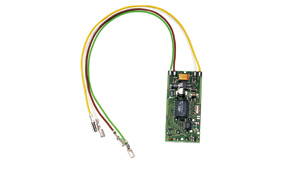 When purchasing a locomotive with a decoder installed, look for the wording “DCC equipped”, or “Factory installed decoder”, or “W/DCC”, or wording like that.
Be careful though, because the words “DCC Ready” usually means that the locomotive is capable of having a decoder installed and that one is NOT already installed. I repeat, “DCC ready” usually means there is NO decoder fitted, but the wiring inside the locomotive is terminated with a socket, ready for addition of a “Plug and Play” decoder. This is an easy installation, no soldering.
If you are still unsure whether or not a locomotive has DCC status, you can try this test. Place the locomotive on the program track of a DCC system. See if the command station can read CVs… and if it can’t… then no decoder is fitted. Also, without a decoder fitted, the loco would “hum” with the throttle set at “0”.
If the locomotive responds to the throttle on a DC system, then either there is NO decoder, or the locomotive may have a decoder that has analog operation enabled.
If in doubt, it is always best to get clarification from the hobby store staff, or from the manufacturer or person supplying the locomotive.
1861-1865
The Civil War becomes the first major conflict in which railroads play a major role as both sides use trains to move troops munitions and supplies. Two-thirds of the nation’s railroads were in the northern states in 1861. The north was where the industrial centers were located.
In the South there were gaps in the rail network within and between states. Tracks of differing gauge (five feet was the dominant gauge) caused problems in transferring passengers and cargo between rail lines. Also, the South had less rolling stock, while track materials and locomotive factories were scarce.
Naturally, your choice of model train scale will depend on what you want your railroad to do. It is important to remember that bigger is not necessarily better.
You can pack more into the scene with a smaller model train scale (such as N scale).
If you live in an apartment or small house where space is limited, then think about a smaller scale such as Z scale, N scale and HO scale. For a micro train, try Z scale trains, which are 1:220
The Black Diamond Lines Model Railroad Club models in HO scale, which is a ratio of 1:87. This means that if a model is 1 foot long, it represents a real-life object that is 87 feet long. (One foot, in HO scale is actually 0.137 of an inch.) The layout occupies approximately 1500 square feet of space, with a track elevation range from 46 inches to 82 inches above the floor.

Above: This engine is an SD70M. MU cables, air hoses, gps receiver, and ditch lights are just a few of the extras that have been added.

Above: An EMD-SD70 Deminstrator. Three were made, 7000, 7001 and 7002, all which can be seen on the BDL right of way. Again extra details have been added for that prototypical look.
The Black Diamond Lines is an active, operating HO scale model railroad club located in Antioch, CA.