Everything on model trains, model railroads, model railways, locomotives, model train layouts, scenery, wiring, DCC and more. Enjoy the world's best hobby... model railroading!
Weathering (showing signs of wear and tear) can add to the realism of any model train set, but it needs to be done carefully. One, often overlooked, important consideration is the age of the individual freight wagon being weathered. Not all wagons on a freight train are necessarily of the same vintage or have experienced the same weathering conditions. A freight train could comprise a mix of fairly new and considerably old wagons.
For example a model train layout depicting a mid 1960’s railroad might comprise mainly of wagons built around 1950. That would make most of the wagons around 15 years old.
Compare this to a freight train on a modern day railroad layout. Today’s freight train might include several brightly colored newish wagons along with a couple of 35-40 year old wagons built around the mid to late 1960’s. Weathering of the older 1960’s wagons would be different to that seen on the newer wagons.
So, always consider that a freight train is made up of several different wagons of different ages and backgrounds rather than all the wagons on a train being constructed at the same time and experiencing the same weathering conditions.
The Granville Island Museum in Vancouver, Canada houses many collectable model trains, photographs and dioramas including: The Royal Hudson, Lionel Trains, “O” Gauge, “G” Gauge, Standard Gauge, Steam Locomotives and Tender, Transcontinental Trains, Brass Locomotives and many more model trains, toy trains and photographs.
The shear size of the model train collection, the detail and hours required to build the 5 line working diorama will take the steam right out of your engines.
The model train museum has an 80-foot-long diorama of Kettle-Valley-like terrain with almost 1000 feet of train track. There are beechwood cabinets lining the walls, filled with sets that run the gamut from turn-of-the-century tin wind-up trains to contemporary collectors’ scale models. The Granville Island model train museum hosts a collection snowblower cars, dining cars and hand made engines that run on small pieces of coal. There is even a rare pink Lionel train set, circa 1958.
Design and building team for the “O” gauge track layout was a team of talented long-term friends. The Granville Island Model Ships, and Model Trains Museum is located on Granville Island in the heart of Vancouver, British Columbia, Canada.
Nickel silver train tracks are one track option for model train enthusiasts to consider when building a model train set layout.
As with Brass track, Nickel silver train track also forms an oxide, but are still a good conductor of electricity. The oxide that forms on nickel silver happens to be electrically conductive whereas that which forms on steel and brass is not. What this means is that after a while on steel and brass rails the model trains tend to run erratically. This means you’ll need to clean the rails frequently to avoid this problem.
Using nickel silver train track means you will have better running model trains and less time spent cleaning train track. That’s why many model railroaders favor nickel silver train tracks for their model train sets.
True train story: USA December 19, 2005
A dog was found frozen to some railway track and was pulled free just 10 minutes before a train was due to pass by. The dog, nicknamed “Ice Train”, lost some hair in the rescue process and was taken to the Chippewa County Shelter where it recovered quickly.
The dog’s owners were identified but “Ice Train” has since been adopted by a Wisconsin family.
It’s the first time a Canadian company has won a World Travel Award in the train category of the World Travel Awards. Rocky Mountaineer Vacations, has won top honour at the 2005 awards as the “World’s Leading Travel Experience By Train”. Other nominees in the category were: The Blue Train (South Africa), Rovos Rail (South Africa), Great Southern Railway (Australia), Orient Express Ltd (United Kingdom), Orient Express (Peru) and Palace on Wheels (India).
Over 2,000 people attended the gala ceremony at London’s Royal Opera House where the 12th Annual World Travel Awards event was held.
Since receiving the award, Rocky Mountaineer Vacations has announced the suspension of the North Coast Explorer train for the 2006 season. The tourist train, servicing the cruise ship industry, ran along the Skeena River and back form the Port of Prince Rupert.
Model railroading is a fun-filled leisure activity that provides plenty of scope for the creative individual with a technical bent. Model railroading incorporates a variety of interesting activities from building, maintaining, upgrading and operating a model train set.
What kind of world you create, where you create it, and how much time you spend in it… is entirely over to you.
You can build a model train set layout in the solitude of your basement, loft, shed or garage workshop… or you can sit in a sun lounger and watch model trains weave around your garden (g scale)… or you can join a local model railroading club and share your ideas and experiences with others. The opportunities with model railroading are endless.
Brass train tracks are one track option for model train enthusiasts to consider when building a model train set layout.
It is generally accepted that brass train tracks are the best conductor of electricity, but brass train tracks do need a regular cleaning to keep them in good condition. This is because brass forms an oxide when in contact with the atmosphere, which creates a barrier to the current.
1941-1945
US railroads remain under private control during World War II. Trains move on average twice the monthly volume of both freight and passengers as during World War I.
Zinc-coated steel train tracks are one track option for model train enthusiasts to consider when building a model train set layout. The big disadvantage with zinc-coated track is that the zinc can wear off. This can expose the steel that can then rust. However, zinc-coated tracks are often cheaper to buy than other track options and are worth considering by any model railroader who is on a tight budget.
The longest train journey in the world without changing trains is 6,346 miles (10,214 km.), from Moscow, Russia, to Pyongyang, North Korea. The train trip takes almost eight days with only one train a week taking this route.
Model train track comes in different types made of brass, zinc-coated steel, nickel silver and steel. Regardless of what the train tracks are made of, most track sets come with a terminal section so that you can hook into the transformer.
Brass track and zinc-coated steel track are common in starter model train sets and, when purchased separately, are usually cheaper in price than nickel silver tracks.
Of the numerous train models on display in the Chatham Railroad Museum, four are of special note. Scale models of the locomotives in use in the late 1930s on the New York Central Railroad, they were handmade by Walthers Brothers, a top model train set maker, for display at the 1939 New York World’s Fair. The trains were later shown off in various New York Central stations, as well as Grand Central Station, on a working model layout. The late Frank Love, the first director of the museum who had worked for the railroad, arranged for the train set models to be displayed at the Chatham museum in the early 1960s.
To get there: From Route 6 (Mid-Cape Highway) take Exit 11 Chatham/Brewster Route 137. Address: 153 Depot Road, Chatham, MA 02633
Train News: New Zealand
Vintage steam locomotive WAB794 puffed back into service after 43 years on 27 August 2005.
The 78 year old steam locomotive returns to the North Island of New Zealand’s main trunk line as part of a tourism experiment. The historic steam locomotive pulled Tranz Scenic’s Overlander carriages 200 km from Feilding (near Palmerston North) to Ohakune and back. The journey took passengers through some of New Zealand’s most beautiful countryside.
When space is limited in the family home, model railroaders of try and think outside the square when locating layouts. A lot of people decide that a loft is a great ‘out of the way’ place to set up a model train set. Yes, a loft can be a good solution, but be careful and do your homework first.
Unless the loft has been properly converted there is a danger that you may overload the ceiling joists (resulting in cracked ceilings in the room below). There could also be the possibility of overloading the entire roof trusses resulting in a collapse… far worse scenario.
Always seek professional advice, because some roofs cannot be modified safely to accommodate a load bearing down from “inside” the roof. If in doubt consult an engineer, or at least an architect before locating your train set in a loft.
Model train track consists of two metal rails separated by plastic tie sections. Each rail carries one side of the electrical circuit. To work properly, the two rails should not contact each other and no metal object should contact both rails together. This would cause a short circuit, which could damage your model train power pack if it happened too often.
With this in mind, assemble your model train track and connect the transformer… and you’ll be ready to start operating your model train set. It is as easy as plugging in the transformer, carefully placing the locomotive on the train track, turning up the throttle…and enjoying!
Arizona is one of the most fascinating places in the United States to be involved in railroading of any type. It wouldn’t be unfair to say that Arizona owes much of its past growth to the railroads. Arizona itself, is an amazing landscape of striking contrasts – from snow covered forests in the north, to blazing desert sands in the south.
The state hosts the transcontinental lines of both the major western railroads: The Union Pacific and the Burlington Northern Santa Fe. And both of those lines are steeped in historical predecessors, the Atlantic & Pacific, the Santa Fe, the Southern Pacific, and even the Texas and Pacific.
And the state is filled with optimistic short lines to serve the lumbering and mining interests of the earliest pioneers. Lines like the United Verde & Pacific, Verde Tunnel and Smelter, Arizona Mineral Belt, El Paso & Southwestern, Arizona Eastern, Maricopa & Phoenix, Bradshaw Mountain, etc. Many are fallen flags, but some are new like the Black Mesa & Lake Powell and the many incarnations of the Apache Railway.
Arizona is also home to the Ponderosa North Model Railroad Club. The club has a modular layout that is housed at club members homes. This layout is a working layout that is run at model railroading events like Railfair & the Great American Train Show. Work is normally done at these events to show both a running of trains and a demonstration of how to work on a layout providing visitors with help building their own layout.
The Ponderosa North Model Railroad Club also has one of the most informative model railroad club websites on the net. Do have a look because it is well laid out and has some excellent model railroading information and tips.
To give you an idea here is a snippet from a page on building a case for carrying rolling stock to swap meets and model train shows.
Here is an extract from the page courtesy of the Ponderosa North Model Railroad Club.
At a swap meet Matt & I were at recently, Matt took a final look around to see if there was anything he could not live without. He ran across someone selling a tool box that had been converted into a carrying case for rolling stock, complete with 4 trays. I thought it interesting too. What a great way to transport rolling stock while minimizing the chance of damage! However, we both thought the $65 price was a bit much, so we decided to have a go at it ourselves. Here are the results.
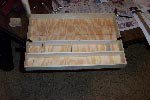
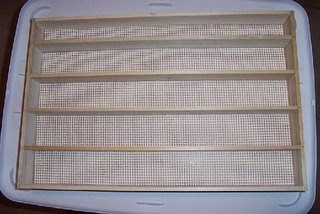
Now as we looked at tool boxes we got the notion that a 19″ long tool box might not hold enough rolling stock for our needs. So after some brain storming and thought, Matt came up with a better idea. We would use a tub, the 58 qt. size you can get at Walmart. Not only did we get 3 larger trays but we also got extra space to either add 2 more trays or what we did, use the space to transport buildings, tools, etc. Note you can make 1 or up to 5 depending on your needs. If you make more, you can always leave trays home if not needed and gain more building space.
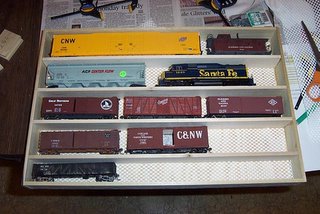
While the basic tub construction was the same, Matt opted to use 1/4″ plywood for his tray base & I used 1/4″ Masonite. Both cost about the same, the Masonite a bit cheaper. I thought the Masonite would keep sanding down and less chance of splinters as the trays got old. But you have to drill some pilot holes to make it easier to nail the frame to the tray base.
More details on the Ponderosa North Model Railroad Club website.
The London Underground or ‘the Tube’ as it is universally known to Londoners, is normally the quickest and easiest way of getting around London with 275 stations conveniently dotted across the city (63 in central London). In London you are never far from a Tube station. Most people in London use the Tube.
London is served by 12 Tube lines. Underground trains on all lines run every few minutes between 5.30 until 00:30 Monday to Saturday, and between 7.30 – 23.30 on Sundays. Each line has its own unique colour, so you can easily follow them on maps and signs throughout the system.