Accessories
Everything on model trains, model railroads, model railways, locomotives, model train layouts, scenery, wiring, DCC and more. Enjoy the world's best hobby... model railroading!

Fred asks readers:
“I have a 40′ Chicago & Illinois Midland boxcar with a build date of 7-29 car number 8004. It is a Life Like car with HWL 5-45 on the side under the words, When Empty Return To Springfield ,Ill. What is HWL?”
Comment below.
“I have an old HO Marklin 410 turntable that I would like to commission. It has 4 points on the outer rim: Brown, Red, Brown, Red. What is exactly connected to what?”
Rich asks readers:
“How does the smoke unit work on Amercian flyer, model 343?”
To help Rich you can answer his question using the green comments link below.
Rob asks readers:
“I am using dcc and I want my light signals to work when I change the points. Is there a way they can be controlled to do that? I am using the Hornby select dcc controller with side mounted point motors controlled by the decoder box. Many thanks”
Readers can answer this question below.
I often get emails from model railroaders wanting to buy a certain locomotive or train accessory they can’t seem to find for sale anywhere.
Well, now they can run a FREE listing on http://www.tradetrains.com in the new WANTED category. There is also a new category where model train clubs can list their open days and activities for FREE.
The TradeTrains.com website is very new, but is getting a lot of visitors wanting to buy and sell model train stuff. So, if you have something you want to buy, sell or swap… list it now for FREE at http://www.tradetrains.com
It is FREE to register on the site.

“I have HO rolling stock from kits from 60 years ago to more recent times and would like to make one pass through standardizing the couplers. I like the appearance of the Kadee couplers on the older kits, but there are so many varieties of Kadee couplers, I’m lost. What is the difference between different Kadee couplers? Why would I choose one Kadee knuckle coupler style over another?”
If you can assist David, please use the green feedback and comment link below.
Jay has sent in some thoughts on the advances in model railroading:
The newest equipment available today has all of the best perks for good performance:
Can motors:
The big advantage that can motors have is that they are pretty much sealed, and keep out dust and dirt. They also have higher torque at low speeds, and are over all much smoother, and draw a lot less current.
Flywheels and dual flywheels:
Flywheels really make a locomotive run smooth. They will carry you over dirty spots in the track and give the locomotive the effects of “Momentum” starting slower and stopping slower or a bit of coasting.
All Wheel Pickup:
What could be better than having all of the wheels do their part in conducting to the energy in the track? The more the better to get over turnouts, crossings and dirty track. It really aids in smooth operation.
Ian wants to hear from others in the hobby who have experience with couplings:
“Hi everyone. I have just come back to model railways again but I have found a problem. I have quite a few trains and rolling stock but I’m unable to interchange my coach stock as most of them are different couplings. Is there a standard fitting that would fit all?”
Comment below.
Jim has a question for readers and asks:
“I have an old Tyco analog locomotive that I received for Christmas as a child. It is in excellent shape and I would like to use it on my current layout. My set-up runs on digital power. My question: Can I replace the trucks on the locomotive with new digital ones? If so, can I buy just the trucks as opposed to buying a new locomotive and swapping the trucks?”
Add your feedback below.
Jeffrey wants to know where to buy some model train accessories and asks:
“Can anyone advise a manufacturer of a 00 ready to run GWR autocoach, or failing that, a kit maufacturer please?”
Add your suggestion or feedback below.
Sam is experiencing layout problems and reports his whole layout stops sometimes when crossing a switch. Can someone help Sam?
“How can I eleminate a short occuring when the locomotive crossing a switch stops the whole layout. I use code 100 atlas track and peco switches. Insulfrog also DCC layout. It happens mostly with 6 axle locomotives. I have deisel engines engines Atlas, Atheran and Broadway”
Add your feedback or suggestions below.
Timothy doesn’t know where to look on the internet to buy these model train spares and is wanting guidance from experienced model railroaders who buy model train parts online. Here is Timothy’s question:
“I need traction tires for a #242 4-6-0 Mantua/Tyco Dixie-Belle Western Atlantic Steam Locomotive. I also need a “Knob” that raises and lowers a Tyco #932 Boom/Crane car. Where can I buy these parts on the internet?”
Add your feedback below.
John has kindly sent in this story for publication:
Coupler problems is a subject very near and dear to me. On British trains the couplings on the older stock ( I am modelling the late 1940s) were screwed up tight. Coaching stock with gangways coach to coach were very close. If models are shop bought then they are designed for 2ft radius curves i.e. the toy market. But my layout will only have a few curves as tight as 3ft radius on turnouts ( sorry “switches” in your language). So not wanting my trains to have about 10ft between coaches I am working my way through my stock modifying couplings so as to have that “bunched-up” look to my trains. With experimentation I have decided to aim for about 5/32 of an inch between buffer faces. This gives satisfactory clearance for 3ft radius curves (00gauge).
The trains look really good at this and the gangways are so close as to appear joined. I know that joined-up gangways are available and perhaps I will at some point fit them. But I do have reservations in this regard not wanting to detract from the ease of changing coaches in a train.
The flexibility of the make-up (what I believe you call “consist”) was a feature of the old-fashioned loco-hauled trains of my era. If a train arrived at a junction station then one or two coaches could be added if there were through coaches from the branch or a coach or coaches could be transferred from the main line train to the branch. Luggage cars and parcels vans could be transferred from one train to another and so on.
The modern diesel (and electric) trains in their rigid formations have lost this flexibility, a flexibility which was responsible for attracting the public to use trains. The Great Western Railway was famous for its slip coaches for example.
Here in Britain we have lost all our branch lines, there is very little freight movement and I am sure that you will be aware that it is freight that makes a railway profitable. We have all but lost our manufacturing industry, factories close down on a daily basis, are dismantled and become supermarkets, housing estates and warehousing for imported, foreign-made goods which the British public in general, cannot really afford!. This is because everything we buy of a manufactured nature is made in China.
Mail, oil, food, even refurbished railway coaches, ALL go by road, even carrier racing pigeons are sent out by road now. Our roads are cluttered up with huge lorries far too large for our little thoroughfares.
Yet the railways are under ever increasing pressure to carry more and more passengers on a railway which is a bare skeleton of what our railways once were. I am sure that the press of numbers of passengers is not because the public is ATTRACTED to trains but simply because our roads are so crowded now that journeys on those roads have become so unpredictable due to the press of more and more cars. We are fast becoming the most over-crowded country in the world and soon the railway train will be the only satisfactory mode of travel. Even the skies have become overcrowded with aircraft!
I have rather got off the subject of couplings but hope you will understand that I want to model a REAL railway!
Mick has a question for anyone who can answer it:
“I an setting up my first DCC N-Scale layout using Peco code 55 Track on Woodland Scenics track bed ST1475. I am also using Peco switches. However, my locos (e.g. InterMountian FTA/B pair) usually sits and spins the wheels on the track – conductivity, but no traction. There are also spots where the 16v DCC is present (as measured using a VOM on AC setting), but the train sits. What can I do to correct this BIG problem?”
Add your answer or feedback below.
Gino asks readers:
“Could someone please help me. I purchased a Heljan container crane and all the functions work except for the hoist which will not go up or down. Has anyone had this problem and if so how did you fix it? Thank you.”
Comment below.
Charles has a question for readers:
“When making up a long coal train of hoppers, why do the Athearn Cars seem to be out of proportion? They always appear to me to be larger than hoppers produced by other manufacturers. Am I imagining things?”
Comment below.
Daiquiri asks readers:
“I am looking for the builders of the new Amtrak Auto Train Carriers. I am creating an HO scale Auto Train and have to scratch build the auto carriers. I need plans, diagrams or blueprints so I can obtain the dimensions of the cars so that I can reduce them down to HO scale.”
Jack has put considerable thought into submitting his question so I am sure you’ll want to help him if you can. Please use the green comments link below Jack’s posting to add your comments and suggestions.
Jack says:
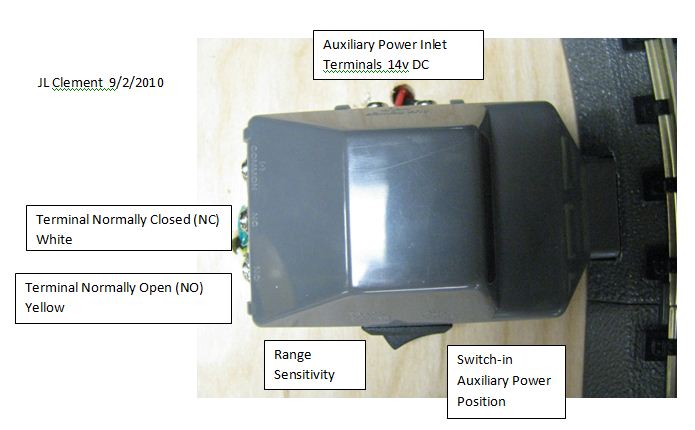
I am sending details of the “O” gauge crossing gates arrangement I have installed which the hope of receiving guidance on modifications required for proper operation. The arrangement uses the RailKing (RK) Crossing Gates in conjunction with a MTH RailTrax I.T.A.D. (ITAD) Control. A wiring diagram and photos describe my installation which does not function and displays the following characteristics:
1. The setup is based on using Auxiliary Power from the 14v DC terminals on the transformer.
2. When the auxiliary power is turned on, the Flashing LED lights start blinking and do not turn off.
3. The gates freeze in the down position as shown on the photo.
4. When the locomotive passes through the crossing, there is no effect on the gates.
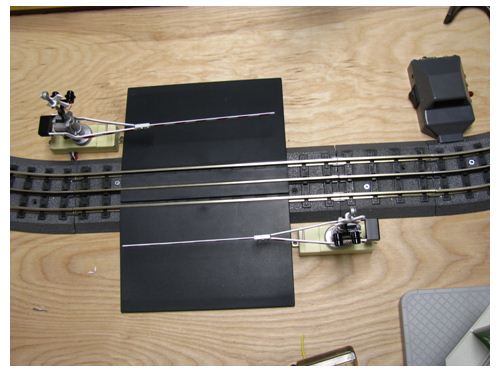
The installation was in accordance with my interpretation of the two sets of operating instructions- Gates and ITAD. I had to make some assumptions:
1. The gates and the ITAD required both to be directly powered from the transformer.
2. The input terminals on the ITAD were interchangeable, ie, either could be the positive terminal.
3. As auxiliary power is selected on the ITAD switch, it was of no importance for the ITAD to be on the same side of the track as the Lock-On for track power.
4. There is not direction about the location or orientation of the ITAD, nor any information on considerations for the infrared sensing circuit. I expected to see a red light on the ITAD but see none.
5. That the components are in good working condition.
The Operating Instructions for the Gates and the ITAD are attached.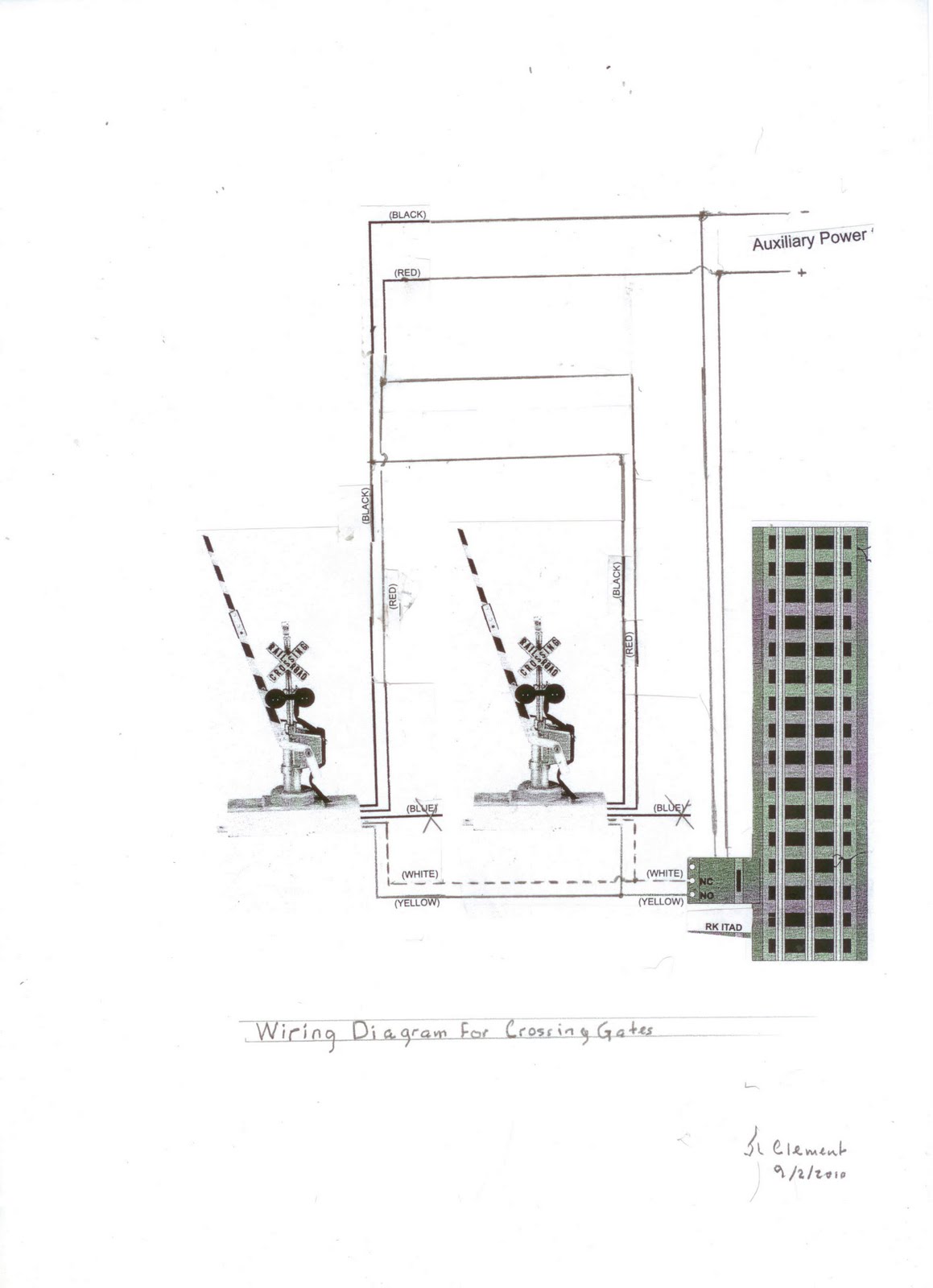 Crossing Gate Wiring Diagram
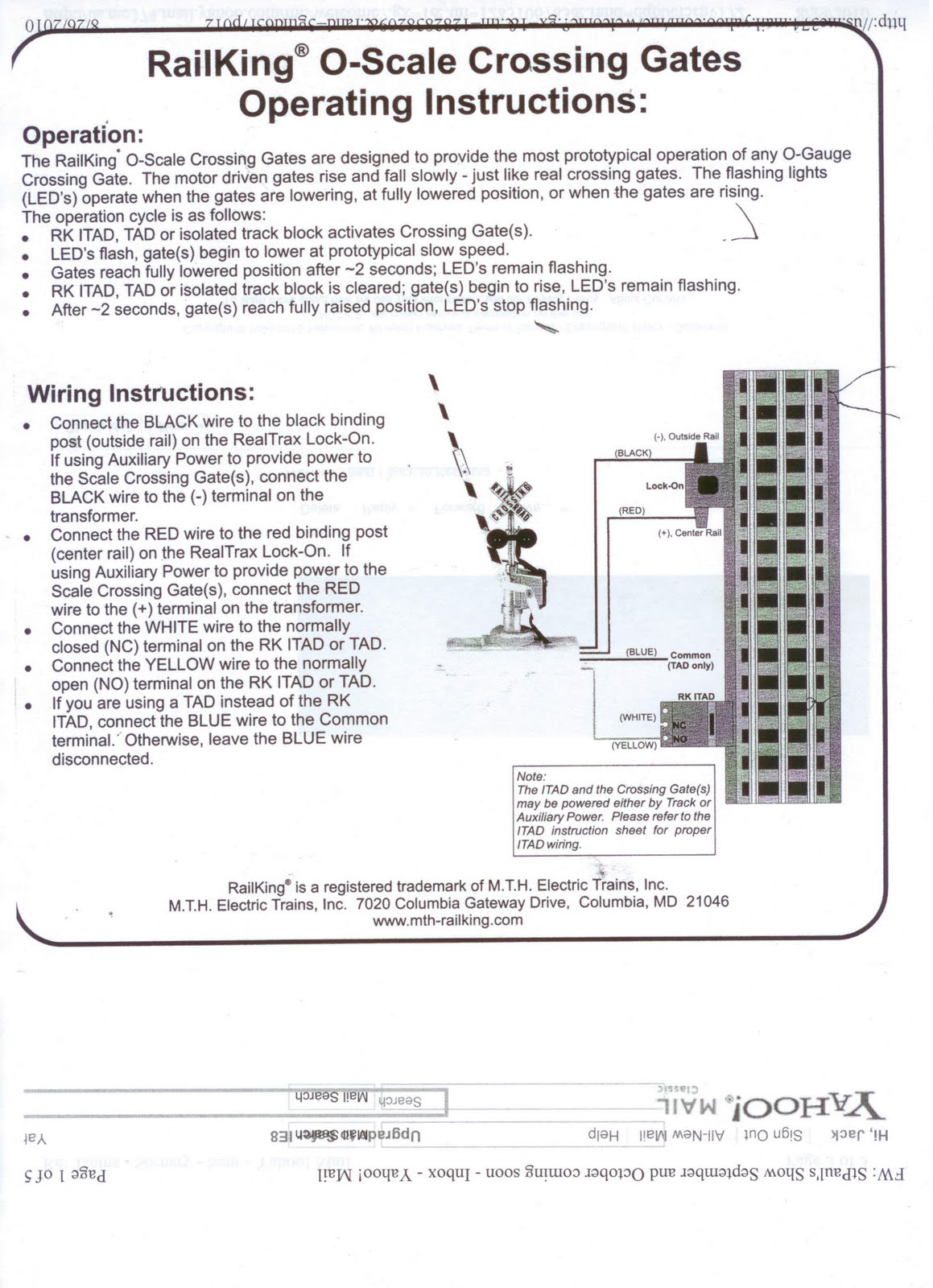
Crossing Gates Operating Instructions

I.T.A.D. Operating Instructions
I would appreciate any suggestions toward making the gates operational as described in the operating instructions.
Readers can comment below.