Accessories
Everything on model trains, model railroads, model railways, locomotives, model train layouts, scenery, wiring, DCC and more. Enjoy the world's best hobby... model railroading!

By Michael Ball
Modelers of HO trains model after specific railroad periods of the United States and Canada. From almost the onset of American railroads the 40 foot boxcar has been in existence. It began to disappear from the railroads in the 1960s.
Refrigeration was changing from the old ice method to the modern thermal air-condition cars that were self cooling. Also, the 40 footer was beginning to be too small. The larger 50 & 60 footers were taking over and they even experimented with 86 foot boxcars. The big railroads wanted to haul more goods and reduce the tonnage they had to haul. It took 125 40 foot boxcars to equal 100 50 foot boxcars. The reduction would be 25 less 40 foot boxcars times their empty gross wait.
This was certainly an advantage for the railroads let alone the maintenance of the smaller boxcar. With this in mind the majority of the model railroaders I know still prefer the 40 foot boxcar. They like the era from the late 1920s though the early 1960s. They are also very colorful and interesting. Many of these nostalgic colorfully designed boxcars are gone unless they might be in a railroad museum. There were so many different designs and logos to see.
The hobbyist still has the opportunity to find many of these colorful boxcars that are manufactured by several model railroad producers of freight cars. Some examples are Kadee, Intermountain, Athearn/Athearn Genesis, Accurail, Bachmann, Walthers, Red Caboose, Bowser, Roundhouse (Roundhouse is now makes only the pre twentieth century cars), Branchline, Life-Like, etc. There are several more that sell kit form freight cars as do some of the aforementioned companies. You can even get wood kits but they are not common.
Now for the types of 40 foot boxcars there are more than you may possibly think. The types of construction and usage varied. It all depended where the railroad was mainly located and types of products, food and perishables that were being shipped. From perishables, staples (wheat, Corn, Barley, Soy, etc.), equipment that needed to be enclosed, parts, manufacturing equipment that was relative small and the manufacturer did not want the tools and or equipment dinged by flying debris, ice, snow and heavy rain, and typical Midwestern hail storms.
Typically soft goods like flour, sugar, fruit, dairy products, and processed meats were hauled in 40 foot reefers. These boxcars are smaller in size than the standard 40 footer. The majority of these reefers were wood as were most of the other types of 40 foot boxcars. This changed however, as time went on to metal reefers.
There are multiple types of 40 foot steel boxcars. There are the following types:40′ Superior Door Boxcar; 40′ Double Door Boxcar; 40′ Ribbed Boxcar; 40′ Modern Boxcar; 40′ Express Boxcar; 1937 AAR 40′ Boxcar; 40′ 12 Panel Boxcar; 40′ AAR Modified Boxcar; 40′ PS-1 Boxcar; 40′ Boxcar w/Youngstown Doors; 40′ Double-Door Boxcar; 40′ High-Cube Boxcar; 40′ Ribbed Boxcar; 40′ Steel Boxcar w/6 Panel Doors; 40′ Steel & Wood Ice Bunker Reefers; 40′ Steel & Wood Boxcar. This includes several types of 40′ stock cars.
In all they all had a specific purpose for the railroad as well as the user. Many of the reefers were labeled with the name of the product and producer of the goods being carried. There was Rath Black Hawk Meats, Swift, Carnation Dairy Products, Needham Meats, and major carriers such as Pacific Fruit Express. The Pacific Fruit Express Company (PFE) owned the largest number of reefer cars of any of the different reefer users. Union Pacific owned the second largest number of PFE reefers and pulled more reefers than any other railroad during that period of the 40′ Boxcar/Reefer era.
As time has gone on the boxcar has almost disappeared from the railroads. However, the need for boxcars has now become critical. The Piggy Back and Double Stack Containers is not necessarily the means needed for some goods. The boxcar may indeed have a come back on the railroads of today.
The Aztec Annihilator is a system for cleaning dirty track (HO). The Annihilator was engineered for ease of use and minimal maintenance. Aztec are the first to admit that the car was not built to look utilitarian but instead to be a functional piece of rolling stock.
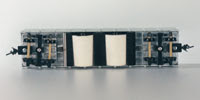
The custom painted 40ft gondola is gray with black “M.W.” and dimi data. No road or end numbers are provided. The modeler can apply decals (not included) in the railroad of his/her choice. To finish off the car the hobbyist might want to cover the mechanism with a piece of cloth (not supplied) to simulate a tarp.
The Aztec Annihilator can be run in a train and go unnoticed without hitting scenery or derailing.
A hard black anodized aluminum chassis holding two free rolling canvas rollers at a slight angle to the railhead, a magnet and a fluid reservoir (1/2 oz. capacity) is housed in a 40 ft gondola equipped with Kadee® couplers.
There is a valve to regulate the amount of cleaning fluid dispensed to the front roller. The rear roller is run dry and mops up loosened grime. A clear plastic lid covers the reservoir allowing you to see when it is running out of fluid. Turn valve about one quarter turn for ten seconds or so. Turn off and run for 10 to 15 minutes (or change times to suit).
This stealthy lightweight tips the scales at a mere 7-3/4 ounces soaking wet. The Aztec Annihilator will clean in either direction but works best with the magnet to the rear.
When selecting adhesives to use in the creation of scenery for your model railroad there are many to choose from in hardware stores and hobby shops / craft shops. Most adhesives will do the job that is claimed, but they are not all suitable for the same job.
When building scenery try using an acrylic matte medium or white glue as both of these modeling adhesives are water soluble. However, a contact cement may be more suitable in some applications.
Quick Tip
If you are going to use white glue, you may want to dilute it with water using 2 parts glue to 1 part water, or a 1 to 1 ratio, depending on its application. Try adding a few drops of liquid dishwashing detergent as this will help break up the surface tension of the water. Another thought is to add a small dab of latex paint to tint the glue and help hide any bare spots.

Model railroading has some unusual terms that can be somewhat confusing to anyone new to the hobby. One such railroading term is the word “Cupola”. It sounds complex but it is really very simple and a clever invention.
The Cupola is box-like Crow’s Nest structure raised above the roof of a caboose for visibility along the train while it is in motion.
In 1898, T. B. Watson wrote “During the ’60s I was a conductor on the C&NW. One day late in the summer of 1863 I received orders to give my caboose to the conductor of a construction train and take an empty boxcar to use as a caboose. This car happened to have a hole in the roof about two feet square. I stacked the lamp and tool boxes under the perforation end and sat with my head and shoulders above the roof… (Later) I suggested putting a box around the hole with glass in, so I could have a pilot house to sit in and watch the train.”
Cupolas were first built into cabooses around 1875 and became permanent fixtures until 1949.
Arizona is one of the most fascinating places in the United States to be involved in railroading of any type. It wouldn’t be unfair to say that Arizona owes much of its past growth to the railroads. Arizona itself, is an amazing landscape of striking contrasts – from snow covered forests in the north, to blazing desert sands in the south.
The state hosts the transcontinental lines of both the major western railroads: The Union Pacific and the Burlington Northern Santa Fe. And both of those lines are steeped in historical predecessors, the Atlantic & Pacific, the Santa Fe, the Southern Pacific, and even the Texas and Pacific.
And the state is filled with optimistic short lines to serve the lumbering and mining interests of the earliest pioneers. Lines like the United Verde & Pacific, Verde Tunnel and Smelter, Arizona Mineral Belt, El Paso & Southwestern, Arizona Eastern, Maricopa & Phoenix, Bradshaw Mountain, etc. Many are fallen flags, but some are new like the Black Mesa & Lake Powell and the many incarnations of the Apache Railway.
Arizona is also home to the Ponderosa North Model Railroad Club. The club has a modular layout that is housed at club members homes. This layout is a working layout that is run at model railroading events like Railfair & the Great American Train Show. Work is normally done at these events to show both a running of trains and a demonstration of how to work on a layout providing visitors with help building their own layout.
The Ponderosa North Model Railroad Club also has one of the most informative model railroad club websites on the net. Do have a look because it is well laid out and has some excellent model railroading information and tips.
To give you an idea here is a snippet from a page on building a case for carrying rolling stock to swap meets and model train shows.
Here is an extract from the page courtesy of the Ponderosa North Model Railroad Club.
At a swap meet Matt & I were at recently, Matt took a final look around to see if there was anything he could not live without. He ran across someone selling a tool box that had been converted into a carrying case for rolling stock, complete with 4 trays. I thought it interesting too. What a great way to transport rolling stock while minimizing the chance of damage! However, we both thought the $65 price was a bit much, so we decided to have a go at it ourselves. Here are the results.
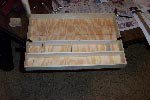
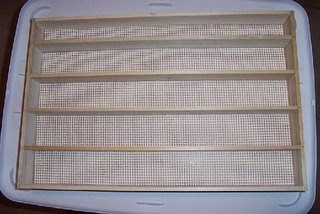
Now as we looked at tool boxes we got the notion that a 19″ long tool box might not hold enough rolling stock for our needs. So after some brain storming and thought, Matt came up with a better idea. We would use a tub, the 58 qt. size you can get at Walmart. Not only did we get 3 larger trays but we also got extra space to either add 2 more trays or what we did, use the space to transport buildings, tools, etc. Note you can make 1 or up to 5 depending on your needs. If you make more, you can always leave trays home if not needed and gain more building space.
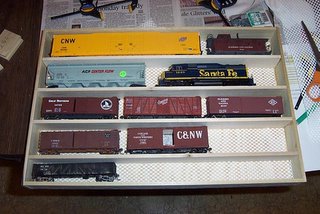
While the basic tub construction was the same, Matt opted to use 1/4″ plywood for his tray base & I used 1/4″ Masonite. Both cost about the same, the Masonite a bit cheaper. I thought the Masonite would keep sanding down and less chance of splinters as the trays got old. But you have to drill some pilot holes to make it easier to nail the frame to the tray base.
More details on the Ponderosa North Model Railroad Club website.
Get all the latest model railway news and views from the world of model trains. Stay up to date in the most enthralling (ok I’m biased) hobby in the world… model railroading!