Maintenance
Everything on model trains, model railroads, model railways, locomotives, model train layouts, scenery, wiring, DCC and more. Enjoy the world's best hobby... model railroading!

Clint has HO and asks:
“I have a DCC layout. I purchased a used, but newer, (closed can motor) Walthers Trainline diesel. The track has been cleaned. All other locomotives run fine, but the Walthers hesitates and sometimes stalls. Are the wheels different on the Walthers? What is the fix?”
Frank asks:
“I have several HO engines that have been in storage for a number of years and now will not run. Are there any recommendations as to how to clean or lubricate them and is there information explaining cleaning and maintenance issues?”
Add your suggestions and see the comments by others below.
Jeff models G scale and has this question:
“Hi all – I need to change the lights in my old G Scale Pennsylvania Coach #6000. There are no screws anywhere. I think I need to pull the roof off but I can’t get it out of the body. Any help would be great. Thanks a bunch.”
John writes:
“I have HO, DC only and I just added a new Alco C-628 from Bowser. Beautiful engine, ran perfect for 2 days, but then all of a sudden I lost forward mode, lights function in front only when in reverse, no lights in front. Still ran perfect in reverse. Next day, reverse worked again, but now, only the back lights work, and no front lights at all. I noticed that the motor felt warm, and possible slight odor. Could this be an out of the box lubrication issue? Operation is still smooth in forward and reverse, not warm, no odor, but no lights in front. Appreciate any insight.”
Tom writes:
“I’m old-fashioned and have 200 cars with Rapido couplers that work fine for me for years and grandkids. All the new engines come with Micro couplers. No one seems to know where I can get this Rapido replacement part for Micro diesel coupler? Any thoughts?”
Add your comments/suggestions below.
Murray would like answers:
“What I thought would be an easy job has become a nightmare. I put my Athearn SD45-2 positioned upside down in my cradle, but can’t get the coupler box and coupler out. I pulled out the first coupler box screw, that that’s all. I even tried a screwdriver and a sharp craft knife blade to pry outwards leveraging on the truck. The whole pilot twists. It won’t come out. No way do I want to break off the whole front of the loco. Am I the only one with this problem?”
Contribute your thoughts below.
Hambal posted this question:
“I own a Hong Kong Kowloon- Canton Railway Kit Double-deck Through Train (Hong Kong – Guangzhou) Precision Motor Train Model N-gauge 5 car set Item No: 99044 Special Limited Edition. It seems that the motor is no longer functioning. I am just wondering if you can suggest a way to solve the issue.”
 Bob asks:
“I have a Tidy Track Roto Wheel Cleaner N Scale. I have KATO transformers with a KATO track. When I hook up the Tide Track to my track with my clips and put the engine on the Tidy Track it shorts out as I turn up the speed (intended to turn the engine wheels). What am I doing wrong?”
Allen J writes:
“Does anyone know how to fix stripped screw threads in plastics? I have been disassembling then re-assembling things and some screws are not gripping the plastic. I thought I was being careful re-inserting the screws into existing holes, but obviously not. I can’t be the only one with this problem?”
Yavuz from Turkey asks:
“I sprayed my HO DC locomotive with rust remover to remove rust from its wheels, but the engine stopped working. What could be the reason? What do you suggest I do? Thank you.”
Ross writes:
“I acquired (for free) an old Bachmann 0-6-0 loco which makes quite a clatter from the side rods when running. I’m not sure if they are supposed to make so much noise? Does anyone else have the same engine and does it make a lot of noise?”
Michael R kindly sent in these tips to share:
I have had a bit of experience working on locomotives to get them working efficiently, so can share some things I learned so far. I numbered the key points:
1. Take your time. Fixing or servicing a locomotive should not be rushed.
2. An older or well-used locomotive needs to be disassembled to locate any faults or to be properly serviced.
3. That is the only way to see inside to inspect and clean everything including all the moving parts.
4. That involves checking and removing the trucks, U-joints, wheel bearings, gears, electrical contacts, and other things.
5. When taking things apart, you might find some broken parts. If so, replace them if doable.
6. Consider substituting spare parts from other locomotives that couldn’t be repaired.
7. Occasionally gears can get cracked and dirt gets can into things. Take your time because cracked gears are difficult to spot. A missing gear tooth on the other hand should be easy to see.
8. When your inspection is complete, you can lubricate everything when putting the parts back together. Use proper greases and oils.
I just tried to keep to the basics, but other people might want to add to my list.
Reece is hoping for help with this question:
“I inherited an old S scale American Flyer set which looks like about 50+ years old. It is a Missouri Pacific set with 6 cars. I haven’t run it yet and am hoping all the dust that covers the cars won’t result in running issues. If so, I will just keep it in the original box or use the cars for staging. Is there a way to remove the dust without causing damage?”
You can submit your own question using the ASK A QUESTION link below, or COMMENT on this post using the COMMENTS link below.
Chris T asks several questions:
“My mind has been working overtime so I jotted down a few questions re lubes. Apart from which oil(s) are the best to use, can I stick with just plastic compatible oil for everything? I have a new bottle of 3in1 oil which the bottle states can be used on plastic and metal. Is this stuff good enough? I have some LaBelle oil that has been in the shed for probably 20 years. Should I use this or is it too old? It looks ok.
Am I right in thinking the wheels need light oil and open gears will need something heavier? I picked up a couple of old locos still in their boxes. I don’t even think they have ever been run. Will they need lubing before I put them on the track?
A million questions I know and I haven’t even asked about dismantling locos, getting the shells off, and removing screws to get access. I told you my mind was racing. Ha! Ha! I was going to just dive in and do things but as usual, I overthink things and thought it better to ask first.”
Bob has HO trains and posed this question:
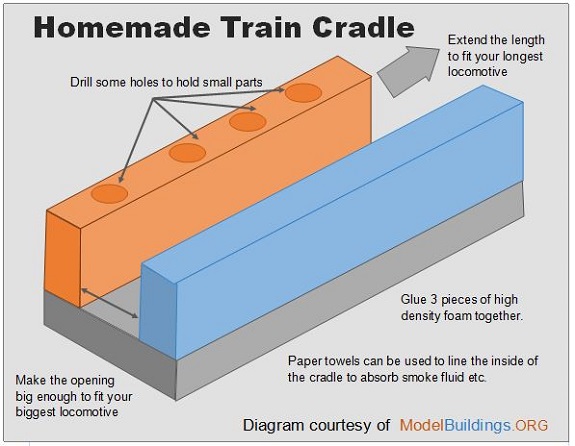
“What are modelers using for train cradles to protect cars and locomotives from damage while working on them?”
There are many possible solutions. Here is one home-made design made from 1 inch thick high density foam. It could easily be adapted to individual needs. You could cut a variety of different sized foam inserts to simply put between the train and the sides to make the engine fit nice and snugly. You could angle cut edges of the foam if you find that easiest. Add your comments, and suggestions on what you use, or how to improve on the design shown below.
Micky sent in this query:
“Is there an easy way or are there any clever tricks for removing engine shells. I want to do some repairs on two locomotives? The shells are only plastic and I want to avoid any damage.”
Submit your question for publication to the Blog Moderator by using any one of the many ASK A QUESTION links on this blog.
To comment on Micky’s question about removing engine shells, simply click the COMMENTS link below.
Rusty asks:
“Does anyone know where I might get my two Lionel engines repaired? I have 2 that won´t run. One is an 0-4-0 Switcher (die cast) and the other one is a 2-4-2 (plastic) Columbia. I have taken both apart and touched both sides of the armature cover and it tries to move. Both armatures spin when I roll the engine, so they´re not frozen up. HELP!”
Phillip sent in this piece of advice to share –
I read sometime back that someone used automatic transmission fluid to clean their tracks. Well, after problems with power connectivity after cleaning with the rail cleaning rubber and/or metho, I tried the automatic transmission fluid (ATF) that I had in the shed. I rigged up a track cleaning wagon with cut to size pieces of sponge touching the track with the ATF on it and cleaned my whole dual track layout and my diesels/locos run perfectly now. My 4.5 x 1.7m OO layout is in the garage with no ceiling and any dust does not affect the track as yet.