Technical
Everything on model trains, model railroads, model railways, locomotives, model train layouts, scenery, wiring, DCC and more. Enjoy the world's best hobby... model railroading!

Stuart
“I have a problem with several older 00 (4mm) locos running on DCC over points where they sometimes stall. I understand that there are ‘stay alive capacitors’ available to overcome this problem. My question is:- do these work and if so how are they connected in relationship with the decoder? Look forward to any members ideas/experience. Many thanks.”
Bill asks readers:
“I have old H & M turnout switches made in England, does anyone know how to wire them up? Thanks.”
 Jim models HO and asks readers:
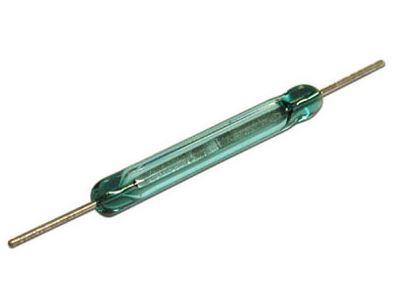
“Does anyone have an easy way to wire reed switches to a layout? Specifically, cylindrical reed switches. Thanks. ”
A reed switch has two metal reed contacts enclosed inside a glass cover. One contact works like a North magnetic pole and the other a South magnetic pole. The reeds spring together when near a magnet, which lets the current flow. When removed the reeds split apart and the current stops flowing.
In simple terms, a reed switch works like a ‘drawbridge’ in an electric circuit. A closed switch has the ‘bridge’ down so the current can flow through the circuit; an open switch has the ‘bridge’ up so no electric current flows.
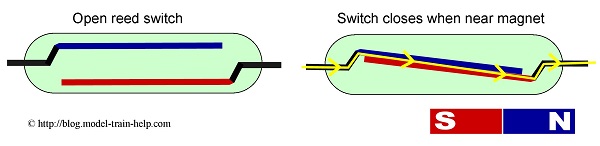
The reason for having a reed switch is to activate (or deactivate) a circuit when needed. Some railroaders use a reed switch and glue a magnet under their locos for train detection.
Gavin asks readers:
“I bought a mix of rolling stock on eBay including some Tyco, Athearn, Proto 2000, Bachmann, and Mantua . I would have preferred to stick with just one brand but I couldn’t resist the low price. Is there any problem with mixing brands? I am thinking of replacing the old horn-hook couplers with some knuckle couplers but I am confused with all the different types, lengths and offsets. What type should I use?”
Douglas doesn’t give a lot of information but asks readers:
“How would I begin to wire the switches for my HO layout?”
Karl (a new member to model trains and the Online Model Train Club) asks:
“Does anyone have an suggestions for keeping under-benchwork wiring organized and tidy. I am just starting off in HO and am worried I’m going to end up with a confusing mess below the surface. Any suggestions appreciated?”
Murray asks readers:
“Where can I purchase tiny replacement N scale machine screws for locomotives and cars?”
Larry asks readers:
“I have some N scale Bachmann frieght cars,and some have a real looking coupler and some have Rapido couplers. What are good ones to get?”
Murray asks readers:
“I’m new to modeling. I want to get a DCC light decoder for an N system that will light as many lights as possible. It needs to be compatible with an NCE system. Any help would be appreciated.”
Owen asks readers:
“Hi I have a loco (b12 4-6-0) that I need to replace a cog in and I can’t do that without taking off the rods that connect to the wheels and I don’t know how to take them off and put them back in without damaging it. Any help would be greatly appreciated.”
Josh asks readers:
“I hope this doesn’t sound stupid but I can’t get power on my HO tracks. I laid the track, and it seemed to operate smoothly. Even after I wired up my points it was working ok. I tested everything again before laying the ballast. After the ballast dried I tested it again with my only loco (yes I’m new to railroading!!) and got no power to the track. I then tried taking away some of the ballast near the contacts, but I still couldn’t get it to run. I feel embarrassed asking for help because I’ve probably made a stupid mistake somewhere along the line, but I’m stuck and don’t know what to try from here. Please help.”
Terry asks readers:
“I have an old Proto 2000 engine which must have owned for at least 15 years, and I want to install a sound decoder. I am a bit frightened where to start and if I’ll do any damage. Do I need to unhook little computer board behind the motor? I presume the old board was partly used to control the MARS signal-safety light. I do have resistors and LED’s. Will this decoder operate with the board in position, or will I have problems? Any advice on installation would be greatly appreciated. Thank you.”
Reynold asks readers for advice:
“My N scale layout has 78 building yard lights not including the signals which I have spread over 4 transformers. If possible I would like to have them set up to all operate off just one power supply specifically for lighting. Is this hard to do? What would I need as a minimum transformer power output? I am hoping someone can shed some light on the problem – sorry about the bad pun!!!”
Donald asks readers:
“I have wired my N scale building interiors with 12 V. bulbs to the 18 volt A.C. connections on a power pack under my layout. I wired them in ‘series’, 2 at a time. This cuts the voltage down to 9 volts per bulb. One bulb does each building Great. More realistic lighting inside, and saving bulb life with 3 volts less on each build. Last week-end, I added street lights, wiring them in the same fashion, on both sides of my layout.
However, one side works reliably whenever the power bar is turned on. The other side can be intermittent. When I installed them, they worked Great. Yesterday they wouldn’t come on at all. This morning, I turned on the power bar, and all street lights on both sides of the layout lit. Where should I look for my ‘loose connection. All bulbs are soldered connections. Any ideas?”
Use the comments link to share your ideas and/or a related photo.
Rich asks readers:
“Does anyone know if it is possible to wire a Green and Red Signal Status light (LEDs) to an N scale Bachmann DC turnout control switch such that I get a green light for mainline direction and the red when the switch is not in position to send the train off the mainline?”
Readers can upload a wiring diagram using the ‘Comments’ link.
Dean asks readers:
What does it mean when they state “Smart Route can control an unlimited number of turnouts”. See below. Does this mean that I still need to purchase several of the Hare #dccdsphare1 for controlling the turnouts or will this unit control the tortoise without the Hare device ??
HARE DCC Stnry Dcdr
Product Features
Designed to drive the Tortoise Switch Machine (sold separately), this accessory decoder plugs directly on to the Tortoise simply connect to track power using the two handy screw terminals and the unit is ready to use. The Hare is compatible with all DCC systems that support accessory operations. And, many advanced features are provided to enhance operation including:
Auto Throw automatically throws points when train approaches against the points. Eliminates derailments, layout shorts, loco and scenery damage, and is ideal for difficult to reach turnouts and hidden staging. Works with both insul-frog and electro frog turnouts for Versions I and II.
Smart Route sets up to 13 routes by simple address programming in addition to the primary decoder address. Each Smart Route can control an unlimited number of turnouts. Eliminates complicated programming, the need for computer operation or system macros.
Smart Default Ops allows all Hare-controlled turnouts to move to a predetermined position when layout is powered up or to remain as last thrown. Eliminates possibly fouling the mainline when you power-up your layout.
Operates LED turnout signals or remote panel LED indicators.
Walthers Product Number: 246-DSPHARE1
Walthers Catalog: 2015 HO, page 830
Peter asks readers:
“Hi, I am trying to wire a reversing switch to my Atlas turntable, and I was looking for guidance”
Ed has this question for readers:
“I am a novice. I have a single track on a 5 1/2 foot by 9 1/2 foot layout. I have EZ loc track with five switches. I want to wire in the switches and build a control board but I am totally ignorant on wiring. I have a transformer for every switch (which I found out I don’t need?) and they are Life Like switches with the wiring on three sides of the “block? What do I do with all that? Please respond.”