Technical
Everything on model trains, model railroads, model railways, locomotives, model train layouts, scenery, wiring, DCC and more. Enjoy the world's best hobby... model railroading!

Online Model Train Club member Roger S asks readers:
“What would be the right distance between truck flanges in N scale?”
Submit your answer, or view the answers to Rogers question on flange distances by clicking the COMMENTS link underneath.
Submit your own question to the Blog Moderator for publication by using one of the many ASK A QUESTION links.
LED Electronic Resistors
Andy G asks this:
“I have a few 3 volt street lights (LED) that came with separate resistors. Does anyone know how to wire resistors to lights? Thanks in advance.”
Send in your question by clicking on the ASK A QUESTION tag below.
Micky sent in this query:
“Is there an easy way or are there any clever tricks for removing engine shells. I want to do some repairs on two locomotives? The shells are only plastic and I want to avoid any damage.”
Submit your question for publication to the Blog Moderator by using any one of the many ASK A QUESTION links on this blog.
To comment on Micky’s question about removing engine shells, simply click the COMMENTS link below.
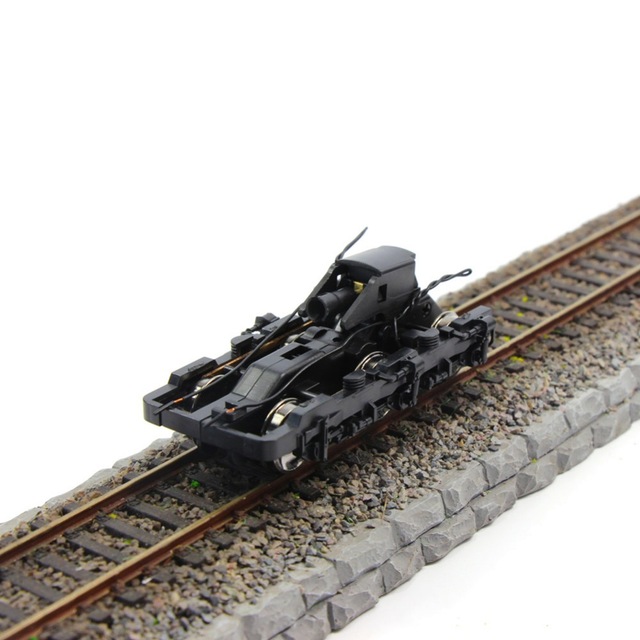 Ranjay models HO scale and asks:
“Hi, I purchased HP0587 from aliexpress. Now, clueless how to fix it to engine chassis as the undercarriage does not have any screw/nut or slot to do this. Plese help me on this if someone has got any ideas/experience”
Add your comments below.
Steven asks the following:
“I have an HO layout that is on 3 levels. Yesterday I had a derailment on a track joint in the start of a track segment where the middle level has a climbing segment to get to the upper level. Everything was fine up to that point but after the derailment the entire upper level is dead as a doornail. Prior to the joint where the derailment occurred, everything is normal.
There is no “clicking”, no flashing lights or other obvious signs on the track decoder board. I’ve pulled the plug and allowed time for an attempted system reset without success. I’ve swapped locomotives without success.
I am a complete idiot when it comes to electricity (the wiring was done for me). So forgive me for that.”
Josh sent in this question:
“I have read quite a bit on how to wire track etc., but still don’t know exactly which wires to use. Could someone guide me please?”
Phillip moderls OO gauge and asks:
What’ the correct wire thickness?
“I have plenty of 240V 10amp extension cords in my shed. I was therefore wondering if the wire could be used for bus wires on a OO/HO DC model railway? Or, would the wire be too thick for the power going from the controller to the track?”
Barry models in N scale and has this question for readers:
“Hi, I hope some one can help. Up till yesterday my track was running without any problems. After giving the track its weekly clean l found that the train run perfectly well until coming to one set of points it then stops dead. The trains run perfectly well ether side of the points. HELP PLEASE.”
Online Model Train Club Member Richo has started work on the second of four planned modules on his N scale layout and questions:
“Is there an easy joining system for disconnecting and reconnecting wires between modules?”
Paul posted this question:
“I am having trouble getting my N scale Atlas switch tracks to work. I have tried all different wiring configurations. They will throw in one direction and when I try the other direction, all I get is a hum from the switching machine mounted on the track. The hum tells me they are getting current but nothing happens. If it were only one track, I would chalk it up to a defect in that track, but it is all of them (8). Very frustrating. Hope you can help. Thanks.”
Contribute your comment, photo, diagram using the COMMENTS tag directly under Paul’s post.
A question for readers from Phillip in Chatswood, Sydney, Australia:
“My single track layout will be laid out over 2m by 3m. I’ve never wired switches but read up about it a bit and want to know the pitfalls to avoid in advance. Much appreciated for letting me post this.”
Submit your question to the Blog Moderator for publication by using one of the ASK A QUESTION links on this blog.
Geoff has this question:
“I’m new to DCC. I’m planning a small UK OO narrow gauge layout. The system I bought has an output of 2 amps. The circuit protector can have up to six zones, but 1 amp each. The docs say that the 2 amps will power up to 4 HO locomotives at one time, but am I right in thinking that the circuit protector will limit that to 2 in each zone? The docs for the circuit protector say you can connect it in such a way to have 3 zones 2 amps each, which perhaps is what I need to do?”
William posted this question to readers:
“I have On30 and M.E. track and turnouts and DCC Cab Controller. I would like to install an automated reverse loop (does not to be that big as I will be running Porters with a few mining cars.)
I am electronically “challenged” and could use advice on what all I would need to set it up. I am in the planning stage now but I would like to know how to wire the turnout and loop section up front to see how feasible my idea is to have trains running on a continual basis in and out of the loop without needing to be manually operated. Is a module AR1 or the like all that is needed or do I need some type of ‘block’ detection? And are Digitrax and MRC cab controllers compatible as far as these loop modules concerned?”
Bert poses this question and hopes for feedback from knowledgeable model railroaders:
“I want to use a slip switch to control a model railroad turnout. I have fabricated linkages using Evergreen Styrene and heavy florist wire. The connection between the turnout points and the slip switch is two pieces of wire connected with a styrene tube forming one continuous rod. Try as I may, I have yet to find an adhesive that will significantly bond the wire inside the styrene tube. Even though I allow an adhesive to cure for 24 hours, after a few toggles on the switch, the wire becomes loose and is no longer attached.
Any thoughts on what adhesive I should pursue? Thus far I have used Insta-Cure CA Super Thin, Maxi-Cure CA Extra Thick, Tamiya Extra-Thin Cement, and Red Baron Adhesive (Thin and Medium).
If the wire/styrene combo will not work, I’ll have use another alternative. Thanks in advance for your thoughts and suggestions.”
Bert used the ‘Ask a Question’ link to post this question:
“I purchased individual strands of battery powered (2AA) micro lights from a Christmas closeout. I intend to use a SPDT slide switch to control turnouts with one terminal lighting a red LED and the other terminal lighting a green LED. A wire from the switch arm will be used to throw the turnout. I plan to cut the strands into individual LED lights and solder them to the proper terminal such that when the turnout is changed, the correct LED is on. I’ve read that LEDs have long and short terminal legs but there is no way to identify them on the encased light strand. Any thoughts and comments regarding electrical connections would be greatly appreciated as I am an electrical novice. Thanks for your help in advance.”
Disclaimer: Obviously, readers are advised to seek proper technical advice from a registered electrician for any job that involves live wires that could result in injury caused by an electrical shock.
Christopher has this question:
“When I first got in to DCC I bought all electrofrog turnouts for my N scale layout. Then the guy at the Hobby Shop told me I should’ve used insulfrog turnouts. Is there anyway that I can still use the electric frogs? If so how do I stop them from shorting out the track?”
Oscaler Jack asks:
“I need to add electrical pickup for both rails on a 2-Rail O-Scale power truck (and non-powered truck) and can’t seem to find available sources. I have been using phosphor bronze wire that I’ve jury-rigged for this problem but want a better solution.”
Phillip asks readers:
“I was wondering if the copper telephone wire would be suitable to wire up a DC N or HO/OO layout, or would the wire be to thin to carry the electricity? I have stacks of telephone wire if I decide to build an N scale layout. Any ideas/thoughts please?”