Tips & Resources
Everything on model trains, model railroads, model railways, locomotives, model train layouts, scenery, wiring, DCC and more. Enjoy the world's best hobby... model railroading!

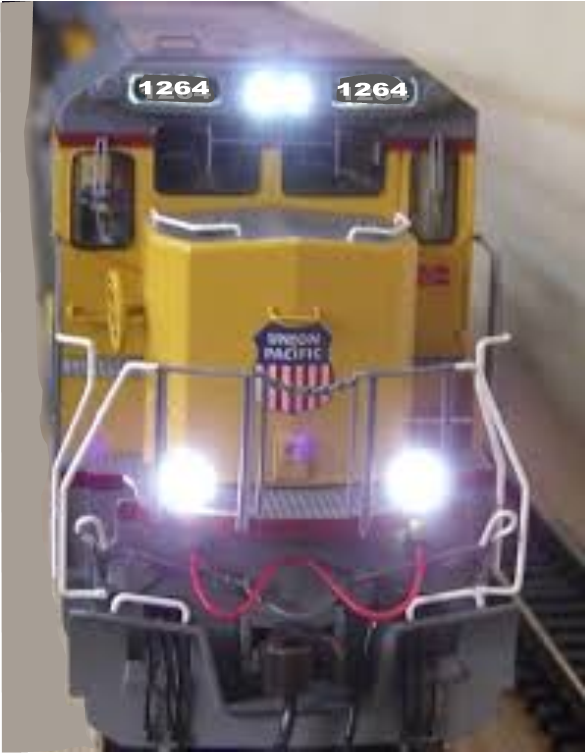 Ron posted this suggestion:
“Just to let everyone else know I used LED lights to upgrade diesel engine headlights. They are brilliantly bright white on my diesel engines. If you haven’t tried LED’s I recommend you give them a go. They even light up details on my structures and scenery when the room lights are switched off or dimmed. Just so you know they’re miles better than regular lights, and heaps more realistic. Well that’s my opinion anyway.”
Gavin sent in this model railroading tip:
“I use small nails and heat them up and put them into the base of the trees. I can also change out my trees for different seasons as my layout changes from Spring to Fall and then winter.”
Dave contributed this tip:
“If the small part does make it to the floor, use a vacuum cleaner with a nylon stocking taped over the end to find it. The nylon will prevent the part from being eaten by the vacuum.”
You can post a comment on these model railroading tips by using the COMMENTS link below.
If you would like to post a question, or share a model railroading tip or two, just use the ASK A QUESTION link to send it to the Blog Moderator for publication.
Online Model Train Club member Roger S asks readers:
“What would be the right distance between truck flanges in N scale?”
Submit your answer, or view the answers to Rogers question on flange distances by clicking the COMMENTS link underneath.
Submit your own question to the Blog Moderator for publication by using one of the many ASK A QUESTION links.
LED Electronic Resistors
Andy G asks this:
“I have a few 3 volt street lights (LED) that came with separate resistors. Does anyone know how to wire resistors to lights? Thanks in advance.”
Send in your question by clicking on the ASK A QUESTION tag below.
Bobby has only started in the hobby and sent in his first question about laying track hoping for feedback from experienced pros:
“Hi, I’m not flush with cash and thinking ahead I know I’ll need to buy/borrow tools to put down my first sections of track. What will I need to do this?
Click on the COMMENTS tag below this posting to view the track laying comments, or to add a comment or answer to help Bobby.
Wayne would like some guidance from those in the know:
“Either scale would be appropriate for the era modeling, space is at a premium to some extent. Is one head and shoulders above the other – HO vs HOn3?”
Add your comment below.
Nigel W posted this question for readers:
“I was gluing my ’00’ Gauge-1:76 Scale railway tracks down on my ‘Woodland Scenics-underlay’ In the mean while, getting glue and other debris on the rails. I would like anyone to advise me on the best way of cleaning the rails!
I was told to use a sharp knife to scrape the glue off, and then use {Isopropy-Alcohol} / also was told to use a sandpaper by someone else. Please can you let me know, what is the best way?”
Roger S posted this question for readers:
“I now have an HO scale train set inherited from my late Dad. Its not a big set, but considering I know very little about trains it’s probably a good starting point. I think he would be proud to know I am finally showing some interest in the hobby. The set with 4 locomotives hasn’t been used in probably 5 years. I’m not too bad at carpentry so thought I would set it up on a 4′ x 8′ sheet of plywood, which I understand is standard.
I wouldn’t mind some tips on how to clean and maintain the various components: locomotives, rolling stock, and the track etc. Thank you.”
The ASK A QUESTION link is under every post if you have a question you would like published.
Bill sent in these thoughts to share:
I find that derailments can happen if cars are not properly weighted to NMRA standards. For example, if you have an underweight car between properly or overweight cars on either side and a dirty section of track causes the pulling and or pushing locomotive to stop and lunge and thus the varying momentum of rolling stock, caused by this weight issue, can result in derailment.
Long standard gauge coaches running on a layout built for mountain climbing tight radius “Mine” trains with relatively short rolling stock can cause derailments.
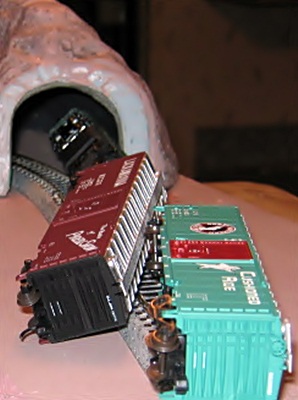 Improper truck adjustment. From my experiences both trucks should swivel with one having less play than the other. Failure to maintain these and you are inviting problems.
Proper height adjustment of couplers. Again I am reminded of problems I have had with coupler “pins” catching on turnout points, resulting in….derailments.
The reason I know about all these issues is because I have at one time or another, ran into these issues. So I mention them from first hand experience and am still learning from my mistakes.
I have also found that even after all my learning mistakes, I am still not done.
I am reminded now about several Labelle boxcars (which are constructed of basswood without any weight to them), that I had built to NMRA standards, gluing weights from end to end and right down the center of the wood floors. Initially they all ran great and then I started having derailment problems. After several attempts of trying to duplicate the issue, it came down to one particular car. Intermittently the weights were sliding off to one side around certain curved track sections causing the car to lean to one side, pulling the trucks and couplers up and down causing an imbalance and derailments. Point being, unless I wanted to park this guy at the end of the line forever, I would have to “Open a door” and carefully try and re-glue the weight in proper position. (not a lot of fun for those of us that tediously build these cars!)
Maintenance, maintenance, seasonal or periodic maintenance of locomotives, rolling stock, track and all other components of a layout including sight check of trees (growing) to the point that they can derail locos and or rolling stock, and testing of all electronics, DC or DCC is a never ending must!
I am sure I am missing other potential derailment causes…would enjoy others’ thoughts on the subject!
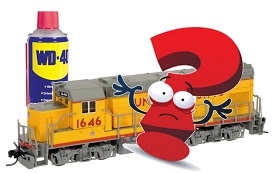 Benjamin W sent in this question:
“I’d like to know if WD-40 is suitable for lubricating the engine gears? Also is WD-40 ok for oiling trucks on the freight cars and track? I’ve had a go and it appears to be working ok for the moving parts and smoother runs on my track, but am I really using the right product and going about it the right way?”
Add your comments below.
Rick asks readers:
“I would like to hear any feed back from a user of Railpro systems. The pros and cons as I’m still in the planning and design stage of building a layout. Thanks”
If you have a question you would like the Blog Moderator to consider for publication, you can submit it using any one of the ASK A QUESTION links on this blog. Please check and proofread your question carefully before submitting it to ensure it is clear and has sufficient information with enough details to prompt quality answers.
Dave sent in this quick tip to share with readers:
“If the small part does make it to the floor, use a vacuum cleaner with a nylon stocking taped over the end to find it. The nylon will prevent the part from being eaten by the vacuum.”
And a tip from Bobby:
“I just read your ideas on using masking tape to keep track of small parts, very good. I also have a suggestion to add to that. Where I live in the State, at our hardware store, there is a 5″ bowl with a magnet attached to it. It’s great for holding small steel parts so they won’t drop on the floor.”
Although a lot of readers know how easy it is to post a question on the Blog, many have never used this free service. Hopefully this short video will show how simple the process is; and also how to post and view COMMENTS; and even add a photo.
Unlike other forums this blog is moderated to eliminate abuse and annoying spam postings. I want to maintain a high quality, so ask readers to carefully think through their questions and spell check them before sending them to the Blog Moderator for approval and publication.
Poorly worded questions that have lots of errors, or lack detail, are unlikely to get published. I know this sounds a bit strict, but having this policy is one of the reasons for the Blog’s success (with 10,000 readers weekly). The quality of answers sent in by readers is generally very high, especially when the question is well worded with ample details to explain the problem. Keep up the good work!
Please share this posting with your friends on Facebook, by email etc. They might like to use this free service to assist them in the hobby.
Tyson used the link below to post this question to readers:
“I am new to model trains.What is the minimum radius i should be using on the main lines for n scale and what is the minimum distance i need to keep from the track to the edge of the layout. My layout size is 3 x 6.”
Bob asks readers for advice:
“I am now retired and going to build my first system in HO. All new layout. I have obtained cheaply ($1 each) about 70 HO rolling stock. All locomotives will be purchased new.
I have space for a 12’x4′ main layout with space for a 3’x8’+3’x4′ L shaped extensions off the main layout. The main will be constructed first.
I am interested in yard operations but also want a passenger train loop. Most of the rolling stock is modern ( circa 1980 and later) so I am expecting to build out a modern era layout that is intermodal focused.
I am a good programmer in many languages and very technically inclined. My system will be DCC from the start. I do not want to needlessly spend money to get what I want and need, however, that said the cost of the DCC controls is not a constraint.
With the above in mind I am interested in advise on which DCC system would best:
1. Allows me to control the entire operation under automatic programmed computer control.
2. Allows control via IPad and IPhone
3. Allows automated control of block control lights, gates, etc.
4. Be as simple as possible but no simpler
I am not tied into anything now so this is a “clean slate” design. While I am not going to have a prototype layout I am interested in simulating as many modern prototypical operation aspects as practical.
Any guidance on makes, models, software, tips and traps, or any other help on deciding which DCC system is appropriate for my needs would be greatly appreciated.”
Delru sent in these ideas to share:
“I would like to let folks know how easy it is to add many ‘accessories’ to your table without the train store pricing. For example, we wanted 6 spotlights to highlight various fair rides. Train store cost? $78. We took some small bells, clipped out the ringer, spray painted them flat black, and ran an LED light thru them. Set them upside down (wide bell facing up). Cost? $2.99 for a pack of 24. Just want to encourage people to think outside the box. Now looking for O scale swans to use as rides on an HO Tunnel of Love. Trains are expensive, but your layout accessories don’t have to be.”
Steve is starting off in the hobby and would like some words of wisdom from those with plenty of experience in the hobby:
“I am new to model railways having last used one when I was much younger (now 64) … an RC model aircraft flyer/builder of a number of years who wants to come in out of the cold.
I have an available layout space of 1.7mx0.53m plus a side section of another 2.4mx0.3m. From what I have already read and been advised it would seem that unless I want a basic A-B layout I should really be considering N gauge and not OO ?
I have been reading as much information as I can …. I think I would like to go with DCC system but have no idea which one. A relative has the E-Z one from Graham Farish and he seems quite happy with that. but there seems to be lot out there. There are a large range of track and locomotive manufactures out there .. any comments on which to avoid … or go for.
Basically my initial thoughts would be to buy a ‘set’ which has the controller with it (and hopefully instructions) to start me off – I am hoping to only use trains etc that would have been around in my youth i.e. 1955-65 say.
So this is really a call for help and advice on which suppliers of track and trains to go for (and avoid) plus any other pointers you think are important BEFORE I start. Many thanks for reading.”
Peter models HO and asks readers:
“What do people think of there DCC electronics for train detection and lights?”