Tips & Resources
Everything on model trains, model railroads, model railways, locomotives, model train layouts, scenery, wiring, DCC and more. Enjoy the world's best hobby... model railroading!

Mary Beth was inspired by the earlier posting on adding people to a model train layout and asks:
“Where I can get scale model people for my train layout?”
Ron sounds like he urgently needs to read the Model Train Help ebook that will all of his questions and more. However, in the meantime, maybe someone could give him some helpful pointers to get him started:
“I am so new to this hobyy and am not sure were to start. I have two old N scale trains from my youth and also some new track, given to me. I have a limited space in the basement and not sure if I want to stay with N gauge. I am not sure what the new digital stuff is and what it works on? What is needed to make it work? How do I find out what I need to know? See I told you I am a rookie.”
Readers can add their feedback below. Also share these postings on Facebook and Twitter. See the buttons below.
If you answered yes to that question, then perhaps you are able to help others by answering some of their model railroading questions on this blog? On the other hand, you could keep all your knowledge and experience to yourself and not share it with those who could really benefit from your thoughts and who would appreciate your suggestions. It is really your choice, but please remember this blog is operated as a free service and it does rely 100% on the contributions from people like you. We want to keep it free, but to do that we need regular contributors who are prepared to answer some of the many questions that get asked. The alternative is for us to pay someone to answer all the questions, but then we would have to charge a subscription to the blog and we don’t really want to do that.
So, if you can help by answering some of the questions on this model train blog, then please do.
Hank has a question relating to power surges for readers to answer:
“I am running 4 sets of Lionel trains on my 20 by 6 and 12 by 6 L shape layout. I use 027 tracks using conventional Engines (purchased in 70’s). Someone told me that I can use a DCS legacy to run these trains. I am using 2 Lionel ZW transformers and use a DCS terminal block for one track. The other three tracks I loop every 6 to 8 feet. However, I still have surges in certain areas. Would the DCS correct these power surges? Thank You in advance for your assistance.”
Comment below.
Sohan wants to hear suggestions from readers on ballasting track:
“I’m finishing up my first permanent HO layout and I wanted to see if you guys had any tips on pouring ballast on the track evenly. My question is to find out how much I need because I have already started and in some areas it looks overdone or underdone. Most of the time the ballast sticks to the rails and I have to spend hours getting it off. I’m on a tight budget, so I can only afford having a can with few holes in the lid to spread ballast and spray-on glue to keep it down. Any tips or tricks?”
Comment below.


Comment below.
Aaron wants to make his own HO scale track and asks readers for advice:
“I am looking for information on making track. I have looked all over and have not found much. Any additional information would be appreciated.”
Comment on this posting below
Max has submitted an idea he would like to share with others in the hobby:
“Experimenting the other day I managed to make some not exactly great, but easy and cheap, trees. Buy a nice bunch of grapes and some fluffy pom poms (green for spring, brown for autumn). Eat the grapes and leave the stalk in one big piece. After it dries it will turn brown and will break easily, so bend the stalks at the angles and directions you desire before it dries. After they are dried, rip up the fluff from the pom poms. Strech it out into a thin layer of green and loosely wrap around the outside of the trees. The fluff should stick to the ends of the stalks. You can add more fluff in the thin patches if required. They only take a minute each and I have about 30 of them sitting in the middle of my train set. I have not tried many colours, but the light green I use looks a little unrealistic when the light shines through it.”
Discuss Max’s suggestion using the green Comments link below.
Buzz has a question that has been asked before on this blog (use search box to see previous postings on the subject). Readers are welcome to give their thoughts on the most appropriate height:
“Can some please inform me what is the finished height from the floor to the platform for ho scale. I am now in the process of putting the legs on my frame.”
Add your comments below.
Janet wants to avoid mistakes building her layout and asks readers:
“I am a total beginner. I have always fancied a model train set up, so I purchased a box set containing 2 trains & wagons & 2 oval tracks with sidings. I would like to know everything there is to know for the beginner. I realize this is a big ask but I am afraid of making mistakes. I am planning to increase the size in time, but need a *don’t* list. I am intending to build a bridge and a viaduct. Any suggestions from experienced railroaders would be greatly appreciated.”
Janet, I presume you have purchased the Model Train Help ebook. It has many good suggestions for avoiding costly time-wasting mistakes.
Emmanuel is a beginner seeking guidance from others in the hobby and asks:
“I am new to train modelling and need help on connecting points and switches for 3 Hornby standard trains. Can someone offer me some quick tips please? Thanking you in advance and hoping for your kind help and assistance.”
Comment below.
Laurie wants to share his experience scratch building structures using wall plaster. Here is what Laurie has to say:
I have been a scratch builder of many years. I started at the age of eight, and I’m now eighty four.
I started before WW2, using s fret saw. I made many models out of an old Tea chest. After serving in the war I didn’t really take scratch building seriously until 1951 when I went into Model Railways for my sons.
Since then we have built 5 layouts, largest 6feet by 10 feet, but they have left home now and with a 6X4layout I go it alone, with visits from my grandchildren and great grandchildren. I’ve just purchased and read your Model Train Help E Book, which I found most interesting.
Here is my explanation of Stone type modeling with pictures of some of the models I’ve made using this method.
You can scratch model buildings and walls to give the Stone type effect by using Powdered Poly filler, or powder wall plaster.
Before you start building you need a plan of your building, I first take a photos at different angles of the building I want to model, then sketches are made of the parts you need for the building.
First you need to cut out the building walls to the Railway gauge size you are using, (I work in the 00 gauge, 1:76.2), also cut out the window and door openings.
From hard board, (use the rough side), Balsa wood or a thick Cardboard, (no less than 1/8 thickness), something the plaster will adhere to.
Next, make up window and door frames, and glue these onto the out side of the of the board, also at this stage add a fascia boards to take any guttering, (don’t forget outside chimney breast), glue the sides together forming the shape of the building. You may need to put inner walls at this stage, or Corner formers to strengthen the building.
Once the building has stuck and can be handled, mixed up some poly filler (plaster) to a sticky paste (not to wet). Spread this over the wall sides to the thickness of your window & door frames, then without the Wife, Partner or Mother knowing, go into the kitchen and get the “Kitchen Foil rap”.
Cut this to the shape of the walls allowing a bit extra around the outside edges, crumple it up so it is well creased, flatten it out & press lightly onto the damp plaster, then leave to dry.
Once dry, (properly next day), peel the foil of, you should be left with a stone looking wall, clean off the edges and any spare plaster that has crept over your frames etc:, you can then if you wish mark out the stones with a pointed tool, or you may leave it as it is & just paint it the stone color you want. Next paint the door and window frames, & when dry you can add you Perspex for you windows, curtains doors etc.
You then need a roof, this can be made to your board type your using, covered with Tiling paper, or I have found the back side of hardboard has a etched markings on it that when painted a dark red looks realistic, or with plenty of time and patience, put a layer of plaster on the roof, smooth it out nice and flat, then when dry, mark out a slated type roof.
 Photo above shows a Goods Shed. (Point of interest, is the lamp over the main double door is from the stem holder of a British Legion Remembrance Poppy, making use of thinks around you).
If you are making an Elizabethan or Georgian type building, when putting in the frames adds you beans, balsa wood is good for this, remembering the plaster is smooth between the rafters. Don’t forget outside fittings such as down pipes, guttering, chimney’s etc.

This a country Public House & has lights (photo above).
If you are making walls of the stone type use the same method, rapping the foil over the top of the wall covering both sides, when dry remember some of these walls have the top layer of stones vertical. If you need bends in the wall, I suggest you use card board for the wall so that you can bend it to shape, and I found it best to glue the shaped card board to a card base so that it maintains its shape, before adding the plaster.

Any matt paint can be used but I have found acrylic best. Lot of patience is needed but I have found that the results have been very satisfying.

Anthony has several questions he is hoping someone with experience will help him with. He asks –
“How long should each cut section of earth rail be? Can you have only run/stop sections? OR do you have to have, run/brake/stop? This is for three rail K-Track to be with Viessmann Commander 5300.I am looking for anyone running this combination. Also, knowledge of feedback decoders with above equipment would be appreciated.”
To assist Anthony, simply add your comments using the GREEN comments link below this posting.
For those who haven’t heard of the Viessmann Commander here is some product information –
The Viessmann COMMMANDER colour Digital system features:
>> Control of locomotives & accessories in all digital protocols
>> Joystick control
>> With Double heading
>> Has two speed-control knobs with two direction-buttons
>> Colored representation switch positions and signal aspects
>> Color track diagram in three zoom steps
>> Colored programmed switched routes (yellow) and occupied track sections (red)
>> Time table operation with control of blocks and shuttle trains
>> Terminals for a programming-track
>> Connection to a PC possible
>> Integrated booster
Ray asks readers:
“Can anyone tell me the proper weights of HO rolling stock box cars or hoppers?”
Use the green comments link to answer Ray’s question.
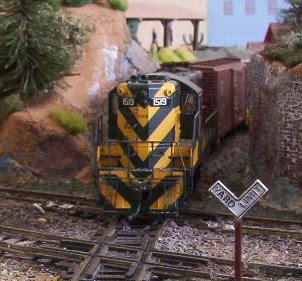
Tony would like to hear from other readers on the subject of model railroad noise. Please add your comments below Tony’s posting.
“I constantly read about deadening the noise of the model trains rolling down the track. The ‘clickity clack’. I also read about the authenticity of the layout and being an exact modeler of the era, etc. Has any one really lived next to, or worked on, or near a real RR? I have. Then, in keeping your layout authentic, you must have the rolling noise of the entire train and the track noise. Isn’t that why we have all the other sounds built into the train, the whistle, smoke chugging, air release the brake squeal, smell from smoke oil, etc. for the realism?
Can some one tell me why are some people so intent on deadening the track noise? I have seen entire articles of 2-5 layers of track noise deadening products. I have loved the sound as part of the whole RR modeling venue and real life. So lets get “REAL” here if you are going to promote authenticity lets keep it all authentic. By the way if one person in he family loves model RR usually most in the family do – so usually no complaints. Any thoughts would be appreciated on your layout and your noise or lack of.
Please add your comments below.
Patrick has a question to test readers and asks for help:
“What would cause my HO engine to travel twice as fast in reverse than in forward. If I rotate the engine on the track then it goes twice as fast in forward than it does in reverse?”
Add your comments below.
Jeff has a question about making smoke and asks readers:
“I hope this is not a silly question. My son and I have decided to get out my Fathers and my old HO model trains. The track is up and cleaned and is in very good condition. The engines have been cleaned and are running well. My question is; on my Tyco Chattanooga steam locomotive and New York Central steam engine (my father recived in 1953), I can’t remember how to add the smoke liquid to get the trains to make steam. I would truly appreciate any help.”
Add your comments below.
Billy has an interesting question some reader might like to help him with:
“Dear Model Railroaders: I have a 1952 Marklin HO train set that I got from Germany with my Dad when I was 15 years old. It still runs! I now have two grandsons who are now interested in trains too. I need your help if you can do it. I purchased Mr. Anderson’s e-book and it is great along with all the helpful e-mail updates. I am now interested in HO layouts and train inventory control software. I would like a good Marklin “M” solid third rail track layout software to document the complicated layouts I have used, and also a software program to keep track of all my various track, catenary, trains, and accessories so I can document them for the benefit of the next owners. Ideally, if I could get both in one program that would be perfect. If you can assist me in this I would be most appreciative. I have looked on the various web sites I have stumbled across in Google and I just can’t find what I need. Thank you in advance for you time and help if you can.”
Add your comments below.
This is just a little courtesy reminder for those who have their questions answered on this blog.
Please find a moment to post a quick ‘thank you’ to anyone who has taken the time to try and answer your question. These are helpful people who do their best to help others. They don’t get paid and do this out of kindness and a dedication to the hobby.
PLEASE PLEASE – I’m sure a quick simple ‘thank you’ posting would be much appreciated. As the old saying goes “courtesy costs nothing!”
Add your thank you, or comments, to the bottom of the relevant posting. Use the green comments link. It is really easy and I’m sure it will be appreciated.