Trackage
Everything on model trains, model railroads, model railways, locomotives, model train layouts, scenery, wiring, DCC and more. Enjoy the world's best hobby... model railroading!

Lester sent in this question:
“I bought a Bachmann engine that must be more than 30 years old and tried it out on my basic oval test track which has a straight piece on each side. It runs ok on the curves but is starts to stall on the straights. My voltmeter showed no power loss. I then cleaned the track, but it still runs ok on the curves and slows a stall on the straights. It baffles me. Any thoughts?”
To add a suggestion or comments to assist Lester, please use the COMMENTS link under this post. No login required.
Owen sent in this tip to share:
“This might help someone with the same problem I had. My Baldwin 4-6-0 loco was derailing after exiting a turnout onto my straight track section. No problem with my other 3 locos. I eventually checked the rail spacing widths and found the rails narrowed just enough causing the front wheels on my 4-6-0 to ride up and come off the track. It was hard to spot because by the time the loco stopped part of the 6 wheels would already be off the track. I think I might have accidentally narrowed and slightly bent the track when laying it. Apart from being careful handling track, this experience taught me to measure track and check rail spacing using a gauge, and to run the locos very slowly through troublesome areas to hopefully identify any problems. I hope my experience with this problem saves other people some time and frustration.”
You can submit your question or tip to the Blog Moderator for publication. Use the ASK A QUESTION link below. No login is required.
Ross writes:
“I plan around 24 switches and want to know the best system or order to number or letter them.”
Add your answer, or view the answers below – click on the COMMENTS link below this post.
Newbie to the hobby Darren asks:
“Is track that branches out from a mainline a siding or spur. Is there a difference?”
Dave B asks:
“I do have stall problems on my Atlas # 6 turnouts. I do understand that shot wheelbase shifters have issues sometimes but my 2 truck GP’s have issues with them also. I RUN DCC, DIGITRAX.
Additionally, I started to have intermittent stalling at different points on my layout with my GP’s and not all at the same place. Sometimes it happens after they stalled at the turnouts. I’ll take on any suggestions!”
Graham asks readers:
“Some of my cars and 2 locos have occasional problems on my newest track switches. Is this a common problem?”
Add your feedback below.
Gerry asks readers:
“I have a small 30inch wide x 16inch deep space quite a bit behind my HO track that I want to bring into use independently of my main layout. It could be used for staging or some yard ops… very limited. I can access it easily from the side. Your thoughts on using N scale trains and structures to give the sense of that area being further away. I presume others have done this type of thing?”
Merv has some good questions:
“Just relocated to our new home and will be upgrading to a 10ft x 8ft layout. A giant leap for me, can’t wait! Before getting ahead of myself though I thought would ask – how much staging should I allow? How many tracks? Should I do continuous staging instead of stub-end staging?”
Share your feedback in the COMMENTS below.
Pete asks:
“I have a few turnouts that are over a ledge where there is no room for my preferred under bench Tortoise motors. Two turnouts in that location are hard to reach so I need to use a track-level turnout motor. I see there are several HO brands available such as Atlas, Peco, and Piko. Some reviews indicate they may be subject to burnout. Suggestions are greatly appreciated. Thanks.
Sharad from India asks:
“I have always bought Bachmann & Hornby locos. My latest acquisitions are Bachmann: Pere Marquette 1218 (2-8-4) & Santa Fe 5034 (2-10-4). I did buy these big locos. Later I realized that I will require bigger # turnouts and frogs. Can you suggest which ones to use from PECO?”
Bill writes:
“I enjoyed Allan’s article on actual dimensions of curved track. I have a figure 8 raised track that my 4 axle locos will navigate, but not my 6 axel. I want to add a DCC steam engine with smoke and synchronized chuff, but do not want to have another unit that costs several hundred dollars that cannot run the track. Does anyone have suggestions?”
Daryl models S scale and would like some advice please:
“I have American Flyer from 1947 Steam locomotive. The front trucks continue to jump the tracks. This just started recently. “
Patrick posted:
“I found Allan’s article very interesting thank you. The problem is that I model N scale so wondered if anyone could give me a comparison for his radius dimensions in N scale?”
Add your comment below.
Alistair asks readers:
“I not keen on using solvents like isopropyl alcohol (rubbing alcohol). Is there any alternative I could use as a ballasting and scenery wetting agent? I have successfully used Windex glass cleaner in my airbrush to thin water-based paint. Would glass cleaner work as a wetting agent instead of isopropyl alcohol? Has anyone tried it or anything else?”
Add your comment below.
Online Train Club Member Allan contributed this article.
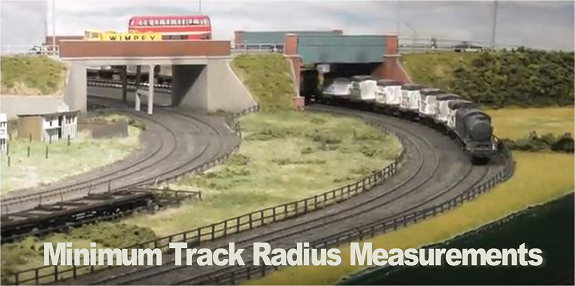
Everyone has limited space for their layout, so compromises need to be made when scaling the size of a real prototype railroad down to fit in the size of the average garage or spare room.
Real railroads need miles of space. The fact is; a real train can be around 90 to 120 cars which can stretch out for 1 to 1 1/4 miles. When the train gets moving it will travel for tens or hundreds of miles. For the engineer to stop the train quickly at 55 miles an hour, would likely require more than a mile of the track using the emergency brakes.
The big challenge for the hobbyist is to condense the track, countryside, mountains, etc into a fraction of the space without making the perspective look forced or too unnatural. In the real world, one mile equates to 5280 ft or 63360 inches which, when converted to HO scale reduces to 60ft or 728 inches. That’s still a huge space to replica just one mile of a real railroad. On N scale a mile is 33ft or 396 inches. This becomes even more problematic when straight track transitions into curved track to allow the train to change direction.
Turning Trains Takes Space
A person can stop on the spot, rotate, and continue walking in any direction they want. Road vehicles have a reasonably small turning circle in relation to their length and width, but a 90 to 120 car train (real or scale model) needs a considerable distance to change direction without derailing. This is why track radius is so important.
Prototype curves scale down to the following in HO scale:
Working to those measurements will still require a big layout space. That’s where the compromise needs to come into play when replicating a real railroad to a greatly reduced scale. The larger the radii on a layout, the more life-like the layout would look, and the smoother trains will operate.
Keeping with HO scale, a radius of 48 inches or even larger would be optimal. However, this is not a perfect world, so working within a smaller space will necessitate the use of smaller radii curves.
The following benchmark would apply in HO scale:
So, even with dreams of creating a perfect miniature replica of a real prototype railroad, reality kicks into play. The distance a train travels, and the radius of curves are just two of the things that will necessitate compromise. The trick is to accomplish this without abandoning the goal of achieving reasonable realism and smooth operation.
 Bob asks:
“I have a Tidy Track Roto Wheel Cleaner N Scale. I have KATO transformers with a KATO track. When I hook up the Tide Track to my track with my clips and put the engine on the Tidy Track it shorts out as I turn up the speed (intended to turn the engine wheels). What am I doing wrong?”
Steve sent in this question and diagram:
“I am completing a layout started by my father over 50 years ago. He had used Atlas brass code 80 (black ties) flex track on cork roadbed, all nailed down, soldered connections. My redo will model mid-century passenger trains from California through the Rocky Mountains. I would like to replace it with a nickel silver track. The total run length is about 80′ (not counting yards). I have 34′ of Atlas code 55 & 35′ of Peco code 80, both brown tie flex track. Not enough of either to complete the changeover. I like the look of the Atlas 55, but code 80 is stiffer, but ties are farther apart. Which would have more options for matching turnouts?”
 The red is lower track, green is transition grade, blue is upper level. N scale, each square is 1’ x 1’.
If you have a question you would like published, then send it in using one of the ASK A QUESTION links. If you want to supply a supporting photo or drawing, then simply mention that when submitting your question. The Blog Moderator will let you know how to email it.
Rob P asks:
“I’ve done too good a job in burying my uncoupling magnets into the cork roadbed and covering them with ballast! I’m modelling NSWGR prototype circa 1910. How do other modellers indicate where their uncoupling magnets are located on their layouts?”