Trackage
Everything on model trains, model railroads, model railways, locomotives, model train layouts, scenery, wiring, DCC and more. Enjoy the world's best hobby... model railroading!

Gary who models O scale asks:
“You have probably answered this before. I have an 022 Lionel switch that the track arm will not fully move to the left or right. I have checked and serviced it three times. Any suggestions? I hate to just dump it. Thanks.”
Ed who models in HO asks:
“I have lots of wire from my old well pump (over 80 feet). Can I use it for my main wiring on my layout? I am also looking for software for Marklin K track. Any ideas?”
Gary who models O scale asks:
“I have a situation where I need to put three switches in a row, with no track sections in between. Will this arrangement give me a problem? Due to the design of the layout, I need this setup. Appreciate any suggestions or comments.”
Brian models HO and has this question:
“I always used a large Weller soldering gun. My birthday present was a soldering station with a variable temperature iron. The question is what temperature should I be using for soldering feeder wires to HO code 83 nickel silver track?”
Add you comment (or view comments) below. Submit your question for publication using link underneath.
Roberto wants to model N scale and asks readers:
“I want to start laying a small track within a space of 24″x48″ I bought Bachmann tracks and wish to form a layout using these tracks. Someone could help me providing with some layout plans showing the tracks identification please?”
George a newcomer to N scale poses these questions:
“I have a simple oval layout with two turnouts, both Kato #6 ( 1 ea. Left (R718-15^) and 1ea. Right (R718-15^)). The turnouts provide switching to an inside partial oval that parallels portions of straight sections in the middle of the oval, and the arcing section of the oval at only one end.
The problem I have is this:
1) If I throw both turnouts from the straight to switched position in preparation of my train accessing in the ‘inside’ leg, there is no power on my mainline and the train comes to a stop.
2) If I throw the first turnout (the #6 Left) to the switched position by itself to get the train onto the inside leg, I then have to throw it back to the straight position while simultaneously throwing the second turnout (the #6 Right) from the straight position to the switched position to get the train back onto the mainline.
3) There is no way to set the two switches so the train runs continually from the mainline to the inside leg without manipulating these turnouts as I’ve described.
I just started in this hobby a couple of weeks ago, so my ignorance is profound! But you see, I have a grandson ‘on the spectrum’ who is fascinated by trains and who I hoped would enjoy running trains with me, but this switching scheme is a frustration to him when he attempts to run the train.
Is there a remedy?”
Richo who models HO would like suggestions:
“My loco has a habit of coming of the track at a point on the beginning of a curve. It doesn’t derail anywhere else. I ran my eye over the track and it looks okay. What else should I try please?”
Have your question on any topic relating to model trains published. Use the ASK A QUESTION link.
Kerry shares this question and is hoping for answers:
“A friend swears by using automatic transmission fluid on his tracks to reduce the need to clean his rails and for better conductivity. He runs long trains and says there is no loss in traction. He only uses a thin coating of ATF. I am still a bit hesitant to use it because I know ATF can dissolve paint. If it gets on my locos or rolling stock, even from fingerprints, I still think it could damage the paintwork. He doesn’t use it to lube his gears, but he does know someone who uses plastic compatible ATF for that purpose. I would be concerned of the effects if a loco sat around unused for long periods. Am I worrying about nothing?”
Have your model railroading question published. Use one of the “Ask A Question” links.
Comment on Kerry’s question (and view the comments) by using the “Comments” Link
Kris would like to know what others think:
“In another week or so I will be ready to fix down my HO track. I saw several bulk packs of track screws for ho, n, z scale on Amazon and eBay. Prices varied, but around $15 seems average for 1000. Before I buy screws, nails or glue I thought I would see what others who have used screws or nails have to say. I suspect that screws, although very tiny, could be easier to remove than nails and glue? I could be wrong. What do others recommend?”
Add your comment and view published comments below.
Mal asks readers:
“I have code 83 and use transition joiners to match code 100 turnouts. I have a couple of older trains which seem more problematic than my newer ones. The problems happen mainly on the code 83. Is this a common problem? Should I replace the code 83?”
 Ryan has this question:
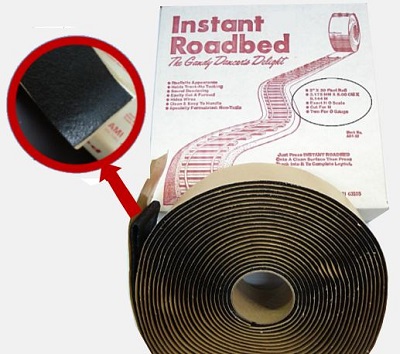
“I was told about a product called Instant Roadbed, and wondered if it is any good? No glue is needed as it has self adhesive backing, but I was wondering how long this would last? I was told you just lay track and ballast on top and that both can be removed if needed without wrecking things. This sounds good, but I question if the the Instant Roadbed tape might start lifting over time? It does interest me because it sounds easy and less messy and quicker than other methods, but I don’t want to lay my track and ballast with the stuff only to regret it. I guess I could use it for making roads, and sidewalks too? Has anyone used it with success or otherwise?”
Send your question in for publication. See the link below.
Harry has this question for readers:
“Does a Atlas GP-7 run correctly on an N scale 11 inch radius?”
Use the link below to submit your question for publication.
Ben posted this question for readers:
“Is there a way of easily and cleanly removing flex track and ballast? I am thinking of replacing my flex track with regular track that I think will look less fake.”
If you have a question, then have it published on the Blog. See the link below.
Bill sent in this question:
“I’m planning a point to point trolley track on my layout, separate from the mainline that would run a DC Bachmann Brill trolley. I’d like the trolley to reverse direction at each end of the track without my intervention. What would be the easiest way to do this reliably? Thanks in advance.”
Max wants advice from others and asks:
“My plan was to construct a duck-under to make my way to the inner track walkway. The benchwork is approx. 42 inches above the floor, which sounds ok, but right now I have my foot in cast (I won’t bore you with what happened… and you’ll probably only laugh when you hear my stupidity). It made me think though, I am not getting any younger so I should try and make access as easy as possible for an old codger like me, so a duck-under might not be the best option. I thought of using a rolling stool but that’s not great.
Thinking it through, I probably will need to have a hinged section that I could swing or lift up. It will need to be wide enough so I can easily squeeze my way through and past the benchwork some 4 ft. Without reveal my stomach size I will probably need about 14 inches to get by.
The particular portion of track will have 4 tracks so I will need to work out the electrics and make sure the tracks properly align. Obviously I don’t want to mess things up with constant use upsetting the electrics or track alignment. If someone has done something similar I would be interested in any advise – tips?”
Add your comments below to assist Max. Your question can also be published – see below.
Seb submitted this question for readers to ponder:
“I have an HO diesel loco with 6 (3,3) trucks. A couple of months back I converted the track from 18″ to 22″ curves and I decided to leave the original turnouts intact. This might be the cause of the derailments when the unit crosses the turnouts…not sure?!? I don’t want to replace things if I am barking up the wrong tree? Should I substitute the turnouts with #6’s [22″ curves] to minimize derailments?”
Get your question published. See link below.
Mike sent in this question. Perhaps you can help:
“I want to nail down to plywood my EZ track. I have some Atlas track nails which are long enough. Some of the track pieces need to be drilled in order for the nails to work. Do I use a pin vise or a mini drill? How do I determine the drill bit size I need? The hole is the size of the Atlas track nails. Thanks”
Ron W posted this question to challenge readers:
“This might sound like a stupid question but I want to lay cork using the center of the track. Marking the line with the track in position on plywood is difficult. I need some kind of tool to mark the center line accurately because my eyesight is not good enough. I thought of using a pencil through the hole but this didn’t work. I concluded the marking pencil needs to be securely mounted to the truck hole. Is there a better way of doing this or even a suitable tool available?”
Have your question posted on this Blog for others in the hobby to see and comment on. Use the link below.