Trackage
Everything on model trains, model railroads, model railways, locomotives, model train layouts, scenery, wiring, DCC and more. Enjoy the world's best hobby... model railroading!

David models HO and writes:
“I am looking to buy a used Noch layout from 1972. Can I run standard HO scale equipment which is not Marklin on this layout, and will the Marklin transformers power them? Thanks.”
Submit your question for publication.
Steve asks:
“I’m new to DCC (running NEC). What’s the difference between programing on the main and programing track? I run a 8X4 HO layout.”
Add your answer below.
Ewan has a problem he is hoping others can help him with:
“I have had some Atlas Code 83 turnouts sitting under my workbench for ages waiting to be installed – you know, it’s one of those things I’ll get around to doing when I have time. Well, now like it seems millions of others around the world with this dreadful virus thing, I have the time to put these Code 83 to good use. Problem is; after a closer look I’m not sure if they are any good.
My concern is with how well the point rails will fit properly into the stock rails. The end tips of the point rails are sticking out of the stock rails by quite a bit. I am wondering if I should file the tip of the point rail to keep it flush with the stock rail. I can probably do this on one side on one turnout, but I am not sure I can do this on the other side because the other point rail is sticking out by quite a lot and I don’t think filing the tip will be enough. In fact there were two problems. The point rail is not fitting into the gap in the stock rail, and the tip of the point rail looks a bit twisted. Does that make sense?
I am worried if I try to straighten it then it might snap off completely. The joint where the actual tab joins the throw bar is really thin. I know if it breaks I could possibly solder the tab back onto the point rail but that is only a maybe. Am I encountering a unique problem or is this more of a wider design fault in the type of turnout?
I would like to hear from anyone else who might have had similar experiences with Atlas Code 83 turnouts, or even with other brands. I am trying to stay positive and keep busy in these troubled times, so don’t want to get all negative and just slang off at Atlas. Having this problem is not good, but at least it is keeping my mind busy right now rather than worrying about bigger problems around the country and world.
Positive thoughts and solutions from others would be very much appreciated right now, and thank you in advance Robert for allowing me to ask this question on your blog. Stay safe to you, your family and friends – and the same goes to everyone else in the model RR community around the world. We need to support each other right now.”
If you have a question you would like to have published for free, simply use the ASK A QUESTION link to submit it for consideration.
Mike models HO and asks the following question. Readers are welcome to post diagrams, or photos in the COMMENTS under Mike’s post:
“What is the best way to build a drop leaf for access to middle of layout? We will be running 2 tracks across about 2 foot span.”
Darryl sent in this question:
“I would like to know if I should solder all my track joints, or just use the rail joiners? I haven’t had any problems as yet, but I’m quite new to this. I read that jumper wires might be a better option allowing for expansion or contraction, given likely weather/humidity changes? Maybe I should solder the rail joiners as a back-up?”
Post your question using one of the many ASK A QUESTION links on this page.
Add your comment, if you would like to take part in the conversation. See the COMMENTS link below.
Also, please provide some feedback on the type size used in the this and the post under it. You will see we have used a larger font size than is used on earlier posts. Do you prefer the larger font size, or the small font size? Feedback appreciated.
Jim asks:
“What is the best method to clean track other than a track eraser?“
Richo poses and interesting question:
“I am thinking of running HO trains above On30 trains around the wall. Would it detract and look weird? I am thinking of maybe a dog bone design, or possibly a continuous run with a swing gate on each level to get access through the door. Not sure, so would appreciate some feedback?”
Add a comment/suggestion to assist Richo below. Have your own question(s) published by clicking on the ASK A QUESTION link.
John is looking at OO gauge and wants to know:
“What is the best way to ballast track and points?”
David has this question:
“I am searching for good looking light weight ballast material for size N. I need to source enough for around 60 meters of track which I need to to ballast. I can’t have the weight of stone material is too high, as the whole layout is hanging in wires from the ceiling for elevation. Any experience shall be appreciated.”
Add your comment.
Rudy models HO and asks:
“My system is all DC and my ballast is already in place. I realize only now, that I could use an 18 inch section of my layout where I could temporarily switch power, on and off, and let my 2nd engine rest, while continuing use of the first one. I already have a siding wired for this, but could use another. Is there any way to do this without ripping up my ballasted track ?”
Lincoln sent in this question:
“I was wondering what is the correct spacing width between parallel straight tracks (HO), and does this differ from on curves? I presume curve spacing is different depending on the curve radius? I want to run some long freight trains and I am looking at buying some long passenger cars, so I want to have enough space between the tracks. Thanks in advance for publishing my question, and to any rail fans who can help out.”
S-curves can be a railroader’s worst nightmare, yet they are a feature of many track plans because they can add interest to a layout. If you are going to add an S-curve, plan it carefully. That means that you need to have at least one straight section of track at as long as your longest car between the curves. Otherwise, regular derailments might become unwanted events on your layout. Fixing a problematic S-curve can be exceptionally hard once the track is permanently placed.
One of the most challenging placements for an S-curve is just beyond a turnout. Avoid having a curve in the opposite direction immediately after the turnout diverges. Follow the straight section between changes of direction practice described above.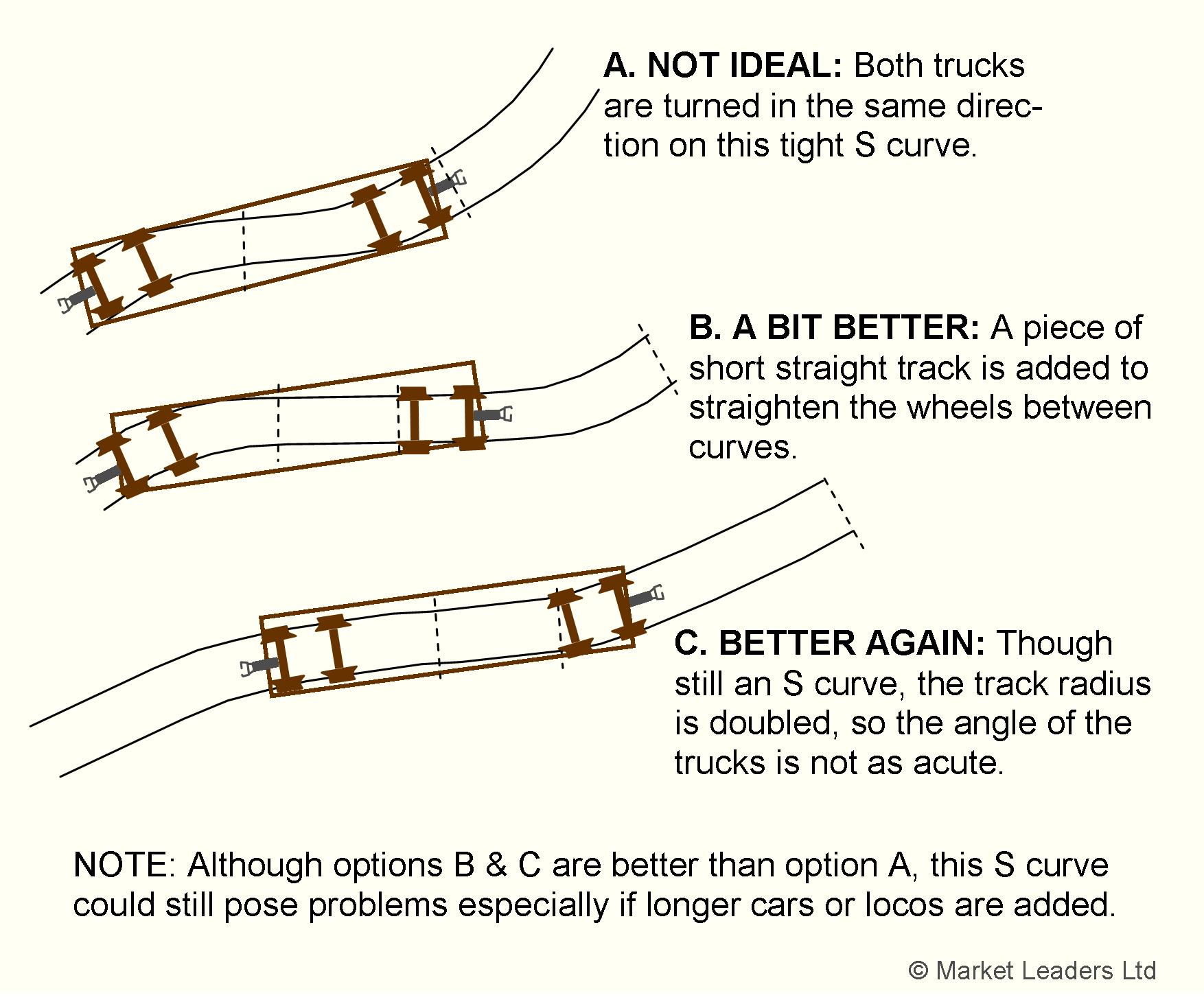
Marshall models HO and asks:
“I would like to start ballasting my track with Woodland Scenics medium ballast and need to know if there is a rule of for how much material might be used for a specified length of track. My track, which totals some 200 foot, sits on a cork roadbed. Thank you.”
Have your question published on the blog by using one of the many Ask A Question links on this page.
Callum asks readers:
“When using Double Pole Double Throw (DPDT) switches with DCC, is it advisable to stop my loco first, or is it okay to throw the switch while my loco is running? My thinking is that I should stop it first?”
Send in your question for publication using one of the many Ask a Question links on this blog.
With the pr essures of fitting everything into a layout, there will always be the temptation to make the curves tighter than they should be. This is typically fraught with problems, even if you have done some test runs with locomotives and cars around the curve.
Even if the trains run okay –
The golden rule is this: make the minimum radius AT LEAST as large as that recommended for the longest car you plan to run on your layout. That way you won’t have any regrets later.
Duncan is into N gauge and sent in this question:
“Hi just starting in N gauge, I am planning my DCC railway and want to know about turnouts, do I need Insulfrogs or Electrofrogs?”
Use an Ask a Question link to send in your question for publication.
Ian models HO and asks readers for opinions on dead rail systems – “Any thoughts anyone
if so best systems available please?”
Dead Rail Definition – One of two rails that are laid across a railway track-scale platform, but which are not connected with the weighing beam, and that will permit a locomotive, or other load exceeding the capacity of the scale, to move across the scale.
Richard asks:
“Is it possible to wire 2 Kato switches to so that when I throw the controller lever they both switch? I have the switches on opposite sides of my layout with a half circle connecting them to my main line.“