Everything on model trains, model railroads, model railways, locomotives, model train layouts, scenery, wiring, DCC and more. Enjoy the world's best hobby... model railroading!
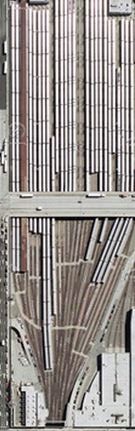 If you are new to model trains, then you’re at a loss about where to start from. Prototypical designing is just for people like you. It allows the entire railroad to be modeled according to a real system. This eliminates possibilities where trains might not be on schedule or not operate at all.
 The layout ground cover is basically the ‘vegetation’ or landscape that covers the outer surface of your model train layout and is intended to hide the plaster, wires and form that coat your terrain. Layout Ground Cover is a very important part of your scenery and is vital to bring out the realism in the whole project.
The layout ground cover is divided into – low, medium and high. The low area incorporates the coloring of the surface with small elements like grass, and other plants. Medium includes taller plants like weeds, medium sized vines and bushes. High on the other hand includes tall grasses, larger bushes and shrubs.
A great tip in creating layout ground cover is to use a variety of textures and shades to bring a much more realistic outlook than the use of a single shade of color. The realism of the layout ground cover totally depends upon the imagination of the modeler.
Watch this short video if you are thinking about constructing some model buildings for your layout.
Enjoy!
Dave asks readers:
“I have built a HO layout Ana want to have it DCC. I want to start off with an expandable controller any suggestions. My layout is a 4×6 wth a 2′ x 9 foot leg with a dog bone.”
Add your comment.
Local freights are also known as peddlers and way freights. Their prime responsibility is to drop certain cars off and pick certain cars up at different towns. So local freights usually make a stop at every town and perform their respective task. When compared to fast freight, thorough freight and passenger trains, local freights are relegated to a second class status. This means that if one of the three trains mentioned above is on the track, then the local freight has to make way for them to pass first before it can carry on with its operations.

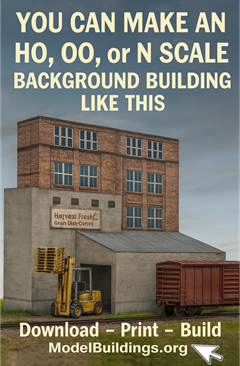
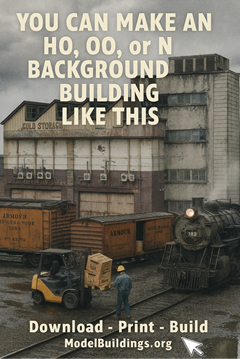
This photo shows a consist of HO scale freight wagons stationed in front of some industrial storage warehouses. The scale buildings have been constructed from corflute in low relief and are glued to a photographic backdrop. Corflute is what waterproof real estate signs are made from and can be purchased for under $10 for a very large sheet (makes several buildings) from a DIY store.
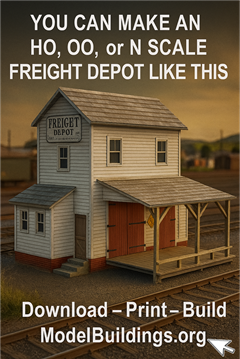
The plans for these model railroad buildings can be downloaded here.
Peter asks readers:
“What is the best way to join track when you need a new section of table that is removable.”
Add your comments.
Ken asks readers:
“What radius would I use if I had 3 tracks next to each other ( 10-12-14 inch ) and hopefully a 4-8-4 would work on at least 2 of the 3 tracks? I model N scale. Thank you.”
Add your comment.
Gil sent in this question for readers:
“I have access to a large amount of Florist Foam (Green). How do you break this down to make a decent and cheap ground cover or if possible Trees and Shrubs?”
Add your comment.
 Ben sent in this idea to share:
I have used several inexpensive techniques for keeping wiring together. The wires still need to be easily accessed if you need to add or remove a wire. This photo shows some of the methods I have used. I only add a plastic cable tie when I’m finished wiring the cable. If you are using metal screw eyes it is worth opening the neck slightly so you can remove, add, or simply move a wire.
Add your comment.
 Jack sent in this short article to share:
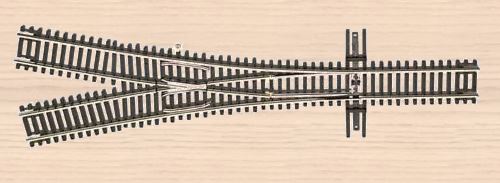
A wye track is shaped like the letter ‘Y’ where tracks merge into a single one and single tracks diverge into two tracks. The track is designed like this because it allows easy turning of locomotives and routes trains to another track without reversing. It can be part of a junction or used in place of a turntable.
A wye track is connected in isolated blocks. If continuous wiring was employed, a short circuit would occur. Therefore, the track is wired in different blocks where each block is electrically isolated from adjacent ones. A Digital Command Control (DCC) system achieves this.
Add your comment
When you consider the cost of buying locomotives, construction products like foam board and corflute are incredibly cheap to buy. A huge sheet of corflute (like they use on real estate signs) cost less than $10 at a local DIY store and was large enough to construct several model buildings. What’s more, the material is very strong and very easy to work with.
This video shows how to use corflute board for constructing a model railroad building.
The plan in this video can be downloaded here.
Andy asks readers:
“Do anyone offer help in converting an HO DCC equipped locomotive to Ring Engineering’s Rail Pro LM module installation?”
Add your thoughts.
Warren seeks guidance for others in the hobby and asks:
“Does anyone make HO roadbed to fit Bachmann easy track? We have alot of eztrack which I want to use instead of purchasing new track. Is it necessary to use roadbed under the eztrack or can I elimanate this step. I did plan on using ballast just not sure about the roadbed. ”
Add your suggestions for Warren.
William asks readers:
“This may sound like a stupid question; however, I bet there are many modelers that are thinking the same thing. I look at a layout and I see dotted lines, straight lines, helix curves, etc. I never see a chart to help you determine which lines are which! If a line is going from one level to another often times you cannot see where it picks up. Doesn’t anyone have any suggestions or solutions?”
Add your comment.
Ron asks readers:
“To put sound in an N scale boxcar I’m told I need a 50′ box with metal wells and a truck with a metal frame for the electrical pickup. Where might I find such a thing or what should I ask for?”
Add your comment to assist Ron.
Gerry asks readers for help:
“Where does an absolute beginner start when wanting to layout/build an oo gauge railway for his grandson, on either a 6×4 solid base or a 8×4 folding base? Should I go DC or DCC? Where can I get a good shunting type layout?”
Add your comment.
Bobby asks readers:
“I have been looking at N Scale engines on line and noticed that they, for the most part, are DCC equipped. Can they be run on regular analog DC or do they need to be modified?”
Add your comment.
Donald has an N scale question for readers:
“How do I break open the N scale freight and passenger cars to add weight and what is best to use for that extra weight, hopefully keeping them on the tracks?”
Add your suggestion.