Everything on model trains, model railroads, model railways, locomotives, model train layouts, scenery, wiring, DCC and more. Enjoy the world's best hobby... model railroading!
Thomas asks readers:
“Where can I get a footbridge which will span more than two tracks?”
Edward has a question for readers:
“How do I check for a warped rail or track twist or a small level change? My trains uncouple once in a while and leave cars behind.”
Add your comment below.
Henry has a question for readers:
“My old DC railroad is about 20 years old and is needing a facelift. Can it be changed to DCC without a lot of new wiring? I have several blocks so that I could control trains in different areas. Do I need to remove the blocks and make it all one block? Lastly, can my old engines be converted to DCC or do I have to buy new dcc equiped engines?”
Comment below.
Cecil has a question for readers:
“I have a lot of track but no locomotive and no cars. 23.456 ft of track. I go to e bay a try to get things but get out bid. What do I do to get what I want? I don’t want to sell any of my track. I want to make a big layout. What to do?”
George has a question to test experienced railroaders and asks:
“Why do the frogs in the switch keep derailing my engine or cars. I have checked the tension of the Atlas switch, and I also have Bachmann N gauge which does the same thing.”
Add your comment below.

Use an eye dropper to achieve more accuracy and avoid damaging other parts of your railroad.
Ballasting Track can be quite tricky and it takes at most patience and effort to get it looking right. Ballast is laid between the tracks and sometimes on the sidings of the sleepers such that one can in a realistic effect there are different techniques for laying down Ballasting Track.
If you are using cork it is important that you stand the edges of the slope first so that the smaller stones will obey better. Use almost 70% isopropyl alcohol spray as the wetting agent instead of plain water.
With the help of an eyedropper you can do a better job and avoid spraying on the scenery. To soak the Ballasting components use a mixture of white glue and alcohol in 50-50 proportion. These tips will help you do your job perfectly.
You’ll get a more detailed guide to step by step ballasting in the members area at the online Model Train Club.

Code 100 track
Each model train track comes with various codes or sizes for each scale. These codes are identified with numbers which translate into the height of the rail track in inches. For example: Code 100 – gives you 0.1 inch height and 156lb rail. In the same way, Code 83 – gives you 0.083 inch height and 132 lb. rail.
When it comes to creating a prototype track, the main lines are made with heavier rails and the branches or deviations are made with lighter rails. The roadbed and the space between ties of these codes vary as well. For example if the mainline needs 24 ties/39 foot rails, it comes down to 11 1/2 inches between each tie. With this in mind, use heavy code rail for the mainline and smaller code for the sidings.
We recently ran a reader poll asking “Do you know how to add a comment (or answer) to a posting on this blog?”
We were staggered with the results. Despite our techies insisting the method for posting comments was easy to use, a massive 63% of readers disagreed and said they didn’t know how to post a comment on the blog. Shock! Horror! We had no idea there was such a problem.
The New Easy Way To Post Comments
To fix things we now include two links directly UNDER EACH POSTING where readers can post a comment or ask other readers a question. The links appear under EVERY posting so they are easy to find. Obviously to keep the quality of posting high (and to avoid unwanted spam comments), all comment need to be reviewed and approved by the blog moderator. This is a quick process and most comments will be live within a few minutes or few hours.
So, there is no excuse for not having your say and getting involved in the discussions on this model train blog. It is now really easy to have your say and share your ideas.
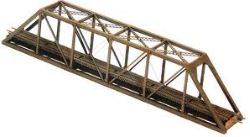 Tom has a question for readers:
“I need help on installation of N scale bridges. I specifically require help on preparing the roadbed, bridge abutments, and pier foundation. I recently completed a Pratt Truss Bridge kit, and two deck bridges. Can someone advise please?”
To guide Tom, please add your comment here on this posting.
Ed has a question for readers:
“I am looking for some help in choosing a power pack to start my model railroad. I have seen all of the features and eventually want to go to DCC and hand held but not now. So can someone suggest a reasonably priced power pack that will allow growth?”
To post your question use the link in the right hand column. To comment on this posting, click on the link in this posting.
 John has very kindly contributed this article to help others in the hobby…
Halloween is almost here, and there’s no better time to add an old/haunted house to your train layout. What’s better, you can do so at little cost, and even use materials that can be found outside, such as broken-off tree branches, weeds, moss, etc.
I used an N-Scale Model Power built-up Haunted House shown in the photo. The house itself comes a bit off-kilter, making it perfect for this purpose, though the exterior is a cream color with green shutters and a black roof. To weather the bright colors I used some black paint cut with a small amount of water, and blackened the exterior of the house to simulate dirt, grime, and overall wear, making it look like it should be torn down and rebuilt. The fall colors are in season, and Woodland Scenics trees are great for this, as well as fallen branches.
You can add a lot of detail if you work in the larger scales like HO or O. Put in broken windows, leaves, doors off their hinges, and ghosts, bats, and various beasties that go bump in the night. But the main purpose is that a modeler can use any house for this if you “beat it up” and make it look misused and run-down.
By putting a haunted house on your layout, it’s certain that a slow-moving freight train will go a lot faster as it passes the house, not sure of who (or What) lives inside!
Click the link if you would like to add a comment to John’s posting.
Ted would like to hear feedback from others in the hobby on the idea he is working on:
“To make my layout easy to move if required I know that the board has to have tensional strength. Plywood the standard is heavy and too flexible without diagonal bracing which adds even more weight. So I intend to use internal blank doors. They are available in different heights and width. However the primary size would be standard height and 36″ wide. Light and inflexible. Using 3/8″ dowels I can attach then accurately and clamp them using old furniture draw clamps, terminate wire harnesses at the joints as well. Using foam and or cork I can vary the height and it’s easy to attach raised decks.
I am so into this concept I may be blind to negative implications so am looking for comments. Can’t hurt my feelings so be blunt as it will help.”
Click to add your comment to Ted’s posting.
Stuart has a question for reader:
“I recently installed carriage lighting using led strips which work perfect until train moves when they flicked which spoils the effect. I use a DCC system, rails are clean and new wheels and pickup have been used. Any idea from your readers on how to overcome this problem, thanks in advance.”
Click the link to add your answer or comment.
 DCC or Digital Command Control sends signals to the locomotives through the rails. Multiple locomotives are independently controlled within the same block. Train operation depends on the decoder installed in each block. Programming is done to allow users to set the decoders address.
A programming track can be implemented in two ways. Program the track onto your workbench or build it into your layout. The former approach allows simple control and testing facilities. The latter approach incorporates the track into the layout and is easily moveable. It also allows programming a dead zone for track protection. For more information on dcc programming and other model railroading tips and ideas get the Model Train Techniques ebook available free with your first months membership to my online model train club.
The results of our recent reader poll are in. There were 431 responses to the question: How would you describe your overall level of experience in the hobby?
42% = Average skills (180 Votes)
21% = Reasonably experienced (92 Votes)
18% = Limited skills (76 Votes)
15% = Beginner level (63 Votes)
4% =Very experienced (20 Votes)
If you are looking to rebuild your railroad model form scratch, then you’ll have to remove decals off the train. Follow the steps below to achieve a neat look.
A double yard has both ends connected to the main track. This is accomplished with a ladder that guides the train onto one of the many tracks in the yard. The components of an ideal yard should include a runaround track, one arriving and one departing track, thoroughfare that connects ladders in a yard, classification tracks and drill track. The following points must be followed.
 There are many small details that can be added to model railroads to improve the design. The following ones are ideas for any layout for it to depict a real railroad system.