Everything on model trains, model railroads, model railways, locomotives, model train layouts, scenery, wiring, DCC and more. Enjoy the world's best hobby... model railroading!

Make Non-Expensive Signs For Your Layout

John has kindly sent in these tips to share with others in the hobby.
Road and railroad signs as well as lighted billboards are readily available through many online distributors, who also sell building and storefront signs. But what if you need a sign that’s exclusive to your train layout and is not available anywhere? You then have to make your own, and there is a way to do this without spending a whole lot of money.
To make these signs, you need a computer with a word processor that lets you change the size and font of the printed letters. You can use regular 8-1/2″ x 11″ copy paper, which will be reinforced later. 
As for the sizes, I work in N-Scale right now, so my signs are made using 8-point type and varying the fonts and colors, even the background colors on some signs. They come out a bit too large for N, but at least you don’t have to look through a magnifying glass to read them! Paper will curl up or shrivel after awhile, so after you make your sign, cut it out and put it on plain white or pre-painted brown or gray light cardboard. Elmer’s stick glue or the equivalent is good for mounting signs onto the cardboard. 
After drying, glue on painted or unpainted wooden toothpicks to act as sign holders or billboards for your creation. O-Scale modelers can use bamboo skewers for the sign structure.

For signs that are put on buildings such as industries, stores, stations, freight houses, etc., use heavier full-sheet label paper. Print the sign you want, peel off the back, and place the sign with the adhesive on it directly on the structure. However you make it, the sign is completely original, and use the money you save to make your layout even better!

Thanks John, you are making a wonderful contribution to the hobby.

4 comments  Ask A Question

DCC Or DC? – Watch This Video

The results of the recent poll revealed 51% of the 1047 model railroaders surveyed operate DCC. I actually thought the figure might have been a little higher than that (38% operate DC and 9% didn’t have a layout yet).

There are definite advantages for both systems, and I would never try and push anyone into DCC if they are already comfortable with DC and don’t want to change. That said; I would recommend DCC operation for anyone starting off in the hobby as the system is very versatile and fast becoming the norm. Whichever system you operate, always remember the whole idea is to have fun and enjoy what you are doing!

1 comment  Ask A Question

Know Your Railroad’s Time Period

Another great contribution from John.
From horse-drawn cars to the great technology of today, railroads have been around for a long time and hopefully will exist for many years to come. For that reason, it is good to choose a time period to model, but besides the usual questions of how much space and money are available, that brings up other questions, the most important being what you as a modeler like to see in locomotives, cars, and the environment in which they will run.
 
To use myself as an example, I model in N-Scale in the United States during the late-1950’s, with a concentration on the roads that will make up Conrail less than 20 years later. To do this, much research was involved, as there were many major railroads in the United States that weren’t yet merged into a bigger and more affluent company. Though most railroads had completely dieselized by the 1950’s, there were not a lot of types of freight diesels available for modeling compared to later times, so one had to choose carefully. The same with freight cars, as the box car red color in pre-war consists was being replaced by colorful units that really made a company name stand out.

Knowing with what was around in a certain place at a certain time is a lesson in history as well as railroading, so it pays to study actual railroads, which parallel the time periods that we model. But there’s something that was not discussed yet, and that’s doing what gives you enjoyment in your work and makes other people happy to see it. 

No matter if your layout is small or garage-sized, and though it is good to model a specific time period/road, the main consideration is to do what makes you happy. If you like to see a Burlington Northern SD pulling a string of old Central Pacific box cars, then go right ahead and know that no railroad “law enforcement” will arrest you for that. The layout is YOURS alone, and that’s what makes our hobby great!

Click To Add A Comment  Ask A Question

N Gauge Tramway

John M has sent in this article about the N gauge Huncote Tram Layout:
History
 
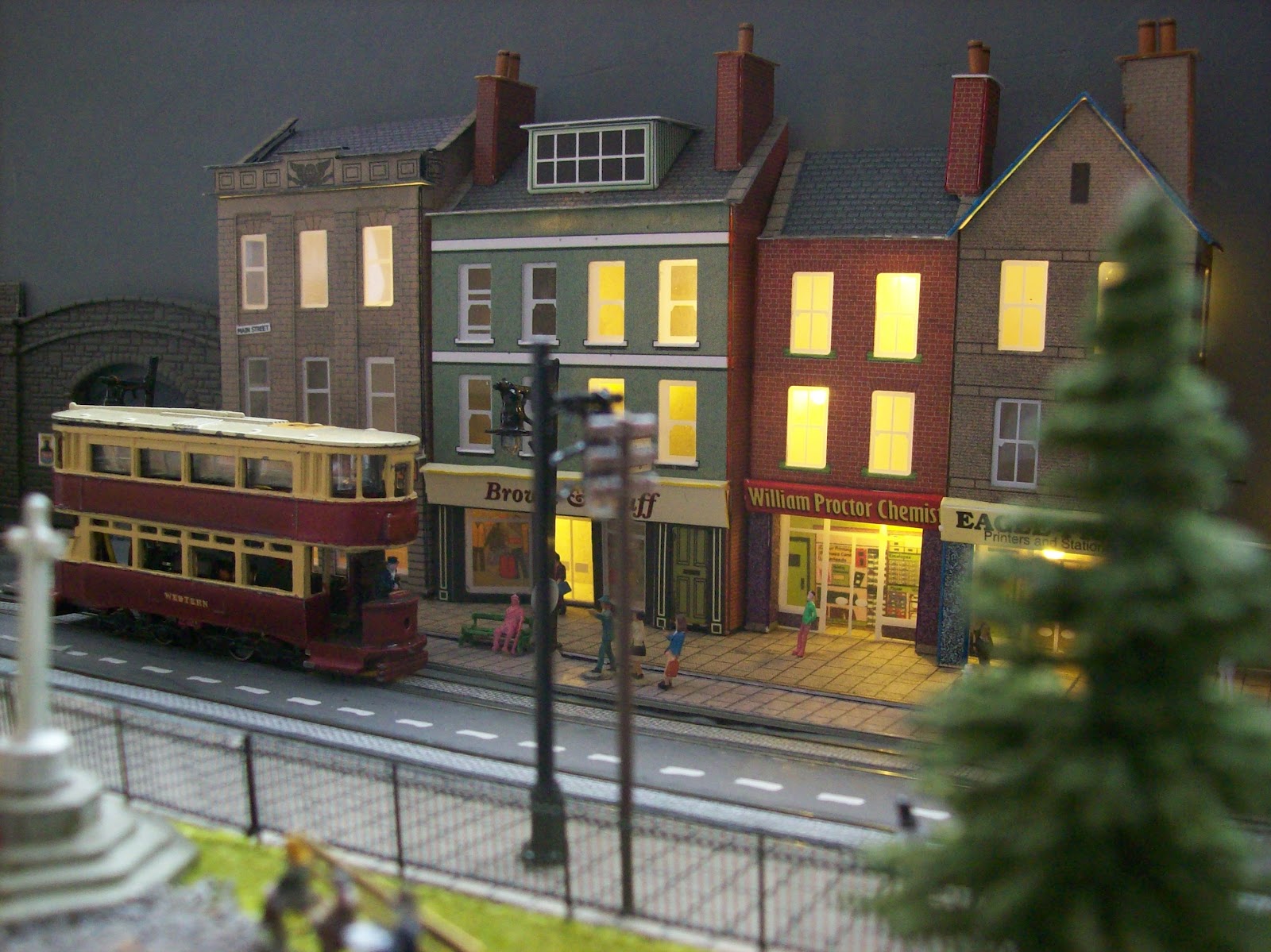
The layout is named “Huncote Tramway Museum” which is a fictional location able to run passenger trams of any type and from any real or imaginary authority. 
 
 In reality Huncote (where I live) is a small village (population 1000 in 1970) 7 miles south of Leicester, a city in the center of England, and situated within a triangle formed by the old Roman roads of the A46 (Fosse Way), the A47 and the A5 (Watling Street). Within this triangle many of the villages benefited from the extraction of granite. Nineteenth century maps show a mineral tramway which extended from Huncote granite quarry to the south of the village to Narborough quarry in the next village. 
 
 Layout
 
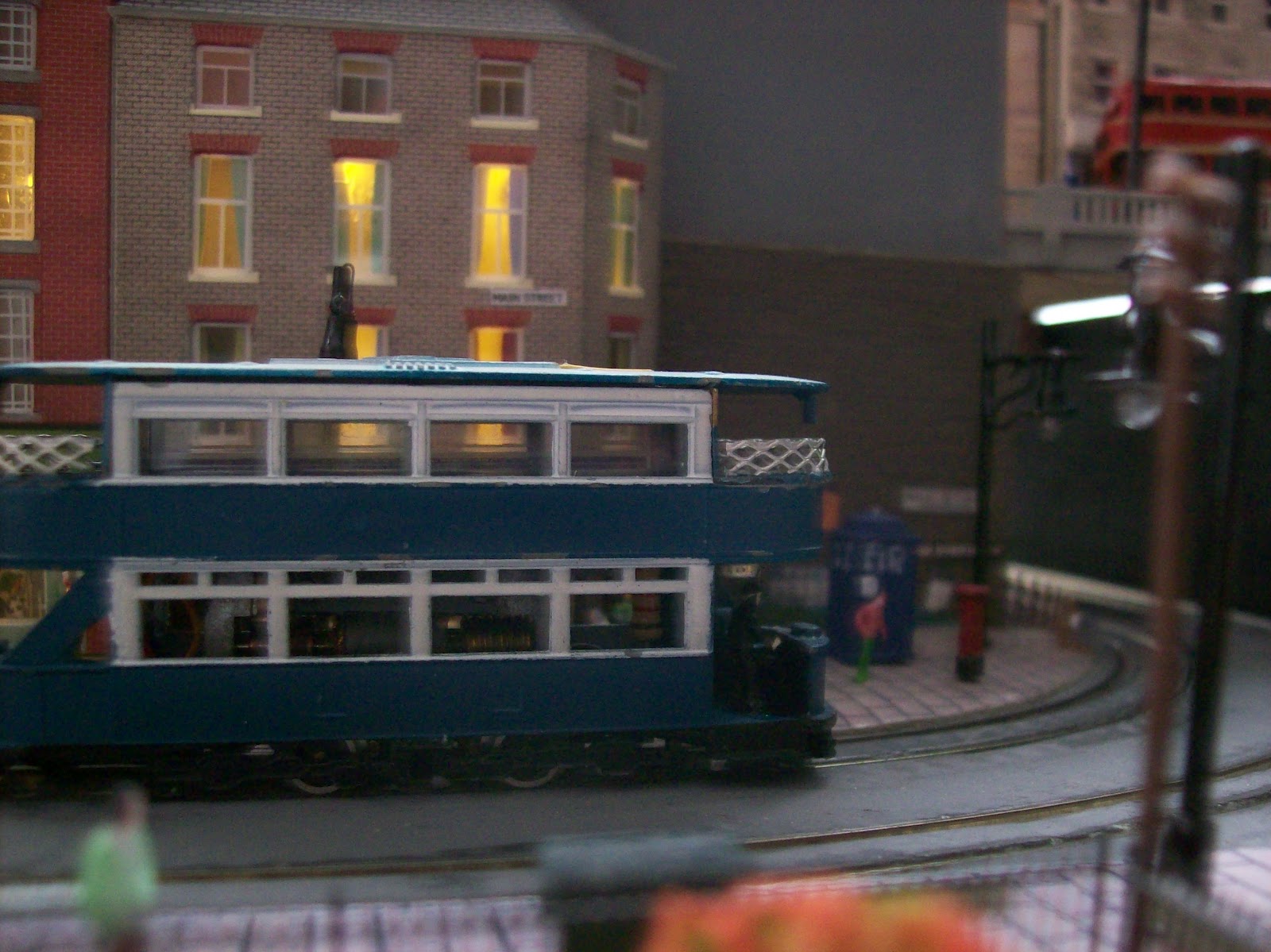
The layout is constructed on a piece of 50x85cm chipboard and consists of a hidden double-folded dumbell to create a straight section of road, the center of a 20x85cm display with a road bridge at one end and a railway bridge at the opposite end. A dumbell format was chosen to enable the trams to always run in a forward direction. I currently have four operational vehicles (see photographs) with two more in preparation. All are heavily modified Lesney Series 1 Matchbox trams No.3 which are slightly out-of-scale for N gauge but very effective. The tram displaying adverts and colored red is in the original livery of a London Transport tram. Traction is provided by Graham Farish 4-wheel motors which are now, unfortunately, obsolete. A test track, which runs onto and forms part of the railway bridge, is provided across the top of the rear section cover and can be also used to run a couple of DCC steam locomotives. 
 
Control
 
Each vehicle is fitted with a six pin, 2 function, DCC decoder. Three types are used: Bachmann NEM651; TCS EUN651 and Digitrax DZ1251N. Programming is done by a Lenz Digital plus compact and control by an E-Z Command Digital Command Train Control System. Switchable (F10) forward headlights are fitted currently to each tram.
Lighting
 
Working street lights, bulbs powered by an old DC controller, are fitted and lighting in the buildings is proved a battery powered leds (a string of 20 mini Christmas lights – excellent value for money!) There is also an old ‘tardis’ type blue Police Box which is surmounted by a switchable flashing blue light. 
Hidden dumbell sections of track
 
These are monitored by a strategically placed web-cam to monitor both ends at the same time and connected to my lap-top computer (far cheaper than CCTV!).

Click To Add A Comment  Ask A Question

Which Type of Couplers Do You Use Most?

A total of 483 model railroaders voted in our last poll which asked,  “Which type of couplers do you use most?”

The results were:

Horn-Hook Couplers 11%
Knuckle Couplers 69%
Combination  14%
Other 6%

Click To Add A Comment  Ask A Question

German N Scale Layout

John sent in some info on his N scale layout for publication:
This is a German Epoch lll freelance N scale layout situated on the Rhine. It includes part of the river with a barge and two stations.
 The layout is approximately 4 1/2 x 3 feet and consists of two parallel ovals each with a passing loop. A backscene about 9ins from the rear allows an unseen area and trains enter and leave this by means of two tunnels. The layout is landscaped with a village scene in the center.

One of the ovals is AC powered and includes non-working overhead catenary towers. The other is DCC. Track is pre-ballasted Fleischmann Piccolo with electrically operated points on the AC circuit.

Locomotives are steam Classes 38, 64 and 50. I also operate an electric E19 and a diesel Class V 200. Both passenger and goods trains run on the layout.

Click To Add A Comment  Ask A Question

Camelback Locomotives

Bill has a question for other hobbyists and ask:
"Does anyone know of a manufacturer that makes Cammelback locos in N gauge --- Besides me??"
Add your answer below.
Note: Camelback locos are also called the Mother Hubbard, or a center-cab locomotive. It is a type of steam loco with its driving cab positioned in the middle - astride the boiler. The Camelback was fitted with a wide firebox which restricted the driver visibility as opposed to the regular cab location at the rear.

Click To Add A Comment  Ask A Question

Point Motor Switch

George has a question for those with experience on point motors:

“As I am only 11 and been collecting model trains for 2 years, I am not an expert on point motors and since I fitted scenery boards I can’t access points. So I bought an above track Hornby point motor but I needed a Hornby switch to go with it. Which one is it? ON-ON, PASSING CONTACT or ON-OFF?”

Add your answer below.

1 comment  Ask A Question

Throw Stands

A reader asks:

“How much space (room) do I need between two HO tracks for a (caboose etc.) throw stand and related items?”

Add your suggestion below.

1 comment  Ask A Question

HOn30 3D Rapid Prototyping

Charles is into HOn30 and would like advice from others:

“Has anyone had any experience in designing, producing, using 3D Rapid Protyping of Locomotives and rolling stock in HOn30?”

Add your suggestions below.
Click To Add A Comment  Ask A Question

Install Railroad Signals

A readers asks:

“I am having a difficult time finding the proper way to install HO railroad signals. I need to know where, what type and the distance from the point it is controlling? Also the distance from the center of the track to the center of the signal.”

Add your answer below.

Click To Add A Comment  Ask A Question

Installing Decoder in Mantua 4-6-2 Steam Engine

Charles would like to hear from experienced hobbyists:

“I need information on installing DCC decoder in Mantua 4-6-2 Steam engine or disassembling the engine.”

Add your suggestion below.

Click To Add A Comment  Ask A Question

Weathering a Wagon

Weathering (showing signs of wear and tear) can add to the realism of any model train set, but it needs to be done carefully. One, often overlooked, important consideration is the age of the individual freight wagon being weathered. Not all wagons on a freight train are necessarily of the same vintage or have experienced the same weathering conditions. A freight train could comprise a mix of fairly new and considerably old wagons.

For example a model train layout depicting a mid 1960′s railroad might comprise mainly of wagons built around 1950. That would make most of the wagons around 15 years old.

Compare this to a freight train on a modern day railroad layout. Today’s freight train might include several brightly colored newish wagons along with a couple of 35-40 year old wagons built around the mid to late 1960′s. Weathering of the older 1960′s wagons would be different to that seen on the newer wagons.

So, always consider that a freight train is made up of several different wagons of different ages and backgrounds rather than all the wagons on a train being constructed at the same time and experiencing the same weathering conditions.

John comments:

“A modeler (like myself) might not think about weathering a wagon (freight car) of the same road name in a different way, due to varying outdoor conditions.

A good example, using a U.S. road, is modeling the early-1960’s Erie-Lackawanna (the hyphen in the name appeared until around 1967). The EL was the result of the 1960 merger of the Erie Railroad and the Delaware Lackawanna & Western, and since the EL kept many of their merged freight cars, it would take a lot of careful and different weathering of cars that haven’t been repainted yet. For the locomotives, the black of the ERIE and the gray and the black of the DL&W should be weathered. The newer EL engines, such as the Geeps and SDs, should appear new or fairly new.”

Click To Add A Comment  Ask A Question

Modeling 1850 -1880 Alabama

Larry wants to hear from anyone who models the Civil War era and asks:

“Does any one know a good source for rolling stock that can be kit-bashed to use in the Civil War era? I’m working on my first layout and have chosen my hometown of Tuscumbia, Alabama as the prototype. I will have an out and back between Tuscumbia and Decatur carrying cotton, lumber and goods from the North to Tuscumbia Landing on the Tennessee River for loading onto steamboats. I would love to hear comments from anyone who has modeled this era in the South.”

Add your suggestions below.

1 comment  Ask A Question

Install Tortoise Motors

Would someone like to help John who asks:

“How do I line up and install Tortoise motors under layout on my own, tracks in place please?”

Comment below.

Click To Add A Comment  Ask A Question

Engine Operation – Clean and Lubricate

A reader asks others for advice:

“I have been out of the hobby for many years. I have unpacked several boxes of HO locomotive engines and track and set up some for the kids. The engines are all sluggish and work intermittently. I realize they are most likely dusty and dry. How do I get them performing like they did previously? How do you clean and lubricate old equipment like these engines?”

Add your suggestions below.
2 comments  Ask A Question

00 Flying Scotsman – Repaired Running Gear

Neil would like some help if you have a Flying Scotsman train or understand the workings of running gear:

“My son’s Flying Scotsman lost a hex screw from one side of the running gear recently (it is 3 months old). Returned to the shop for repair under warranty. It runs but seems to me to waddle or fish-tail, especially at slow speeds. It does this forward and reverse. Should it do this? I think the running gear left and right are out of sync with each other. Should they be in sync? Seems to me the wheels on one side have rotated leaving the drive for the left and right sides out of step. I think this could have happened when the hex screw came off while running. Any help appreciated.”

Add your suggestions below.
Click To Add A Comment  Ask A Question

N Scale Home Office Railway

Kent sent in some details of his project to share with others in the hobby:

“I started this project to complement my home office computer workstation. I originally intended to have just one section, but the project has now grown to twice the original size. My workstation is an L shape. One module will be on the right side of the L, and the other section will be on the opposite side of the L. The two sections will be connected by runners that will have turnouts to park different cars. One turnout will be used for log cars, another for freight and tanker cars, and the last for a set of old time Overton cars. The entire layout is modular, and meant to be taken apart when needed.”

Click To Add A Comment  Ask A Question

SUBMIT YOUR QUESTION

ho scale house

Model Railroading Blog Archive