Everything on model trains, model railroads, model railways, locomotives, model train layouts, scenery, wiring, DCC and more. Enjoy the world's best hobby... model railroading!
Comment below.
"This is my first layout I've now done and I jumped into DCC straight off. I'm glad I did it but I have just invested in a Kato Bullet train in analogue. It is blisteringly fast but once the Decoder board is inserted it slows down. I have set the acceleration and top speed and volts on the board to maximum but even this programming has not changed things. I tried removing the decoder chip from a Dapol loco and that increased it's top speed so it was not the decoder chip at fault. Does anyone know if this is to be expected and if not what I may have done wrong?"
Readers can offer suggestions below.
You will also need to have reasonable writing skills and have the ability to communicate your thoughts clearly in simple to understand language (in other words… not so technical that only a few people will understand).
This won’t be a highly paid project, but there will be some payment involved.
If you think you have the skills and you might be interested in helping out, then click here for more information.
Readers can comment and offer suggestions below.
David has kindly sent in these tips to share with others in the hobby:
Just read your tunnel problem with not being big enough and thought I would add something to it.
When getting ready to plaster a tunnel use heavy duty aluminum foil to line your tunnel.
It won't allow any drying plaster debris or anything for that matter to fall on your track. At the tunnel portals area you can actually crunch the foil to resemble rock work inside the tunnel and spray paint it to look like rock work. Keeps your tunnel free from all debris and keeps track clean.
I have actually been using it instead of wire to form mtns. and hills and then using the plaster cloth on top of foil. You can spray paint foil first-add plaster cloth-then do your ground or rock work. Easy to use and very inexpensive. I have also crunched foil up to resemble rocks and used the foil as a rock mold and poured hydrocal in and made really large rock formations. It really makes great looking rock formations.
Take a sheet of foil about 12" in length and just crumble it up-then carefully spread it back out and you will see the wrinkles and the rock formations appear and then add your plaster cloth and try settle it into formations. Give it a try. Can be used over for molds. Spray with wet water befor pouring hydrocal into foil mold.
Readers might also like to look at these tunnel tips submitted by Geof http://modeltrainsetshelp.blogspot.com/search?q=tunnel
Using track power, I use either Hillman clamps or the standard LGB sliding connectors, but after several years of use, and many experiments with different layouts, I had big problems with electrical continuity through the LGB connectors.
I solved this problem with the use of 2 stainless steel self tapping screws - 2.2x10 - and drilling either side of joint using 2mm drill bits. Drill through the connector and brass rail section at about 45 degrees, and drill from outside of track to avoid any interference with rolling stock wheel flanges.
TIP - invest in quality drill bits, as the cheapies don't last long.
It looks more realistic than the clamps, and can be spot touched with dark brown paint for effect, if necessary.
No more continuity problems ever again, in any weather conditions.

A reader from Australia (Robert P) has kindly sent in these photos and story of the Pendle Town Rising layout.
Our layout comprises of three "module" boxes. When we say module box, they are constructed on a 1.2 m x .6 m box with two common rail lines.  The beauty of this is that you can connect to other people's module boxes and create a unique continuous railway. We recently displayed this concept at a local festival and the response we received was amazing.

A key point about our module boxes is that all of the points were hand made, and the scenery was completed by myself as well as my two sons Zac 11 and Damien 8.

We took the module concept a step further and created mini scenery modules which are interchangeable.

The above photo shows the module boxes in their entirety. The middle two tracks form a common rail lines which can be attached to other modules. For showing purposes, we built a loop behind the boxes meaning we could run our stock continuously. All of the points have been made by hand - no gigs used, all done by eye. These boxes were created by myself as well as my family with a large input from my sons Zac 11 and Damien 8. My wife is great at shopping at the $2.00 shop and has a knack for creative thinking. Who would have thought you could create wild long grass from wallpaper brushes. The man in the shop thought she was mad!
The buildings on the upper level are interchangeable and my boys are working on even more of them. We chose to do a zig-zag railway as it optimises the limitations in space when working in module format. From the rear, all of the points have been connected to slide switches and colour coded by section. This means that running the layout is virtually idiot proof.
Common sense prevails. My youngest son ran 3 trains continuously independently for hours on end. I think a few people got quite a shock when his little head popped up over the top. Both boys but particularly my eldest son contributed to a good percentage of the scenery, amazing where a child's imagination can take you.
Robert Anderson comments...
What an inspiration to everyone! I'm sure society wouldn't have half the problems if more families worked as a team like this. Congratulations and well done!!
Note: The new 303 Model Railroading Answers ebook has several excellent solutions to coupler problems.
Comment below.
Comment below.
Add your comment below.
Add your comments below.
Add your comment below.
 The fascination with tunnels is when the train disappears into the darkness and then, all going well, mysteriously reappear on the other side of the mountain. However, what happens if the train stops or derails inside the tunnel? It can be extremely frustrating if you know exactly where the train is, but are unable get it to it without doing some damage.
The simple solution is to always have a method of accessing or removing your trains from tunnels. Some model train hobbyists build a secret removable panel into the side of the mountain for easy access.
Another important thing when building tunnels is to carefully calculate clearances when building tunnels.
Always check there is enough space for your biggest locomotive to run through the entire stretch of tunnel especially if the track does not run straight line.
You wouldn’t want to apply paper mache to the chicken wire frame of the tunnel (if that is the construction method you use), only to discover your biggest loco is too high to get through the tunnel.
Tunnels can look unrealistic if the clearances are too low or too narrow. A tunnel also needs to accommodate the longest freight or passenger train you might ever want to run. The other thing to consider is that steam engines were taller than the model diesel locomotives.
So, if you ever want to run steam locomotives, then make sure there is enough clearance top and sides throughout the entire tunnel length (allowing for bends in the track).

My suggestion is to make tunnels higher. I see so many tunnels constructed for modern diesel locos which are not as high and much shorter than steam trains were. They don’t look real. When you see photos of real railroads, the tunnels are often quite old, and many were originally built to take steam engines which were higher. The tunnels had to accommodate the taller engines and the plume of smoke they belched out.
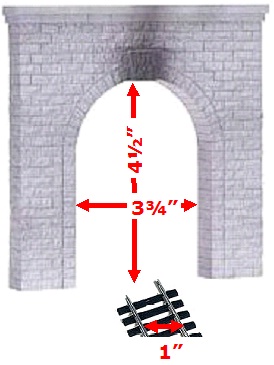
Look at photos and measure the proportions of the tunnel entrance in relation to the distance between the rails. You might find that some tunnels are 4½ times higher than the width of the rails. The width of the tunnel might be 3¾ times wider than the rail width. A narrow tunnel might cause derailments with longer cars.
If the engine is nearly 12 inches in length, has 8 axles, and is about 3 inches wide, then the tunnel should be long enough, high enough and wide enough to accommodate the engine as well as the other cars. This is especially true if you have parallel track flowing through the tunnel.
Building your own model railroad tunnels can be a lot of fun. You can buy ready-made tunnel portals (ends) to add a touch of realism. They look much more realistic at a tunnel entrance than a rough-cut hole. You can ‘weather’ them with gray-wash, chalk, etc. You can also purchase plastic kit-set tunnels in different scales. Finishing off the tunnel with matt paint and adding some ground cover can be very effective. Some model train shops and online retailers even sell tunnels that have bends, or can be extended, or joined together. The possibilities are endless.
To blacken the insides of tunnels use a flat black paint on all interior surfaces – walls, ceiling and floor. There’s nothing worse than a beautiful layout with a plywood-colored tunnel interior. Tunnels should be dark and mysterious.
More model train scenery and structures ideas
I am trying to put together a train layout and I have lots of S scale train stuff. My question is Is there anything I should put down on the plywood before making my layout? It's about 14' by 18'.
Add your comments below.
The long awaited release is here. Two new ebooks out now –
1. Model Train Scenery and Layout Construction Ideas
2. 303 Model Railroading Answers
Read full details on what is included in each one at Model Train Layouts.
They are the perfect follow-ons to my best-selling Model Train Help ebook.
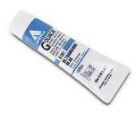
Have a go using Gouache (a water mixable color available from art stores) for adding a pitting or streaking appearance to freight cars. Use a very fine artist brush to put a small dot of Gouache on the spot where you want to add a rust pit that has streaked down the side of the freight car. Let the Gouache start to dry. Then dip a wider brush in water (or Micro Sol Decal Set) and then pull the brush gently downwards from the dot. This will create a streak.
You can also use Gouache to create much thin washes of rust or dirt. Try using white gouache to give a bleeding white effect on wagons.
Another idea is to prepare a thin Gouache wash. Apply the color to the car so it is is wet. Then sprinkle a little salt (kitchen table salt) on the surface. Wait for it to dry, then rub the salt away with your fingers. Then touch up the car with dabs of gouache to finish off the pitting. Always test new techniques on an old car first. You wouldn’t want to make an mistakes with one of your best cars.
More scenery ideas in my new ebook available now from http://www.model-train-layouts.net