Everything on model trains, model railroads, model railways, locomotives, model train layouts, scenery, wiring, DCC and more. Enjoy the world's best hobby... model railroading!
Grace has a question for anyone who can advise her on loops and wyes:
“My table is 4’x 78″. I’d like a layout to be able to go both clockwise and counterclockwise using either 18″R or 15″R track or both. Do I use wyes, loops, or what? Any ideas welcome. I have both EZ track(Bachmann) and Atlas. At the moment it’s all on one level but I can be flexible if that’s what it takes.”
Add your comments below.
Geof has kindly sent in this advice to help others in the hobby.
Working in N scale requires a steady hand, particularly when painting small plastic parts or details on structures or vehicles. I have found that using your typical rubber molding compound as a masking agent can make this work much easier. I have a number of the Woodland Scenics structures that, if painted in two or three tones (broad colors for the overall structure with detail painting for windows, doors, trim work, etc.) can be very difficult whether you have a steady hand or not. I paint the detail work first (window sills, frames, doorways) and then come back and carefully apply a heavy coat (or two) of the molding compound directly on the painted surfaces after it has dried over night.
Then, after the rubber molding compound has dried (a few hours), I can spray paint the larger areas for a nice, uniform surface. After this second layer of paint has dried well (over night is best), I pick at the edge of the window sill areas or whatever with a toothpick to work the rubber compound free of the model.
Using my fingernails or a pair of tweezers, I find the hardened rubber pulls away very easily from the model. You may find that some small areas require touch up repainting where the rubber molding compound was applied too generously but if you were careful, these areas are few.
It takes a little practice but I have found this technique works best because I have found without it, the two (or three) different colors tend to smear into one another as one dissolves the adjacent color(s). This tip works for any scale (obviously) and only on plastic. It MIGHT work on other surfaces like cardboard or paper but I have never tried it.
Use the Comments link below.
Norm is about to build a train table and asks readers for suggestions:
“I am starting to build my new train table lay out I’m using 4′ x 8′ plywood sheets on a 2” x4” frame. I’m debating on how high the table should be. I am thinking 36”long legs & the overall thickness of the plywood / insulation board is 1 1/2 ”which would give me a table ht. of 37 1/2”. “
Use the Comments link below.
Ken is new to the hobby and wants help:
“Doing my first model train since I had one when I was a kid. I am gonna do steam from when the C&NW was in Wisconsin serving the Neshkoro, Princeton, Wisconsin area early 1900’s.
I am guessing 2-4-0 thru 4-6-4 and maybe 4-8-4, if there are such steam engines. I am just starting to get it together.
Now the question – what would the minimum radius I could use. (keep it under 36″) fingers crossed. Thank you to anyone who is willing to help.”
Add your comment below.
Thomas has a question about Kato and asks readers:
“What does KATO’s future hold for HO locomotives? I am a huge proponent of their engines but have not heard of any plans for them to release GEVOs or SD70Aces, etc. Can someone please shed some light on the subject? Thanks in advance!”
Add you comments below
David wants someone to help him and asks:
“I have constructed a layout with inclines going over girder bridges — double track. I have used foam to support to the gradients, because I found that the Hornby supports were too steep.
However, I find some locomotives will not not climb the inclines. These tend to be those OO locomotives without traction tyres. I would be interested in what others think?”
Add you comments below.
Dorothy has been creative but now needs some help:
“Last winter I made two lovely piles of sand out of brown sugar. They held up very well in the dry basement. Now that the air has been a bit damp I had to scrape them up today. How do I construct a pile of sand?”
Add your comments below.
A reader asks:
“I have a DCC engine and controller. Can someone please tell me if the tracks run on ac or dc from the controller? That is – does polarity of the power connections matter (assumed no if ac) and for a DCC system do I need to worry about track connections on return loops (mixing and connection of right and left tracks) in my track layouts?”
Barry recalls the days when life was less complicated and writes:
I was a boy, about 5 years old at the time. We lived on a farm, with a railroad and a river running through it. Needless to say, our parents were always worried we (brother and sisters) were either going to drown or get run over by a train. For myself, they thought I was going to be run over by a train, as I was seen always sitting on a fence post, waiting for the trains to go by.
It was the 1950’s, and so there was still steam engines running down our railroad line. The engineers had gotten to know me well as I was always sitting the fence, waiting for them to come by. We would always wave to each other, and say hi!
On this particular day, they slowed down sooner than usual and stopped the engine right in front of me. The engineer came over to talk to me. He asked if I would like to ride up in the engine with him and his assistant. I said, “yes” and raced to the engine. I watched as he backed the train on to a siding and disconnected it. He then put the engine back on the main track and backed it up to the water tower, where he proceeded to fill the boilers full of water. This was about a fifteen minute job, so we talked as we waited. We then hooked on to the cars on the siding and then proceeded out of town.
What a thrill to be able to blow the horn as we left the town. We got back to the point where he picked me up and that is where he dropped me off.
I continued to come back to this fence post everyday to watch the train go by and wave at them, but it was with an exhilarating experience and with a profound love for trains and what goes with it. I was very fortunate to experience a steam locomotive as a year or two after that, it was replaced by diesel locomotives. Also, in today’s climate of distrust and pedophiles, this would never happen where a engineer stop and give you a ride on a engine.
I was very fortunate to have an experience like this. It never transformed to a career, but it helped developed an interest in model railroading. What a great memory to carry for the rest of my lifetime.
Alan has a question for anyone who understands DCC operation and asks:
“I would like to know if I can use a capacitor with my dynamiss point decoder as I have problems with the decoder not having enough power to throw the point across? I’m sure someone with some DCC experience will know the answer?”
Tim has a question about how to make model cars move on a layout (like in the “Miniatur Wunderland” video we showed readers. If you know the answer and would like to inform Tim (and other readers), then use the green Comments & Feedback link below Tim’s posting. You will need to register (it is very quick and easy) and it means you can participate in future blog discussions. Here is Tim’s preamble and question:
After 30 years I have decided to get back into model railroading. I have just purchased a copy of “Model Train Help” and have read about half the first night. I’m still struggling with what scale to use HO or N, I like the idea of HO as I feel it will be easier to model the landscapes, bridges and buildings but N is appealing as I can get more track in the same space. I have been putting together sketches of different parts of my projects when I received the e-mail with the link to your Blog site. That video of the “Miniatur Wunderland” is incredible and depressing at the same time, that’s what I want in my basement! Ok here is the question part, in the “Miniatur Wunderland” video they show trucks and cars moving seemingly independently on the roads the same thing is happening in their new airport with the planes, what are they using to control that? I have searched the web for clues but have found nothing. Could you point in the right direction?
Tim, I had a look on the Miniatur Wunderland website and it said “The program has one process for each car which calculates all situations for this vehicle 20 times per second. A vehicle can either just ride the streets, have a fixed tour (like buses or trash trucks), have a fixed destination, or be on it’s way to an incident (fire fighters, oversize load transport).” The link is here http://www.miniatur-wunderland.com/exhibit/technology/carsystem/technology/
Clarence has an interest in HO trains and asks readers:
“How much spacing should I have between tracks on curves? It probably varys depending on the radius. I intend to run passenger as well as freight.”
Bob sent in this story of his wonderful trip on Amtrak and writes:
In August of 2008 my wife and I boarded the Cresent train in Atlanta bound for Washington, D.C. We booked a sleeper car, the only way to travel on Amtrak. After a very fine meal we headed back to our sleeper for a wonderful eight hours of sleep. Keeping in mind we are 76 and 75 years old and a little slow of foot.
We had been to Washington. DC several times before, but never as Amtrak passengers. It’s a whole new world.
We had something like 4 or 5 hour layover so we got to do a little sight seeing. Then it was off to Chicago and another wonderful night on the train. I’m on this trip for the train ride and my wife is on the train as a way to get to Seattle and board the cruise ship to Alaska.
Our luck was holding out in regard to our companions at meal time as you got no choice as to who you sat with for your meals. So far so good.
I had never been to Chicago before so we didn’t venturer to far from the station. Amtrak will leave you behind.
I really felt sorry for the smokers as there is no smoking on Amtrak. They said they would put you off the train if they caught you smoking.
I loved the sunflower fields in North Dakota. Just acres and acres of sunflowers.
After two nights, I’m in hog heaven. We arrived in Seattle for the worst cruise we have ever been on. It was cold and wet and I couldn’t wait to get back on Amtrak for another four nights between the sheets. Amtrak, it’s the only way to travel.
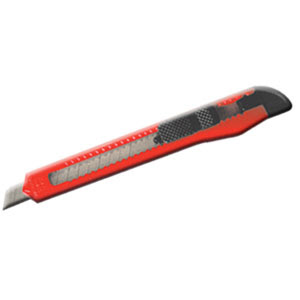 A craft knife (with snap-off blades), a Stanley knife, or a scarpel is a very useful tool for anyone doing hobby work. These tools are great for giving a clean cut through cardboard, balsa wood, polystyrene etc. However be very careful, because they are also very efficient at cutting through flesh. That’s why surgeons use scarpels in operations!
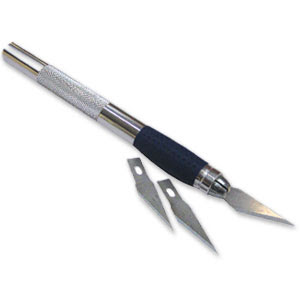 I have found from experience it is best to make several cuts along the same line using light to medium pressure on the knife rather than pressing down hard on the knife to make one deep cut. The knife (or your grip) is more likely to slip under pressure and result in a serious cut to a finger (or damage to the object you are cutting).
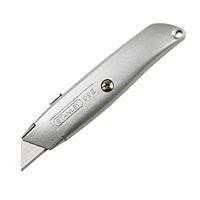 Many in the hobby prefer using a Stanley knife as they are more sturdy than the snap-off blade types. However, they are a little more bulky so it depends on the type of project you are working on, or what you prefer using. Whatever you choose be careful!
Sherry is building a Z layout and wants to hear from others who know anything about building Z layouts:
“I am doing a small Z layout and have the basics assembled. I am disappointed in the Marklin track in that I think it is hard to get a smooth joint. I am wondering if I would find the Micro-Track with the attached road bed any better/easier to work with?
I don’t live near a store that carries Z supplies and don’t know anyone doing Z so I am just going by pictures. I have worked with all the other scales….this is my first Z layout. Would appreciate any in-put on this question from those who model Z scale….or any other hints from anyone.”
Add your comments to Sherry’s posting by using the green Comments & Feedback link below. Simply register (it takes just 2 minutes if you haven’t already done so) and then you can participate in future Model Train blog discussions.
Jeff recalls the rattling, clanging and squeaking of trains and writes:
I grew up in the Bronx and the memories of trains that I have are of the elevated passenger trains. They use to shake the house as they went by. I would hear the rattling and clanging and squeaking of the metal brakes.
I sinced moved away from there to a peaceful quiet place and in my heart I do miss those trains.
Now I am in my my late fifties and I have moved again. I moved about a few hundred yards away from tracks carrying freight. I now hear the trains and feel the rattling and the objects in the house shaking. I love it! I run out sometimes and count the engines and see which way they are facing.
What memories I now have old ones and new ones.
Gary remembers his days working for the Chicago Transit Authority and writes:
I started working with the CTA in 1979 as a conductor on the elevated line and the subway which are rapid transit passenger trains. I also worked as a motorman, a ticket agent, a switchman, a foot collector (witch means collecting money from the ticket agents after they collected from the passengers) riding the train getting from one part of Chicago and suburbs to another.
After the agents stopped collecting money from the passengers, CTA used the ticket agents as Customer Asssistants who now help passengers find their way around Chicago. I worked that job part time and then ended my time (28 years 9 months) as a courier. A courier collects paper work from customer assistants and take them supplies and maps of the system and other jobs as assigned.
I traveled from one end of Chicago to the other with this job. I really liked my job. At one time CTA sold replicas of their Trains and also their bus system. That was when I got interested in Model Trains and also diecast cars & buses.
Jeremy kindly sent in these tips for readers:
Re non-shine to make things look more realistic – I use Acrylic artists paints as these are naturally matt, can be mixed (and inexpensive). In our Pound Stores (equivalent of US Dollar Stores) you can get a set of Acrylic paints (red, blue, green, black, white etc) for a pound ($1.60).
Re saw dust – besides fabric dye you can use wood dye and besides sawdust, wood flakes (hamster bedding) can be dyed and used as leaves.