Everything on model trains, model railroads, model railways, locomotives, model train layouts, scenery, wiring, DCC and more. Enjoy the world's best hobby... model railroading!
Mike has a question for fellow model railroaders to try and answer. If you can help him he would really appreciate your feedback. If you have knowledge and experience please don’t keep it to yourself – help other and keep this hobby alive and thriving.
Mike asks you:
“I was wondering what size lumber to make my frame out of, 4X4 legs and the frame 2X6? Cross members 2X6? Drill 2″ holes into the cross members, and 1/2 inch or 1” particle board for the top, or should I use plywood?
My layout is going to be 18′ X 10′ 3.5′ wide on the long sides and 4′ on the ends, should I use 3.5 all the way around? Should I do my wiring before I put the plywood top on? After I put the top on my frame I should put 1″ foam board on top of my plywood, or a board called Homasote as it makes things quiet when the train is running around. If your readers can answer me I sure would appreciate it.”
Click the green comment link to add your feedback.
Ben, is a newbie to model railroading and would like to hear from those of you who are more experience in the hobby:
“Hi all! I am very new to the Model Railroad Hobby and I am having great difficulty in securing track pieces together especially around any sort of bends. Is it okay to use solder or HD Glue to secure track pieces together. I read an article recently and it appeared to be saying this in so many words. Is this in keeping with the model railway layout. I am in a bad way, and would like help from other in the hobby please.”
Remember this blog is for everyone and is read by thousands of model railroaders worldwide – some readers are new to the hobby and others have an amazing level of experience. If you fit into the latter category, I urge you to please share some of your knowledge with others in the hobby – especially with newbies like Ben.
To be truthful, I get a lot of emails from model railroaders who have had bad experiences in model railroad clubs. Members in most clubs generally work really well together sharing ideas and helping each other, but I get feedback that some newbies feel excluded. One young guy used the words “a closed society” to describe his club. He told me how a couple club members were very protective and didn’t want help or share ideas with anyone who lacked experience. This is very disappointing, because we are all getting a bit older and we need to encourage new people into the hobby – otherwise model railroading might eventually die-out. None of us want that to happen.
So, please share your ideas and experiences. This blog is the perfect way you can do precisely that. It is a FREE service, but I need your help to keep it going. Please add feedback to various postings and answer some of the question that get asked. Use the green comments link under each posting.
J.C. would like to hear from those into O Gauge Lionel railroading:
“My pike has two large circles (ovals). The possibilties of two standard trains operating seperatly could be possible if insulating the circles can be done at the switches (connecting the ovals in and out).
I am using fast-trac w/switches.
Question. Can this be done using two transformers (model cw80) I found it to short out when crossing over any seperate insulated section causing the engine to reverse or go to nuetral.
My pike is using over 80 feet of track with 19 switches. I am satisfied it works, so why fix it?
It would be enjoyed a bit more if seperated. I have an old model v 150 volt trainmaster transformer with 4 seperate controls but i cnnnot get the whistle or bell to sound when using it.
Question – What must I do or is necessary to do, to use the more powerful transformer. Lionel railroading is again fun I have been in and out since 1930. Great fun.”
If you can help J.C. please speak out and don’t keep your knowledge to yourself.
Jim wants to hear from others about main track bus lines. If you can help Jim use the green comments link below:
“I have 2 tracks running parallel. Does anyone know, do I need separate main track bus lines for each track, or can I use one set of track bus lines and attach track feeders from each track to it?
Also what about a rail yard with 6 tracks do I need separate main track bus lines? Can someone help me please?”
Please note – this is a free service and relies on readers not only contributing questions, but also contributing answers. To continue this free service we need input from experienced model railroaders. Don’t keep all your knowledge to yourself. There are lots of beginners out there who would benefit greatly from your input. Please share with others in the hobby.
Stan wants an HO layout plan and asks:
“I am looking for a plan for a 8×15 HO layout with end extensions. Has anyone got one? All I have found so far is cut and paste – not one of my strong points.”
To help Stan click on the green comments link below.
Suba asks readers:
“I am new to Marklin 3rail digital AC . Time and time again I have read on the setting up of the signals (but I have no clue). Can a Marklin 3rail digital AC fan advise me what is the simple rule in setting up. Do i need this decoder?”
Craig is deciding between HO (similar to UK OO) or N:
“I am new to model railroading and trying to decide which scale to go with. I have a medium size space, think corner of a garage. I would like to run fairly long trains though I am not sure what my layout will look like. I am getting older, think 50 and the old eyes can’t see the small things anymore. What are the pros and cons of each?”
Yes, Craig you are correct, the smaller the train the more fiddly they are to work with especially if you have unsteady hands. N scale is smaller than HO. There are certainly pros and cons of both N and HO depending on the space you have available and what you really want from a layout. N would allow you to build a layout in a smaller space, or put longer track runs in the space. If you look at the results of the poll on this blog you will see that HO is more widely used than N, and for that reason there is an large selection for train supplies and accessories available in HO.
I would certainly suggest you read about the various scales in my Model Train Help ebook. You will find it particularly helpful.
I’ve had several people ask about constructing a shelf layout, or ceiling platform, to run trains around a room. If anyone out there has got such a layout, I’m sure readers would like to see a photo and hear about what you have constructed. You can either add your feedback using the green comments link below or submitting details of your layout at http://www.model-railroad-resources.com/my-layout.html
Building a small shelf layout can give you time to focus on on operation and detail and be less expensive than a larger layout. However, at a glance I can see some issues that need to be considered before building a perimeter layout:
1. What scale? Carefully consider the size of the room and how you are going to support the baseboard and layout. Obviously HO or OO would carry less weight than larger trains. As a guide – N scale trains with 20 cars will be about four and a half feet long. With Z scale you would have even more space but they are more fiddly if you have unsteady hands.
2. How visible or accessible will the trains be from a child’s or adult height. Safety needs to be a consideration here too.
3. Do you need to put up a wire guard rail, or see-thru perspex plastic (flexi-glass) to stop the trains crashing on the floor from a great height? Trains don’t liker being dropped!
4. Will the trains run in one direction or will you be running parallel track?
5. Locomotives and rolling stock can derail on curves so you might want to install track rerailers after every turn to help rerail.
6. Would you be best to paint the baseboard black to help things stand out? How are you going to incorporate scenery and structures?
7. A shelf layout can attract dust and humidity can build up causing rust. You will probably need to clear the track more often and consider a track cleaning car for easy access.
8. Consider how trains will enter and exist the scene. You may want to adding a staging area at either end of the layout. You could make it removable and store it when you are not using it.
9. You might want to consider starting with a simple shelf layout before expanding it to run around the entire room perimeter in a continuous loop.
Building a shelf layout can be a lot of fun and a shelf layout can be an excellent solution if space or finances are limited. The important thing is avoid potential mistakes and carefully plan your layout before rushing in.
If you have a shelf layout add your comments here.
Andrew would like to share his layout progress with others and has sent in this information and photos for publication.
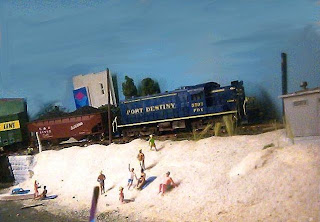
Photo above is Port Destiny Terminal RR’s rebuilt alco rsd4 with an emd engine heading out of the yard heading for the interchange .
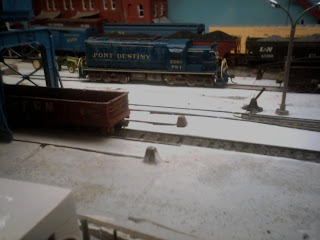
C.E. is working on an HO train yard a wants readers feedback:
“I am in the process of rebuilding at train yard that was given to me, the name of the yard is Maudville Yards. Does anyone know of this yard and are the any plans available or anything?”
Tom would like to hear from ‘O’ Gauge enthusiasts about semaphore:
“I am looking for information on any source for a complete three position, upper quadrant, mechanical only semaphore, or parts such as the semaphore arm, so I can build my own.
No lights are required for my use as I am modeling in the 1890’s through the 1920’s when electric power in remote areas was unavailable. In those days signaling was all handeled by the brakeman, or station attendant, and were operated manually by them.
I would greatly appreciate any help anyone can provide. I found one source in HO Gauge only, for semaphores similar to the ones I want at the following website. tomarindustries.com/signals, #H-853, but nothing in ‘O’ Gauge is listed. Thanks for your help. Tom.”
Add your feedback and help Tom below.
Richard has a question about Bachmann locomotives and wants to hear reader’s thoughts:
“I see a bunch of HO locomotives by Bachmann that are called “Spectrum”. Can someone tell me, do these HO locomotives have power to all driving wheels? If not, what sets them apart from the other Bachmann locomotives? Thank you, Richard”
Add your feedback to this posting.
Tim was to get his late father’s Lionel set operational again and would like help or suggestions from readers:
“How do you identify model numbers in Lionel? My father had a Lionel “O” set-up, but he passed away 9 years ago and I am really new at this. I have the set(s) now and want to clean them up and repair where needed. I can not find serial numbers, but there are cab numbers (ie. 681, 8142, 8609, 8040, 1666, etc.), plus 3 without cab numbers. I would appreciate any help from others using Lionel. Thanks for any help.”
Add your feedback using the green comments link below.
Michael is building a Lionel fast track layout and wants to hear from others who work with the same system:
“I am in the process of building a 6×12 Lionel fast track layout. Can someone doing O scale tell me, is there any rule of thumb or suggestions on how many power leads to use to power just the track from the transformer so my one locomotive will run steadily? My layout is a single continuous loop with no block sections.”
Jim is having a problem with non-compatible couplers and wants to hear from others who have struck the same problem:
“As a newby in the model train hobby, I wish someone had told me to stick with one type of coupler. I didn’t know there were so many and that they don’t match! I bought a conversion kit to make all my units Micro-train compatible, but had no idea it was so hard! Between my lack of experience and coordination and bi-focals, it is more than I can accomplish. Does anyone have a short cut, or do I just go and buy some new gear with all the same couplers? Thanks for the help of your readers.”
Click the green comments link to share your thoughts.
If you have made streets and roads for your rr layout you might like to share your ideas with Tom who asks:
“What materials are out there for making city streets and roads. I have tried various methods including matte board and plaster of paris, neither of which look realistic?”
Add your feedback to this posting.
Lenny wants to hear from someone who knows about automatic switch tracks:
“Can some tell me, how do I get an auto switch track to operate with an under the table mount motor and have to go through plywood and 4-6″ of foam sceanery? Also what N scale brand would be best for me to use?”
Add your feedback below.
Dave has been spending money on his O layout and is having problems with locomotives at switches:
“I recently purchased a Lionel 4-6-2 Pacific U.P. Traditional Steam Locomotive. I also purchase the FasTrack Outer Passing Loop pack. Things were splendid for 2 days, then the locomotive started stopping at one of the switches. The head light remains on. I put an old locomotive on the track and it runs fine through the switch. I put the new one back on, and it stops. Does someone have any idea what’s going on?”
Help Dave by adding your thoughts using the green comments link below this posting.