Everything on model trains, model railroads, model railways, locomotives, model train layouts, scenery, wiring, DCC and more. Enjoy the world's best hobby... model railroading!
John model O scale and asks readers:
“My problem is that SW2 switches as if it didn’t have external power, and it does, as the train passes over. If I remove the connecting track to the switch from the saw mill loop there is no problem. That solution doesn’t allow a return from the spur to the main line. What am I doing wrong?”
John, you can attach a schematic if you think it helps. Just add a comment under your post and attach the schematic there.
More info on how to make these walls and bridges here.
Ed who models HO scale asks readers:
“I am having problems with the switches pressed to actuate a turnout. I’m finding them staying stuck in the depressed condition causing the turnout motor to melt. Does anyone else see this problem. Its happened to me enough times to get expensive.”
Kevin asks readers this:
“Gday. I’ve saved 2 HO scale starter sets to my eBay but are made by different makers. Will, or can I, join the two track brands together? That is if I keep buying different starter sets can I add them to make a bigger layout or should I stick to one manufacturer? All will be HO scale . Thanks“
HO enthusiast Greg asks readers:
“I have a Bachmann 2 6 0 consolidation with bad poly gear and axles. I can’t locate any repair parts with out buying the whole drive system. Are there any upgrades or replacement parts from any other companies? Thanks.”
Chris asks readers:
“I need help with powering a switch frog. I get shorts. What is the best way to power the frog or sometimes switches too?”
Pete G who is into OO gauge asks:
“Swapping over to knuckle couplers is a big task so I’ve been told. Are they as good as they are made out to be and should I bother?”
Use the COMMENTS link below to add your answer of make a comment to assist Pete.
If you want to submit a question to the Blog Moderator for possible inclusion on the blog (read by 10,000 readers weekly) use the ASK A QUESTION link under this post. Approved questions get posted usually within 12 to 72 hours.
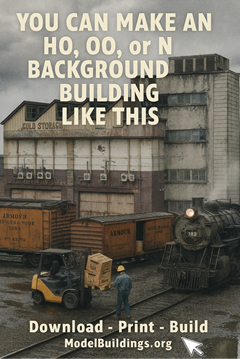
Here’s an easy way to effectively extend the background scene behind a rail yard without spending a fortune on plastic models. The two red and gray brick buildings seen below can be constructed to resemble the images on the left, or you can extend the width of the buildings by just printing out another copy of the full color plans. You won’t need to download the plans a second time… you just print out a second or third copy to extend the building out as far as you want. The designs can even be combined to use a mix of red and gray brickwork (as seen in the third image below).
Foamboard or corflute is the best construction material as it is cheap to buy in large sheets, and is very sturdy. Otherwise you could use card from an old cereal box (maybe double the thickness). Thin strips of balsa or even plastic power ties can be painted gray to add extra detailing if required. They look very authentic when constructed.
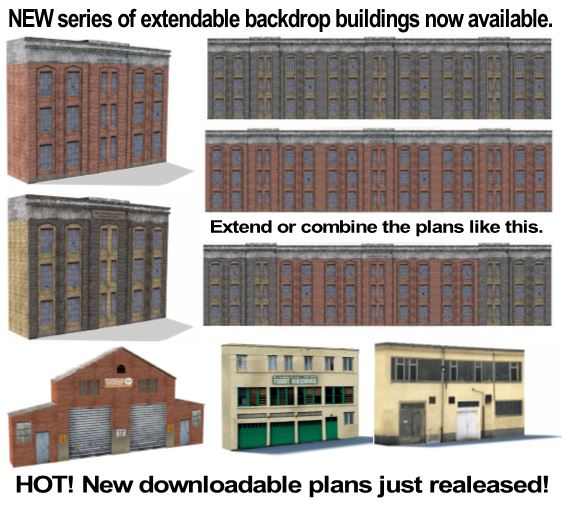
Downloadable plans for the buildings in this new series can be purchased separately, or if you want to save some money, combination packs of several buildings are currently available on the website at a discounted price. Full details here http://www.modelbuildings.org/Pack-K-Industries-Backdrop-Structures.html
Jack asks readers:
“I gave up model railroading around 27 years ago when we moved to a smaller house, but I kept 3 locos packed in boxes. We have relocated to my son’s property on a farm and he has a big shed where I can set up my trains again. I tested the engines but they are running sluggishly and one only goes intermittently. They used to perform well but that was a long time ago. What do I need to do to clean and lubricate them?”
Craig sent in this question for readers:
“My LGB 251902-3 (2051S Cat#) will not pick up electricity from the rail. My smaller Furka Oberalp works just fine on the track. I have found that when I test the pick up plates, there is no circuit between the plates, meaning there is no voltage to the motors. It was working fine until just recently, but has been sitting on a shelf in my workshop for about 3 weeks.Any suggestions?”
When I first visited China back in the 1980’s the cities were over-run by bicycles – there where millions! These days bikes are a reasonably rare sight in most major cities. Motorbikes and buses are becoming less common too. This is because cheap, efficient, safe, environmentally friendly alternatives are now available.
China now has the biggest network of high speed bullet trains in the world, as well as extensive underground metro mass transit systems under most of its major cities. As an example by late 2020, Shanghai will have around 502 miles (808 km) of subway lines servicing 500 plus stations… and that’s just one city! The metro stations are spotlessly clean with marble tiles etc, and trains run every 3 to 4 minutes in most cases.
Above ground, traditional polluting diesel buses will become even more of a rarity when these new transit vehicles that run on “virtual sensor guided track” become widespread throughout China. Some people say its a type of train on a guided track, and others would claim its are a type of bus, or tram.
What’s your opinion? Remember there are no rails in the traditional sense, but it still needs a track of “almost invisible” sensors for it to run on, so it can’t leave the line of track like a bus could. It also has no Catenary or Pantographs; so in your opinion is it a bus, train, tram, or a hybrid with no name? Add your thoughts below.
The 32 meters long and 3.4 meters high people mover, can carry 307 passengers with a top speed of 70 kph.
Instead of track, this passenger vehicle runs along dotted lines on the ground, controlled by hundreds of sensors. It also use rubber tires, which makes the journey like riding the bus. It uses Lithium Titanate batteries enabling it to run 25 km after just 10 minutes of charging.

Dan asks readers this question:
“I am currently putting together my first portable layout to display on Canada Day. I am using two 2×8 foot pieces of 2″ styrofoam SM as the layout surface which will run two separate oval tracks. My current struggle is designing a frame that the styrofoam will sit inside of and hold all together plus provide a No Touch zone and derail barrier. I do not plan on adding legs at this stage as time is limited. I will be setting it up on some fold out tables at our town hall.”
To submit a question use the ‘Ask A Question’ link below any post. To add a comment or to answer a question use the COMMENTS link below the post.
Asa models N scale and asks readers:
“ I have Peco turn out motors. And I have attached to the bottom a switch that controls dwarf lights. When I hook it up to the ac side of my transformer it works fine. When I put the turn out track on it does not work at all. I pulled the little spring that keeps the points in place and it went back to work fine. I’m I doing something wrong or could my transformer be weak or is there something else I should be doing? I would like to keep the spring because it does a very go job of holding the points in place. the ac voltage is 20. ”
Here’s another in our popular “Spot the Difference” series. This week it is crowd a scene from a model train show. In all there are 9 differences between the two photos. If you find it easier to view the photos horizontally you can see enlarged images here…

Add your answers by using the COMMENTS link below.
You can see enlarged images here…
This article kindly contributed by club member Jim P.
If you grew up with a DC system, then you will be familiar with the term “Blocks.” Having blocks on a DC model train layout is basically the process of separating the railroad trackage into sections, so as to control one locomotive independently of another loco in a neighboring block.
If you think of how real railroads operate, they typically divide mainlines into blocks, which are assigned signals to keep railroad traffic on the right track and at a safe distance or separation.
The question that often gets asked is, “Will I still require blocks with DCC?”
In theory you won’t need blocks as in the conventional sense. However, with DCC systems, blocks are regularly utilized to operate signal systems as well as to isolate problems. Blocks are necessary when using block detection, or polarity reversing sections i.e. wyes, turntables, or balloon tracks which are like a big loop tracks with a single switch to enter and exit. It’s worth noting that a reversing section will need to be at the very least the length of the longest train. This is especially so, if the train has passenger cars, or a lighted caboose.
Read more on DCC wiring techniques here…
Blocks for that purpose might be sufficient on some small model railroads, but incorporating more blocks would be beneficial on bigger layouts. Having additional blocks would certainly prove an asset on a layout operated by more than one person, or for one that is larger than would fit onto a standard sheet of plywood. Take it from me… it is so much easier to troubleshoot and isolate problems with blocks in place.
That said; a typical DCC layout won’t usually require as many blocks as would have been necessary on a conventional DC layout, but having some blocks will at least make it easier to locate and fix problem that might otherwise be difficult to pin down. Besides, without having blocks it might be necessary to shut down the entire DCC layout if there’s a short… and that not something any of us would want to do.
Jose models HO scale and asks readers:
“What kind of transformer do I have to buy for led lights?”

It’s always great to see some scenes from yesteryear. These photos of 1970’s commuter trains were sent in by Alexander who shot the photos at the Sydney Model Train Show.